- Categories
- Categories
Last 5 Viewed
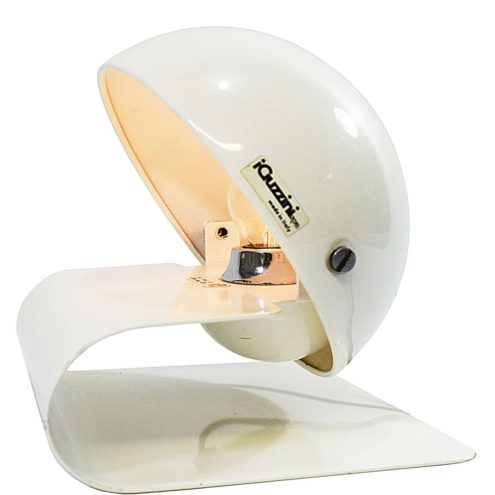
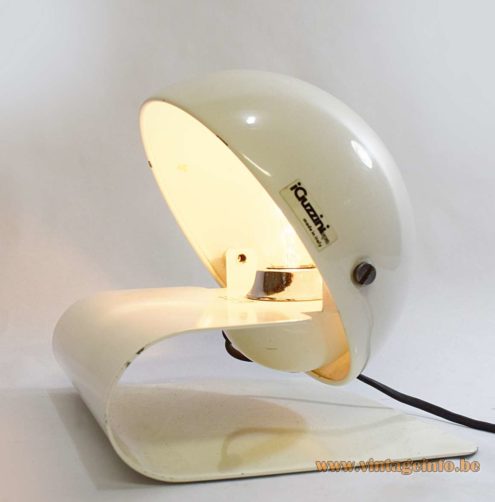
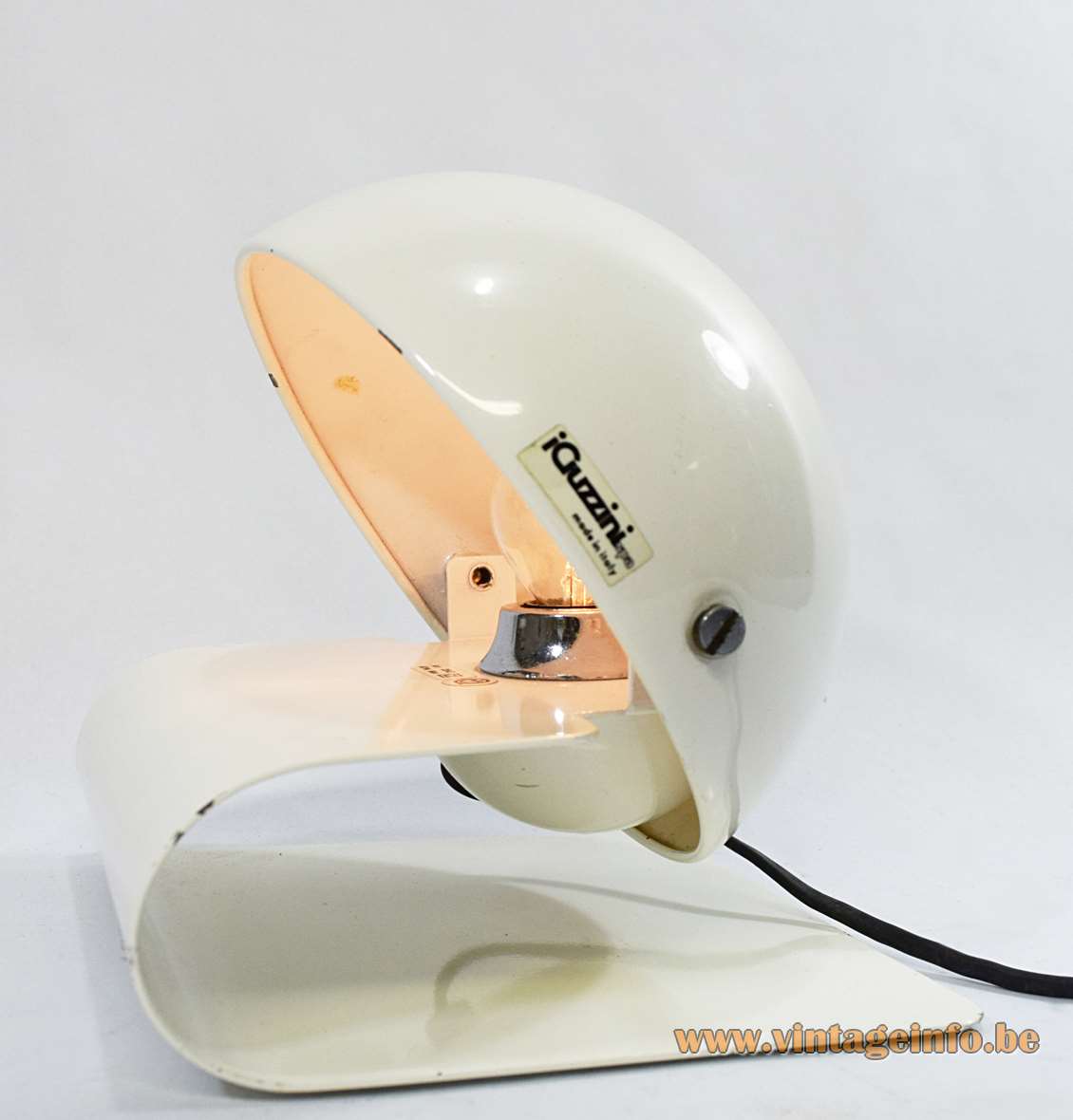
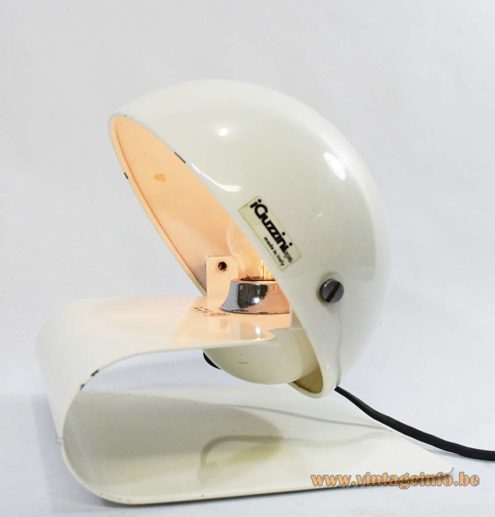
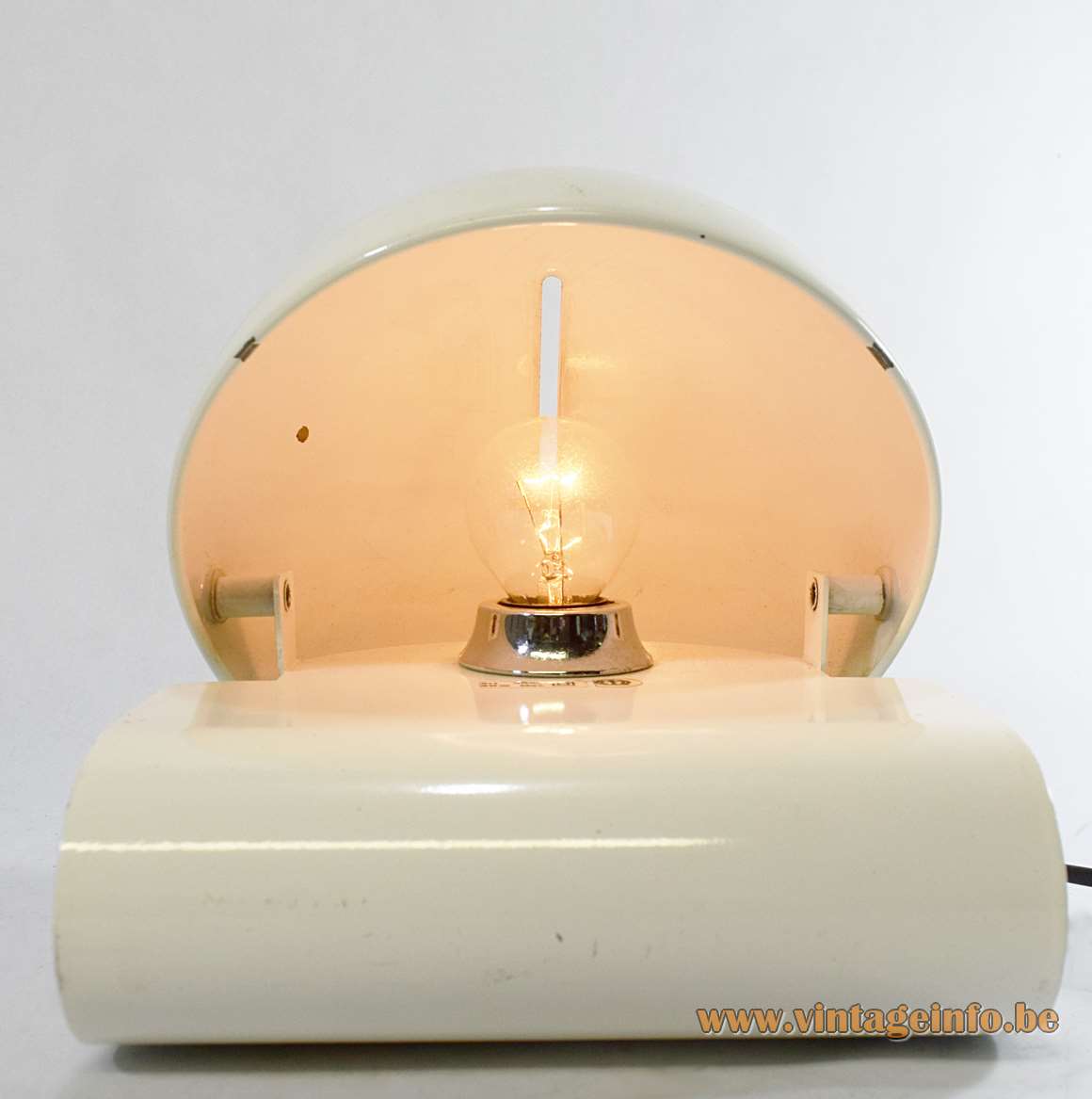
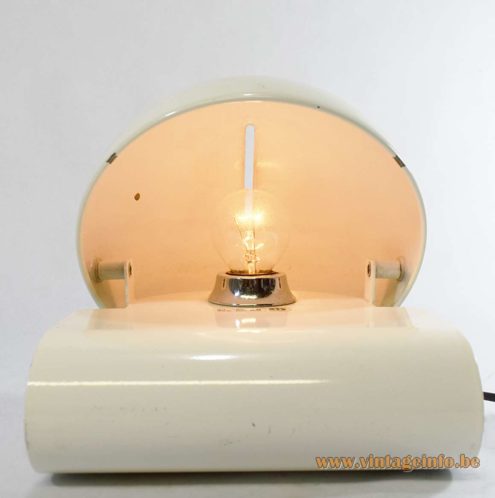
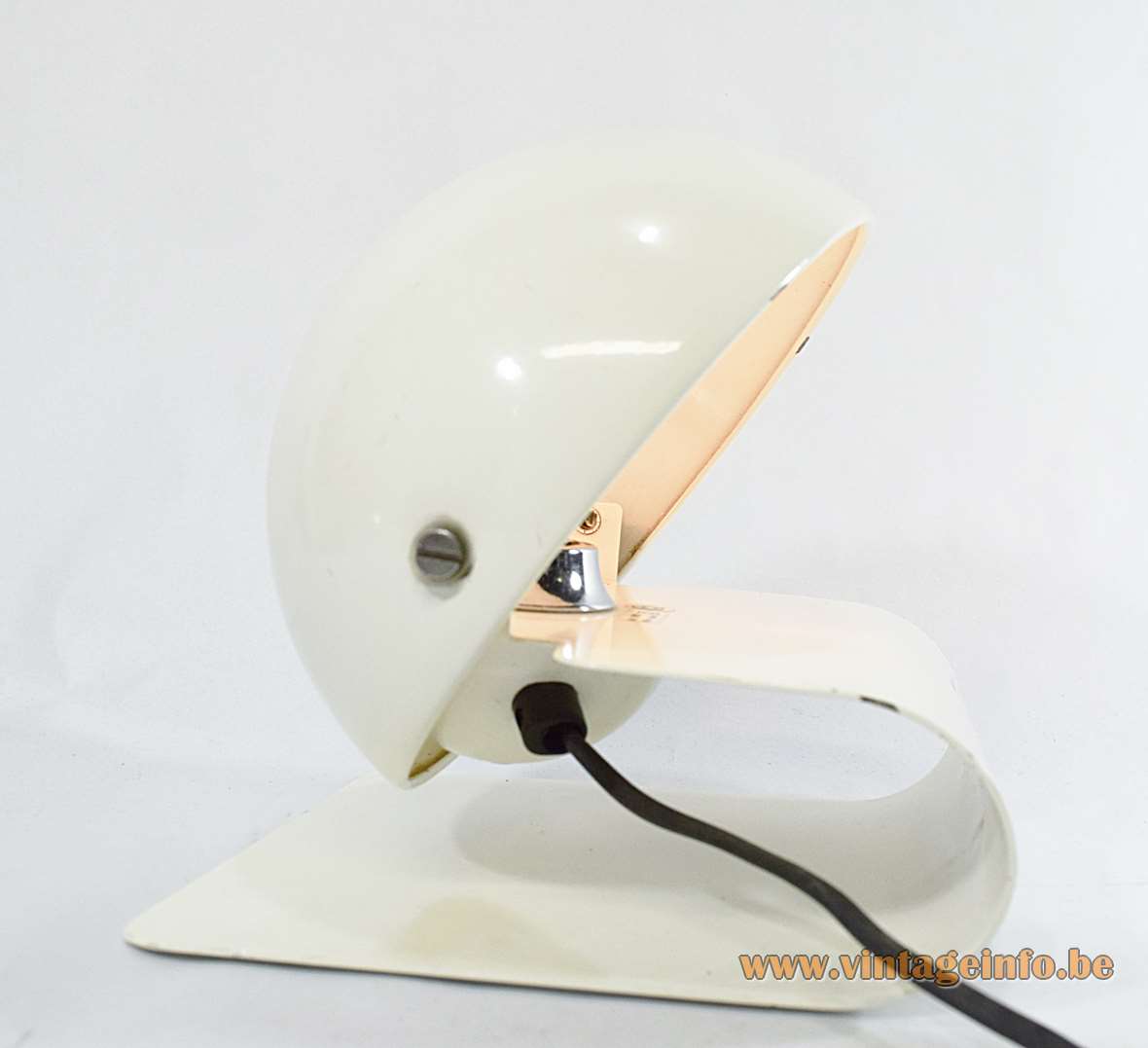
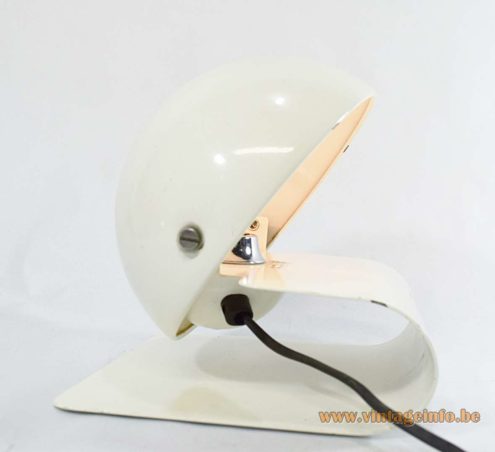
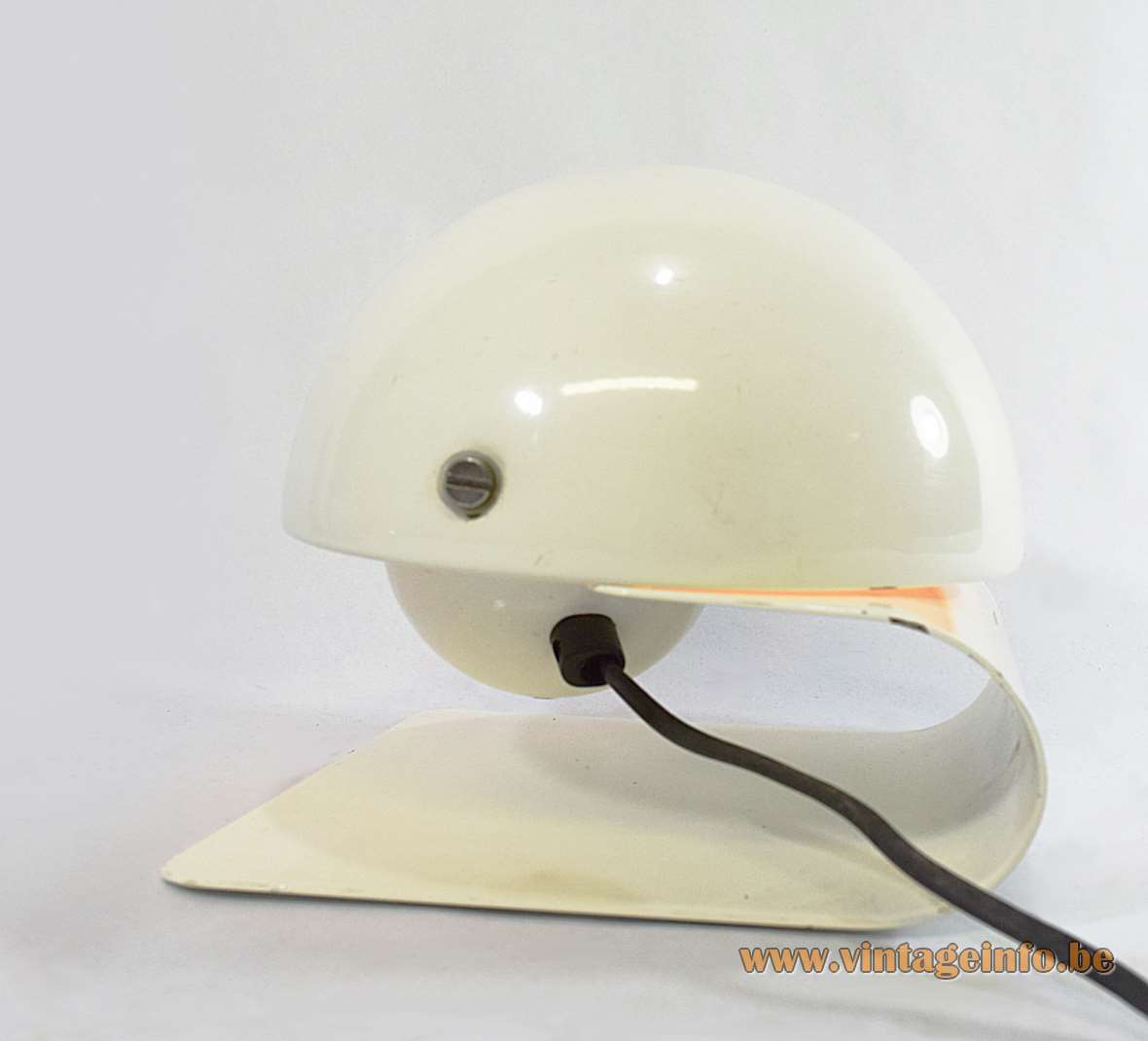
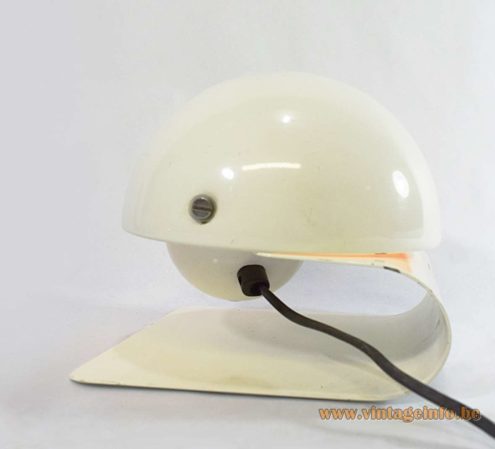
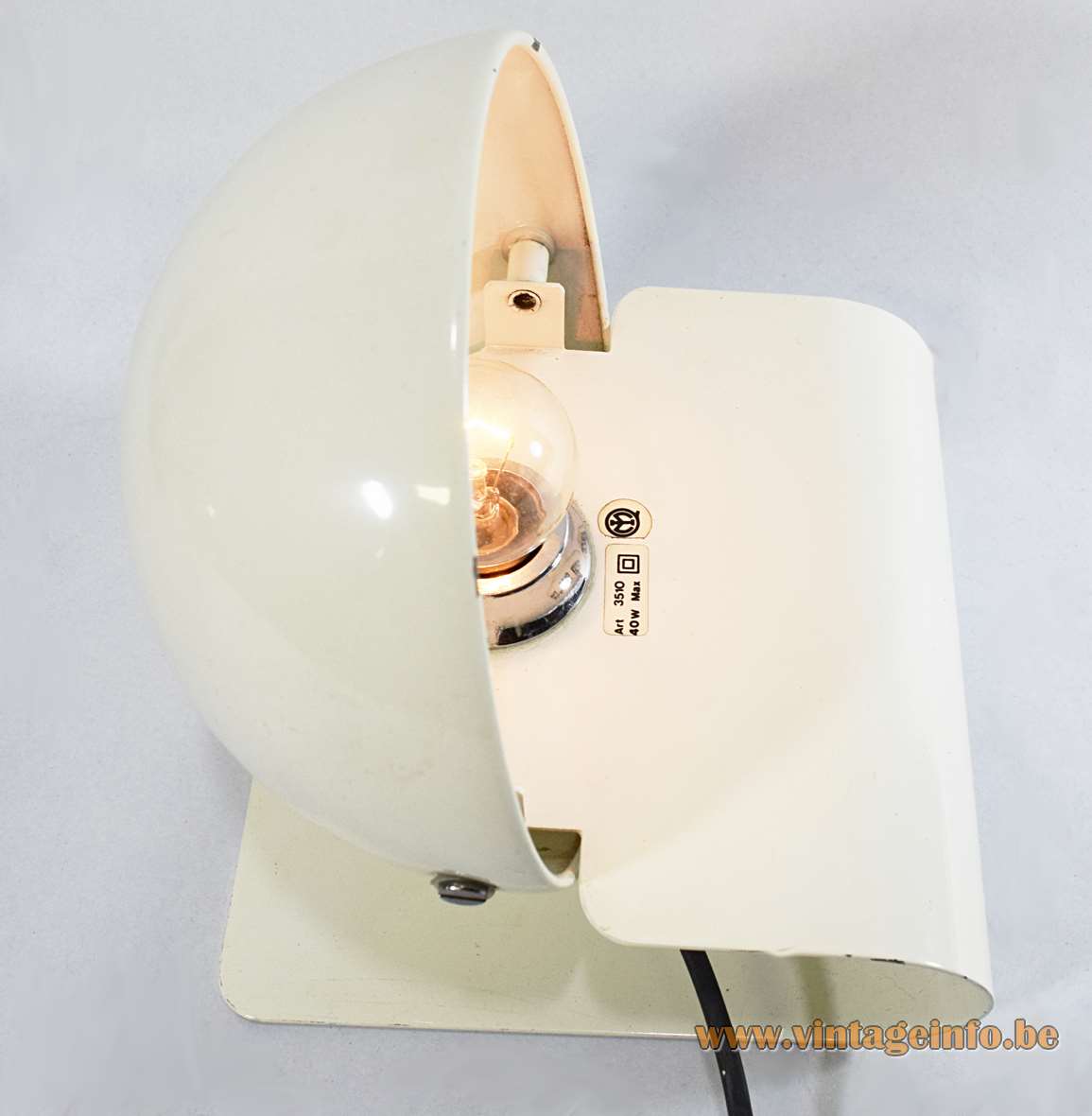
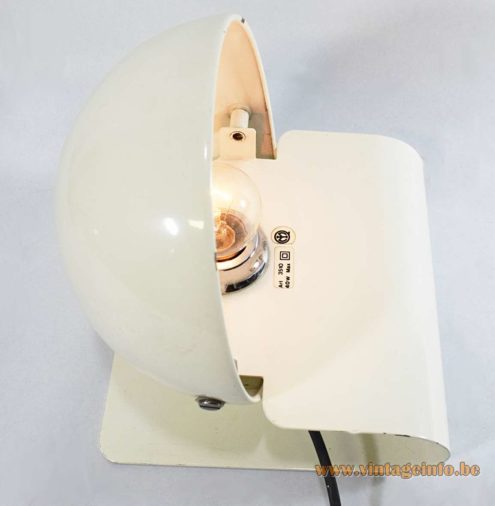
iGuzzini Bugia Table or Wall Lamp – 1992 Catalogue Picture
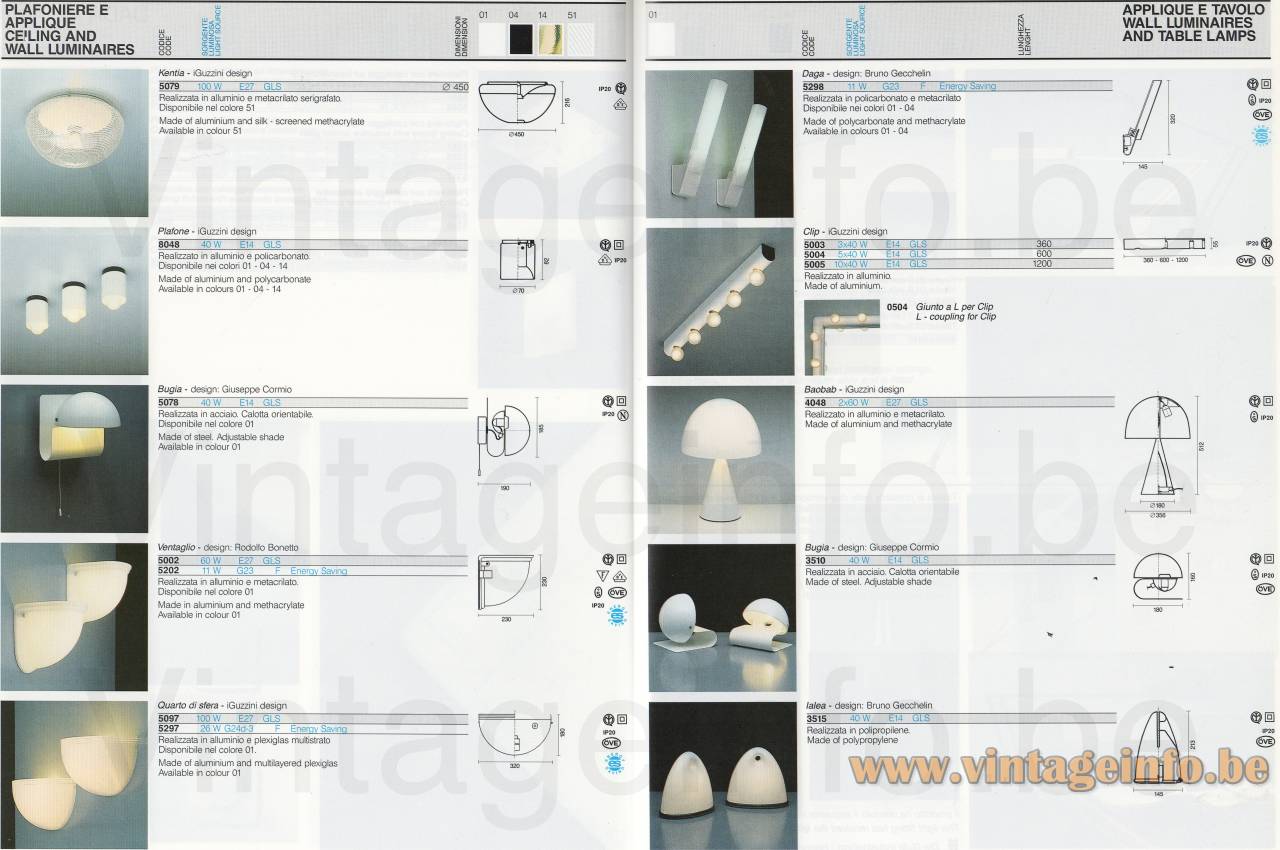
In this catalogue page are these models: left page: the Kentia wall lamp, Plafone ceiling lamp and Quarrto di Sfera wall lamp, an iGuzzini design, the Ventaglio wall lamp, a Rodolfo Bonetto design and the Bugia wall lamp, a Giuseppe Cormio design.
Right page of the catalogue: the Daqga wall lamp, a design by Bruno Gecchelin, the Clip wall lamp, an iGuzzini design, a white version of the small Baobab table lamp. Also this Bugia wall or table lamp designed by Giuseppe Cormio and the Lalea table lamp, another Bruno Gecchelin design.
iGuzzini Bugia Table or Wall Lamp
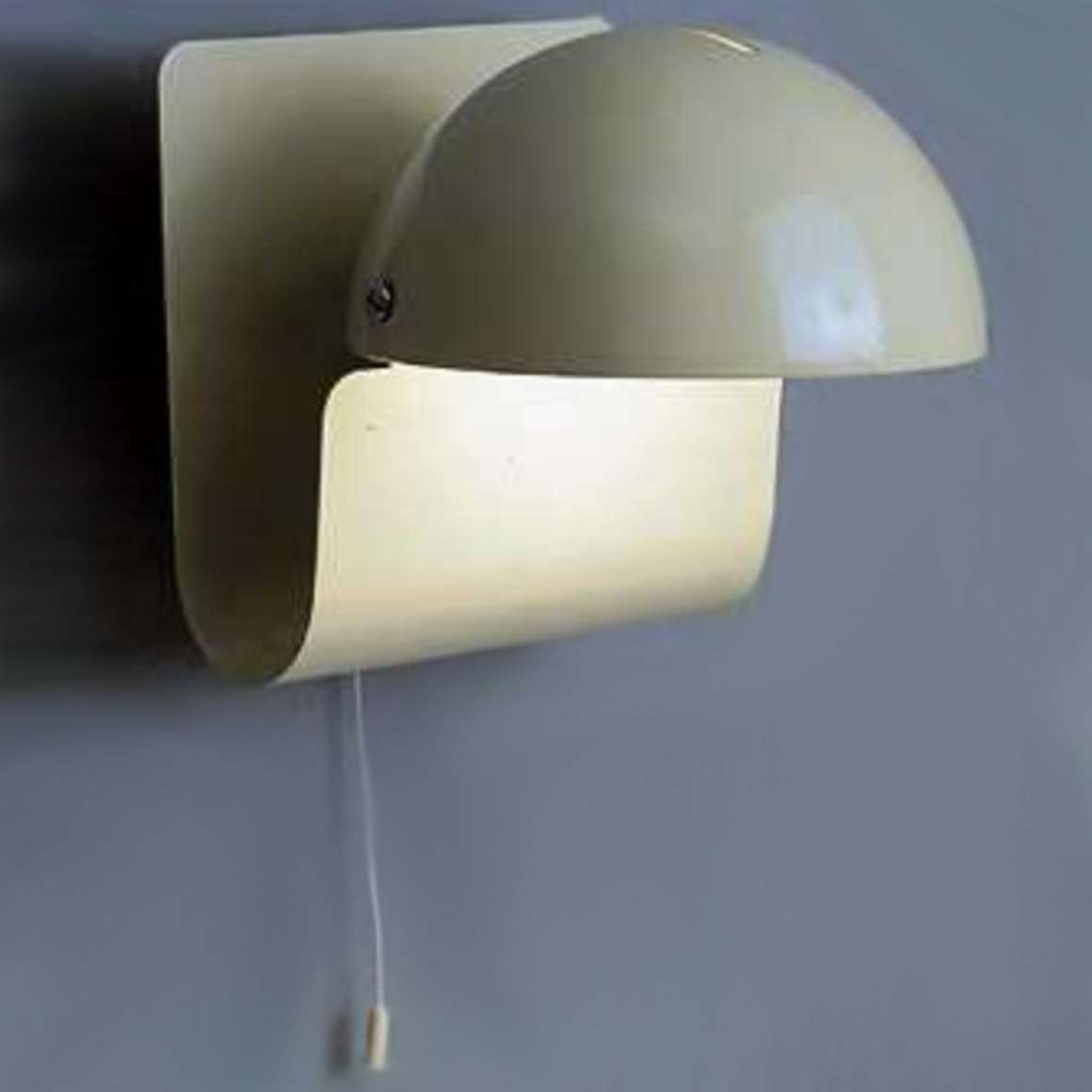
Wall lamp version, with a pull cord mechanism.
Meblo and Sijaj Hrastnik
Outside Italy, Harvey Guzzini lamps were sometimes distributed under local brand names. In former Yugoslavia they were first sold by the Slovenian company Sijaj Hrastnik and later produced and marketed by Meblo.
Meblo grew out of a furniture factory founded in Gorizia in 1948. The company initially produced high-quality wooden and upholstered furniture, and from the 1960s onwards added lighting and a wide range of plastic household products. In cooperation with Harvey Guzzini, Meblo manufactured and sold many Italian designs under its own label – hence the familiar “Meblo – Guzzini” markings on some lamps.
Sijaj Hrastnik, another Slovenian manufacturer, also sold Harvey Guzzini models in Yugoslavia before Meblo took over this role. Today the successor company MebloJOGI specialises in mattresses rather than lighting.
Lamps In The Movies
Extinction (2018)
The iGuzzini Bugia table or wall lamp was used as a set decoration in the 2018 Netflix science fiction thriller film Extinction.

Links (external links open in a new window)
iGuzzini illuminazione website
Bugia Reisue – Codiceicona website
Vintageinfo
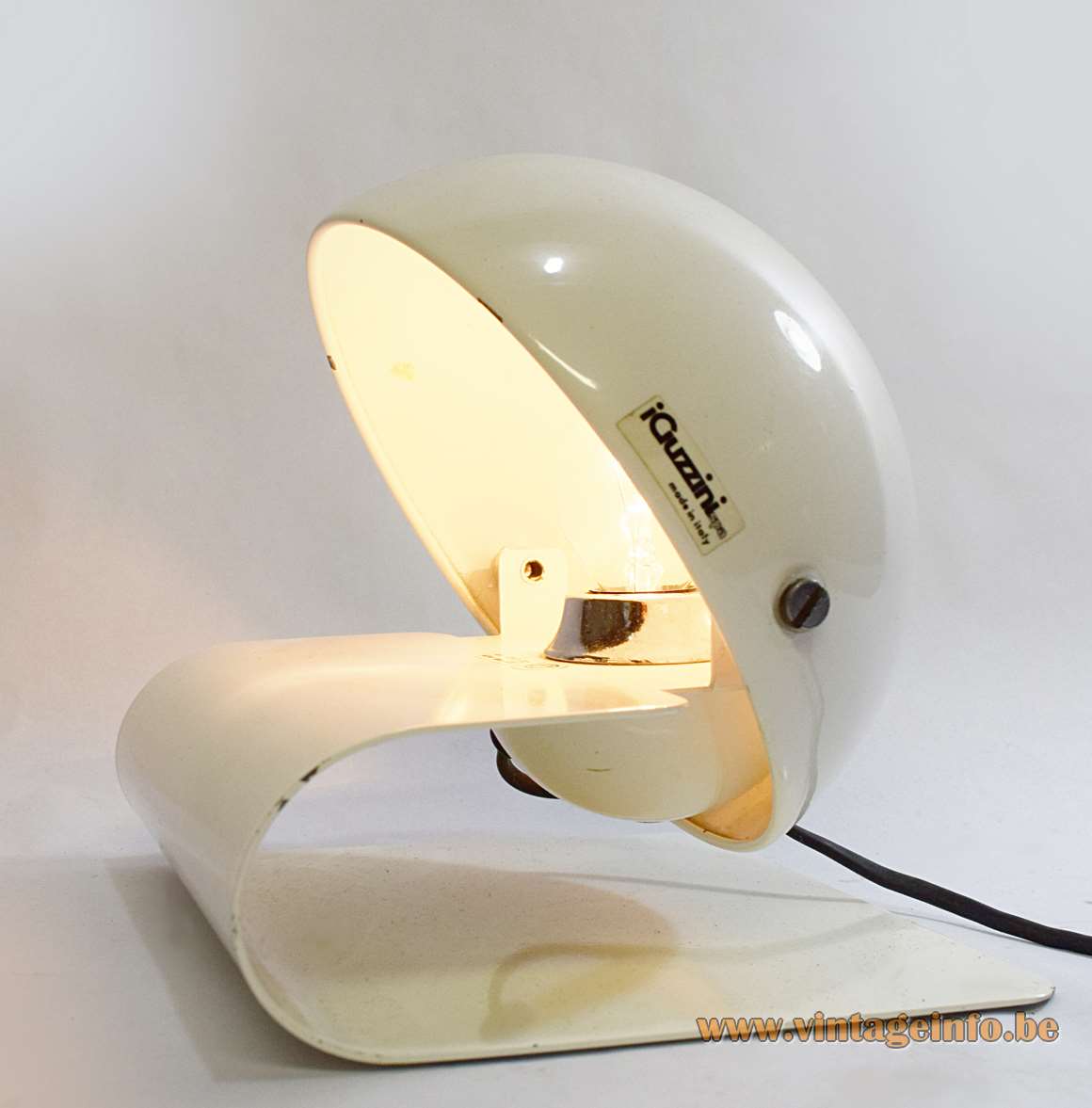
iGuzzini Bugia Table or Wall Lamp
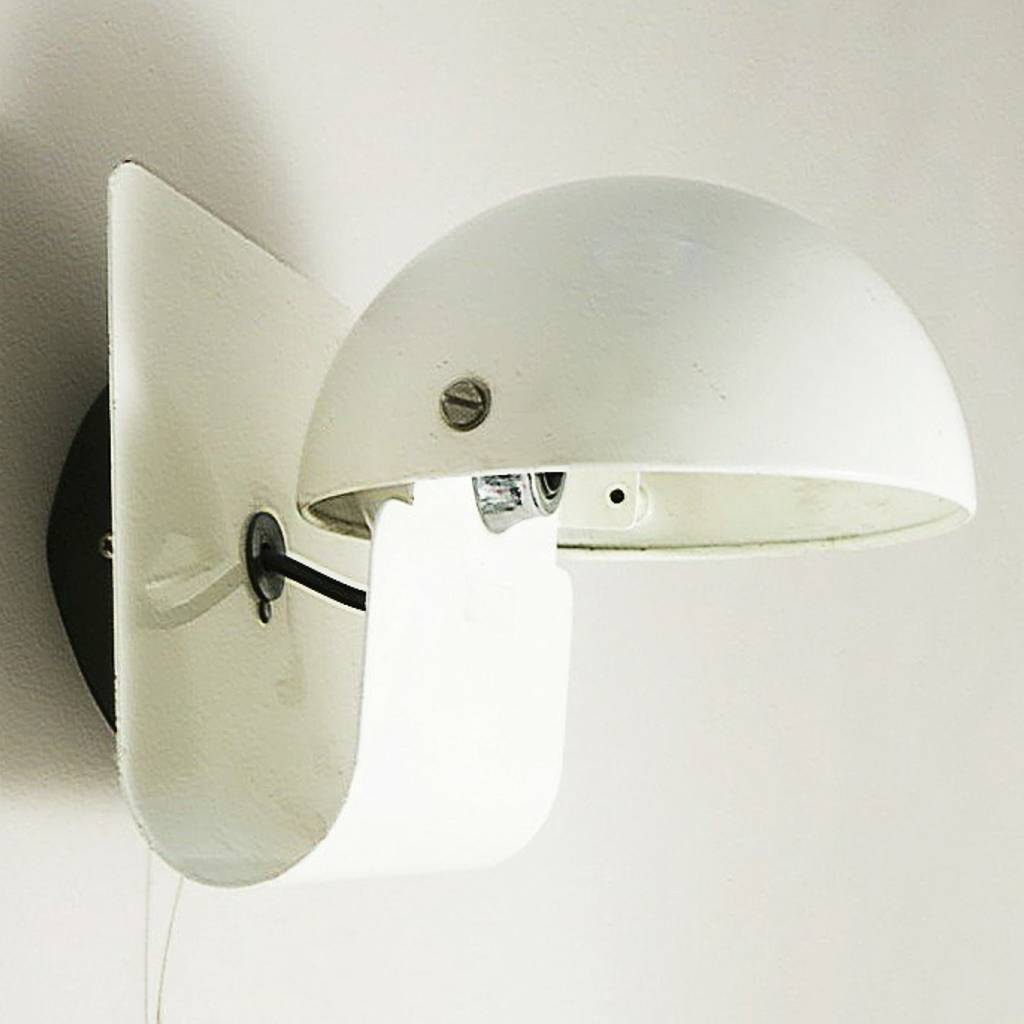
Materials: White painted folded curved metal (iron) slat base. Half round metal lampshade with an elongated slot. 2 chrome ornamental screws and nuts. Bakelite E14 socket.
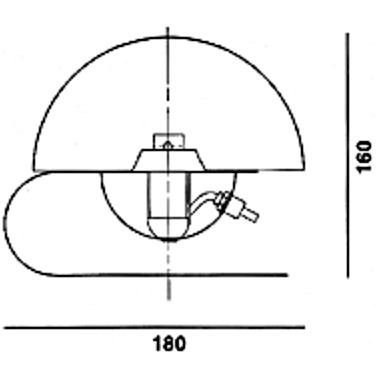
Height: 18 cm / 7.08”
Width: 18 cm / 7.08”
Electricity: 1 bulb E14, 1 x 40 watt maximum, 110/220 volt.
Any type of light bulb can be used, not a specific one is preferred.
Period: 1970s – Mid-Century Modern.
Designer: Giuseppe Cormio (born 1944).
Manufacturer:iGuzzini illuminazione S.p.A via Mariano Guzzini, 37. 62019, Recanati, Italy.
Other versions: The iGuzzini Bugia table or wall lamp comes in many colours, even with a striped design. The wall lamp version has a black round metal wall mount at the bottom, or rather at the back, to maintain distance from the wall and to hide the electrical components. It was available with a pull cord mechanism.
Project year: 1976
Year of production starting: 1976
Year of production ending: 1999
Commercial code: 5078 – Commercial code Meblo: 5010
Period: 1978 – 1999
iGuzzini Bugia Table or Wall Lamp – 1970s Catalogue Picture
Bugia scheme and dimensions. Designer Guiseppe Cormio.
Giuseppe Cormio
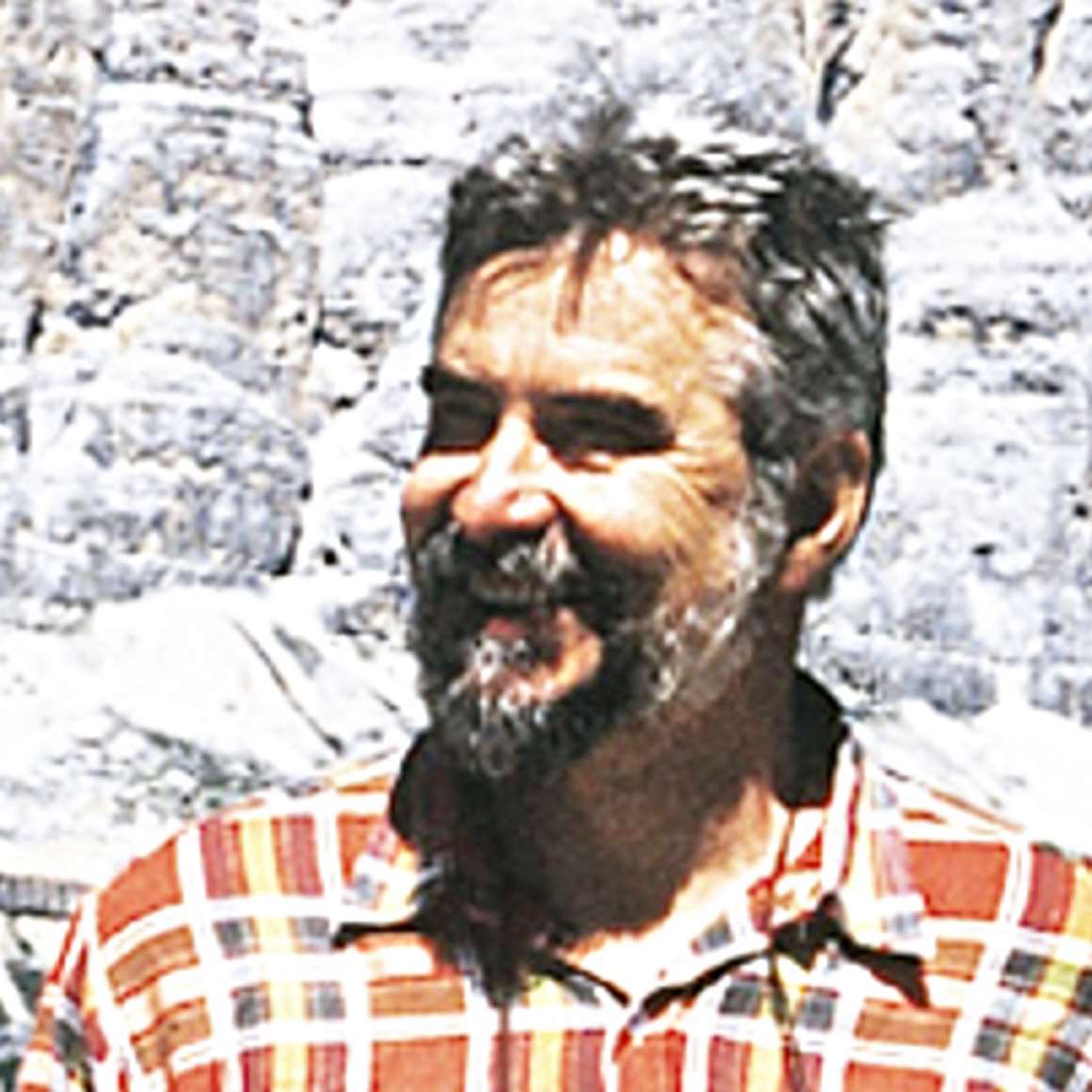
Giuseppe Cormio was born in 1944 in Malnate, in the province of Varese, roughly 65 km (40 miles) north of Milan, Italy. He graduated in Architecture from the Polytechnic University of Milan in 1969. During his studies he worked in the office of urban planner Ambrogio Brusa, an experience that marked the beginning of his professional orientation.
After graduating, Cormio established his own practice, focusing primarily on residential architecture, both new construction and the refurbishment of existing buildings. His work extended to interior design for homes and offices, and he was commissioned by several major industrial groups to create installations for the Milan Fair, including the Plast exhibitions of 1994 and 1997.
A parallel thread in his career was research on inclusive design. In 1985 he co-authored La casa senza barriere (“The House Without Barriers”), a study conducted in Finland and Norway on disability and accessible living environments.
During the 1970s Cormio also designed lamps and domestic objects, offering his projects directly to manufacturers operating in specialised sectors. His best-known design from this period is Bugia, created in 1975 for the Milan Fair and put into production the following year.
The lamp interprets the traditional idea of a small, mobile, personal light source—a modern, functional reinterpretation of the candleholder historically associated with the Algerian city of Bougie. Its characteristic metal cap, seemingly suspended and hinged to the base, allows for a gradual and adjustable tilt, directing the beam of light as required.
In 2018 Bugia was reissued by Codiceicona, reaffirming its status as a timeless object whose essential technical function is expressed through a restrained and persuasive aesthetic. The re-edition ignores several defining details: the original used simple chromed slot-head decorative screws, whereas the new version uses coarse cross-head screws. Combined with modern wiring, it loses much of the character of the 1975 design.
Harvey Guzzini / iGuzzini illuminazione
In the late 1950s the Guzzini family from Recanati (Marche, Italy) set up a small workshop for enamelled copper objects. On 30 June 1959 the brothers Raimondo, Giovanni, Virgilio, Giuseppe and Giannunzio Guzzini, sons of Mariano Guzzini, officially founded Harvey Creazioni for the production of decorative copperware. The name “Harvey” was inspired by the 1950 film Harvey with James Stewart and his imaginary rabbit friend.
Very soon the company moved from the ground floor of the family home in Recanati to a new factory in nearby Le Grazie, where the first lamps were developed. Early lighting models were designed by external designers such as Karl Roters and Charles F. Joosten (Josteen), who had already worked for Fratelli Guzzini on plastic tableware.
In the early 1960s Harvey became a true family business when more brothers joined, and in 1962 industrial designer Luigi Massoni was brought in to lead the design team. Massoni worked for both Fratelli Guzzini and Harvey Guzzini until the mid-1970s and played a key role in the transition from enamelled copper to moulded plastics such as polymethyl methacrylate (PMMA). Under his direction the company developed many of the iconic “space age” domestic lamps that defined the brand.
During the 1960s and 1970s Harvey Guzzini became one of the standard-bearers of Italian mid-century lighting design. The in-house design office, often referred to as Studio 6G or Ufficio Progetti, and external designers created a long series of acrylic pendant, table and floor lamps that combined coloured domes, chrome details and multi-light switching. These domestic lamps were distributed widely in Europe and beyond, for example through Habitat in the UK.
Design House
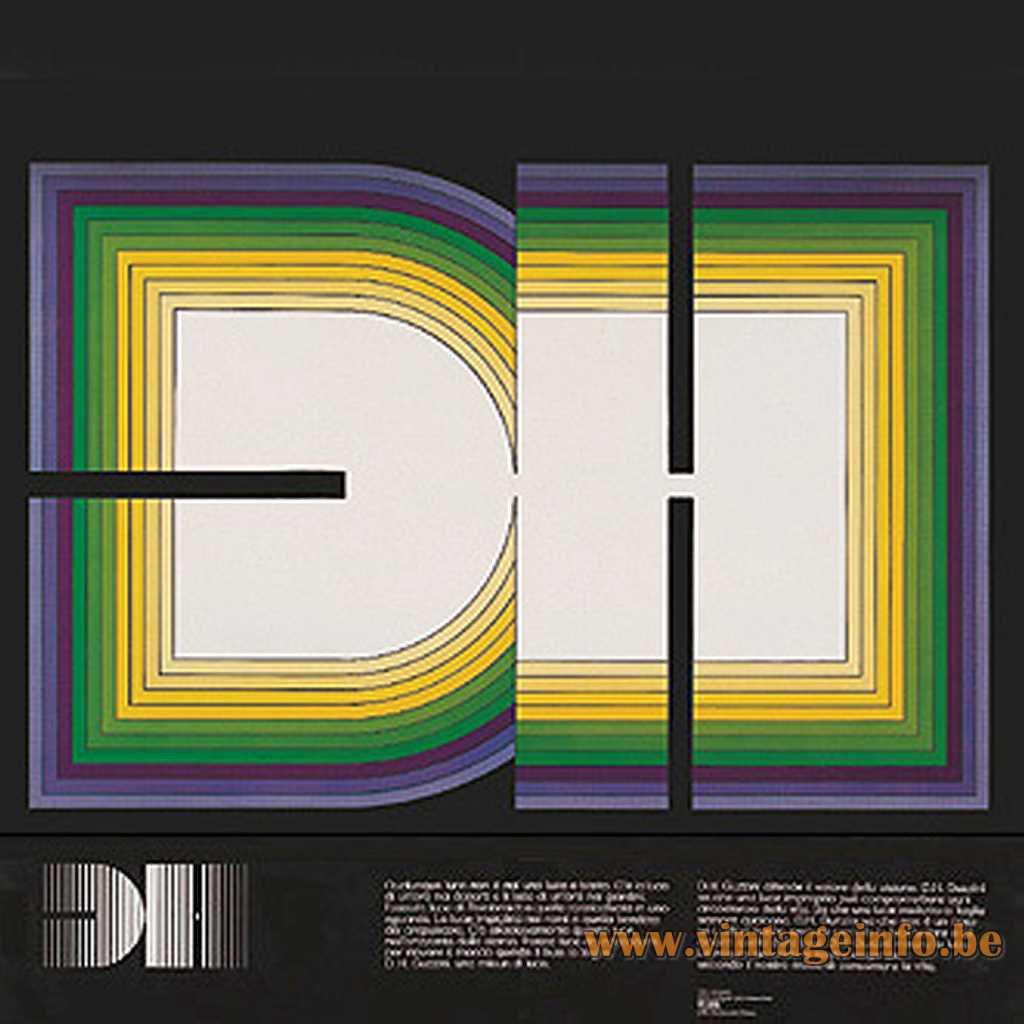
In the late 1960s Harvey Guzzini also introduced the Design House (DH) label for a more explicitly “design-led” range. Under this name, the company presented its products at international exhibitions and in dedicated Design House catalogues. Lamps shown in one of these catalogues include Alicante, Noppo, Ibis, Azalea, Cigno, Moon, Selene, Poliedra, Focus, Tam Tam, Squared, Taw, Cespuglio, Nastro, Moana, Nitia, Lampione, Lucciola, Piuma and Diaframma. In 1969, Harvey Guzzini also opened a Harvey Guzzini – DH store in central Milan, underlining the more design-oriented positioning of this range.
Harveiluce
Around the same period, the Harveiluce name appeared on several models, sometimes alongside or later replaced by Harvey Guzzini or iGuzzini labels. Harveiluce was thus used only for a relatively short time in the late 1960s and early 1970s, mainly as another trade name for the same family of designs that would later be marketed under the iGuzzini brand.
DOMA
In the 1970s iGuzzini also used the Doma name for a line of plastic furniture and accessories. The Doma collection included space age storage trolleys, coat racks, chairs, ashtrays and decorative spheres, often in injection-moulded ABS with metal details, designed by Luigi Massoni, Dino Pelizza, Fabio Lenci and others. These pieces were marketed under the same corporate umbrella as Harvey Guzzini and iGuzzini lighting, and the iGuzzini logo introduced in 1974 covered products sold under sub-brands such as DH, Doma and Atelier.
iGuzzini
In 1974 the company name was changed from Harvey Guzzini to iGuzzini, and in 1981 to iGuzzini illuminazione. From the mid-1970s onwards the firm progressively shifted its focus from domestic “space age” lighting to architectural and technical lighting for public and professional spaces. Today iGuzzini is an international lighting group based in Recanati, known for collaborations with architects and designers such as Gae Aulenti, Gio Ponti, Rodolfo Bonetto, Piero Castiglioni and many others, and since 2019 it has been part of the Swedish Fagerhult Group.
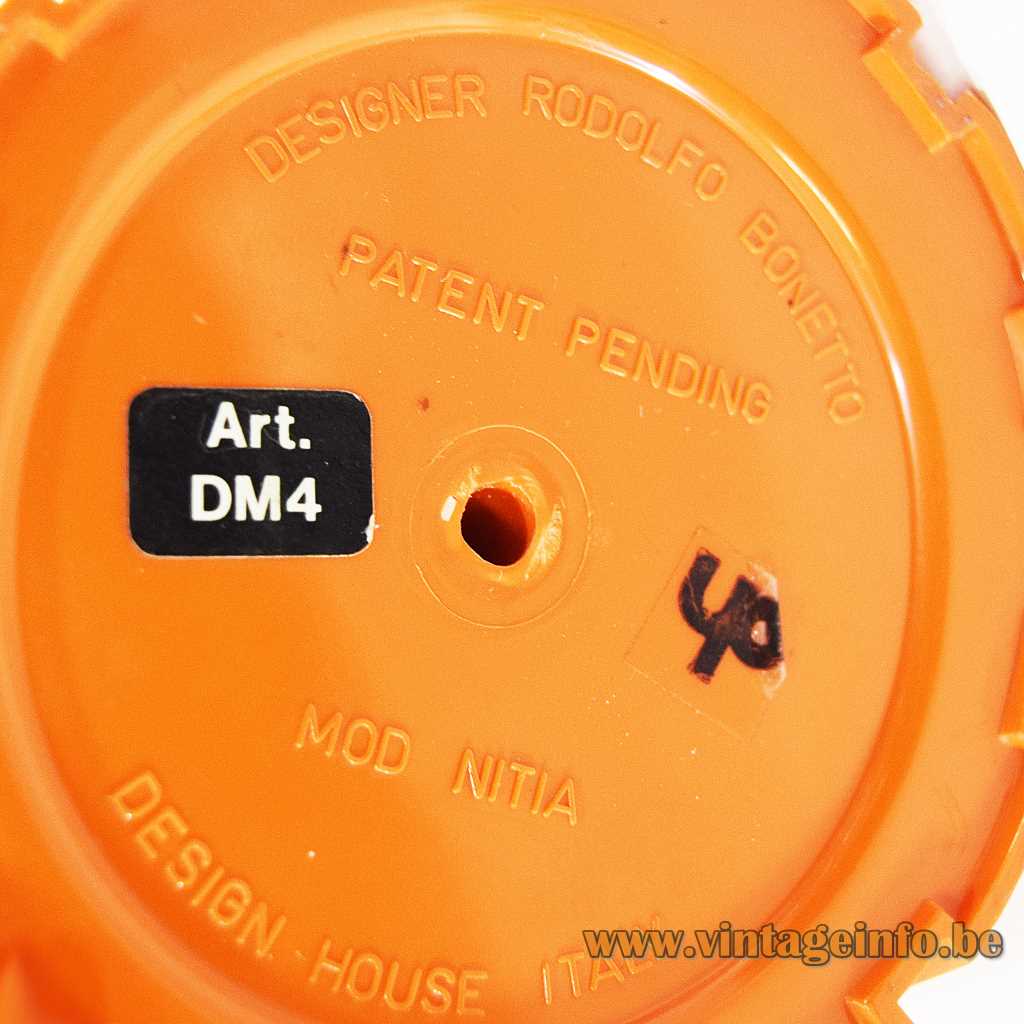
In 2022–2023 iGuzzini launched the iGuzzini Echoes programme: a series of re-editions of classic 1960s–1970s designs, updated with LED technology and recycled / recyclable materials. The first models to return were Polsino (Gio Ponti, re-edition 2022) and Zurigo (Luigi Massoni, re-edition 2022), followed by Nitia (Rodolfo Bonetto, re-edition 2023), Clan (Flash, Bud, Clan) and Sorella (all credited to the historic Harvey / Harveiluce design team, re-edition 2023).
Although the brand identity and product range have evolved towards professional lighting, the vintage Harvey Guzzini domestic lamps from the 1960s and 1970s – as well as the recent Echoes re-editions – remain an important chapter in the history of Italian plastic design.
Designers
Designers who worked for the company include: Luigi Massoni, Luciano Buttura, Sergio Brazzoli, Ermanno Lampa, Giuseppe Cormio, Emilio Fabio Simion, Karl Roters, Charles F. Joosten, Fabio Lenci, Bruno Gecchelin, Gio Ponti, Rodolfo Bonetto, Gae Aulenti, Piero Castiglioni, Carlo Bimbi, Nilo Gioacchini, Antonella Ducci Valera, Carlo Urbinati, Felice Ragazzo, Ennio Lucini, Cesare Casati, Gianfranco Frattini, Ambrogio Pozzi, Francesco Piccaluga, Aldo Piccaluga, Makio Hasuike, Renzo Piano, Dean Skira, Maurici Ginés, Artec Studio, Enzo Eusebi, Jean-Michel Wilmotte, Arup, Norman Foster, Mario Cucinella, Massimo Iosa Ghini, Massimiliano e Doriana Fuksas, Jean-Marie Duthilleul, Roberto Pamio, Paul Andreau, Laura Maria Mandelli, Giuseppe De Goetzen, Franco Bresciani, Studio D.A.
Many thanks to iGuzzini for some images and the help.
Logo used between 1959 and 1964. Inspired by the 1950 film “Harvey“, starring James Stewart.

Logo used between 1965 and 1977. This logo was designed by Luigi Massoni.
The architect Massoni was invited to work with Harvey as the company’s art director, a move that gave further impetus to the idea of collaborating with designers.
Between 1967 and 1971, Ennio Lucini designed the catalogue tor the DH brand, under which lamps for home lighting were marketed.

Logo used from 1974 until today, designed by Advema G&R Associati. This logo embodied the company’s entire output, which was marketed under other brands such as DH, Doma and Atelier.
It was during this period that the company began making technical products. Spot and flood lights in particular.
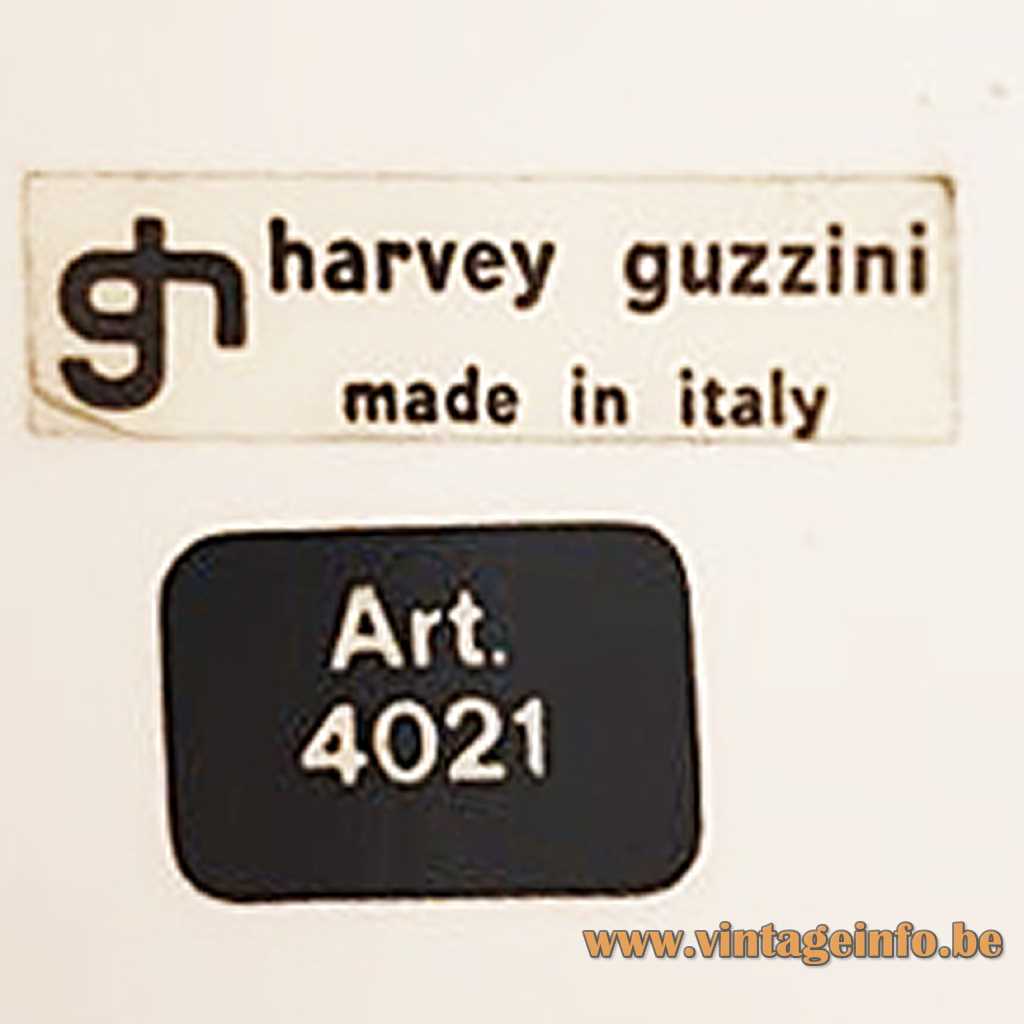
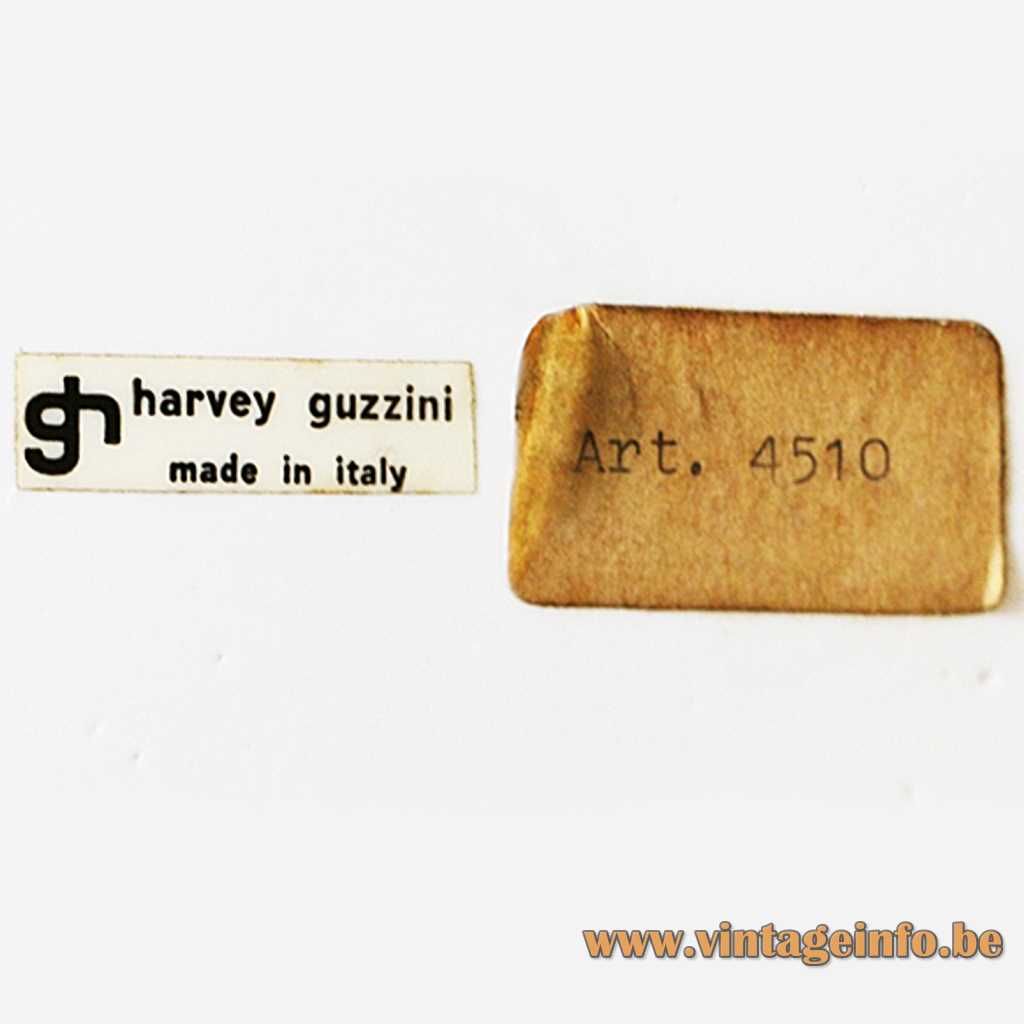
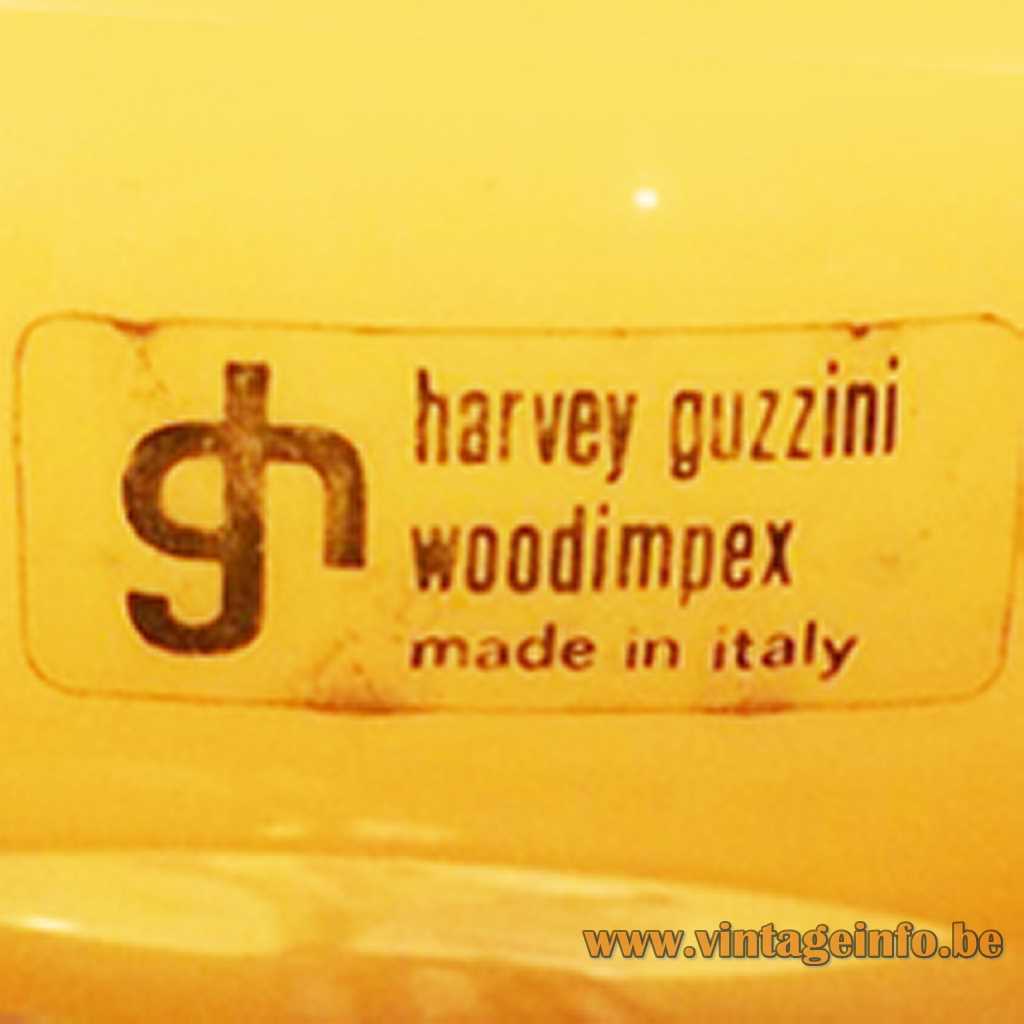
iGuzzini Bugia Table or Wall Lamp – Company Labels & Logos