- Categories
- Categories
Last 5 Viewed
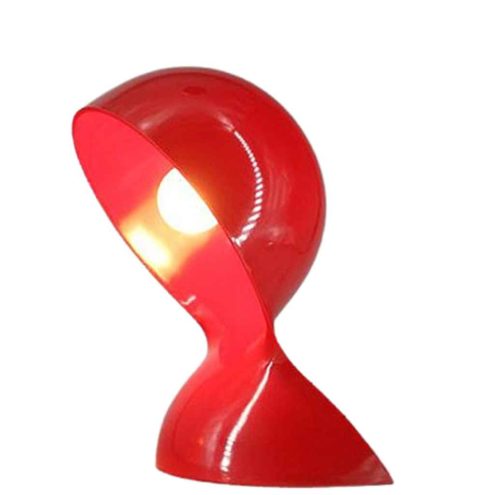
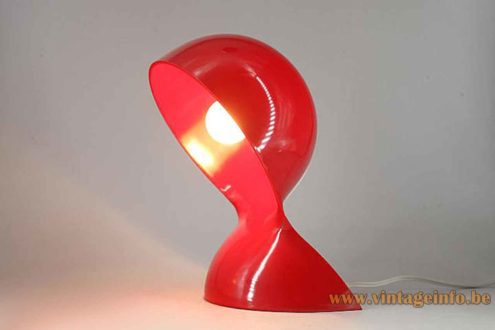
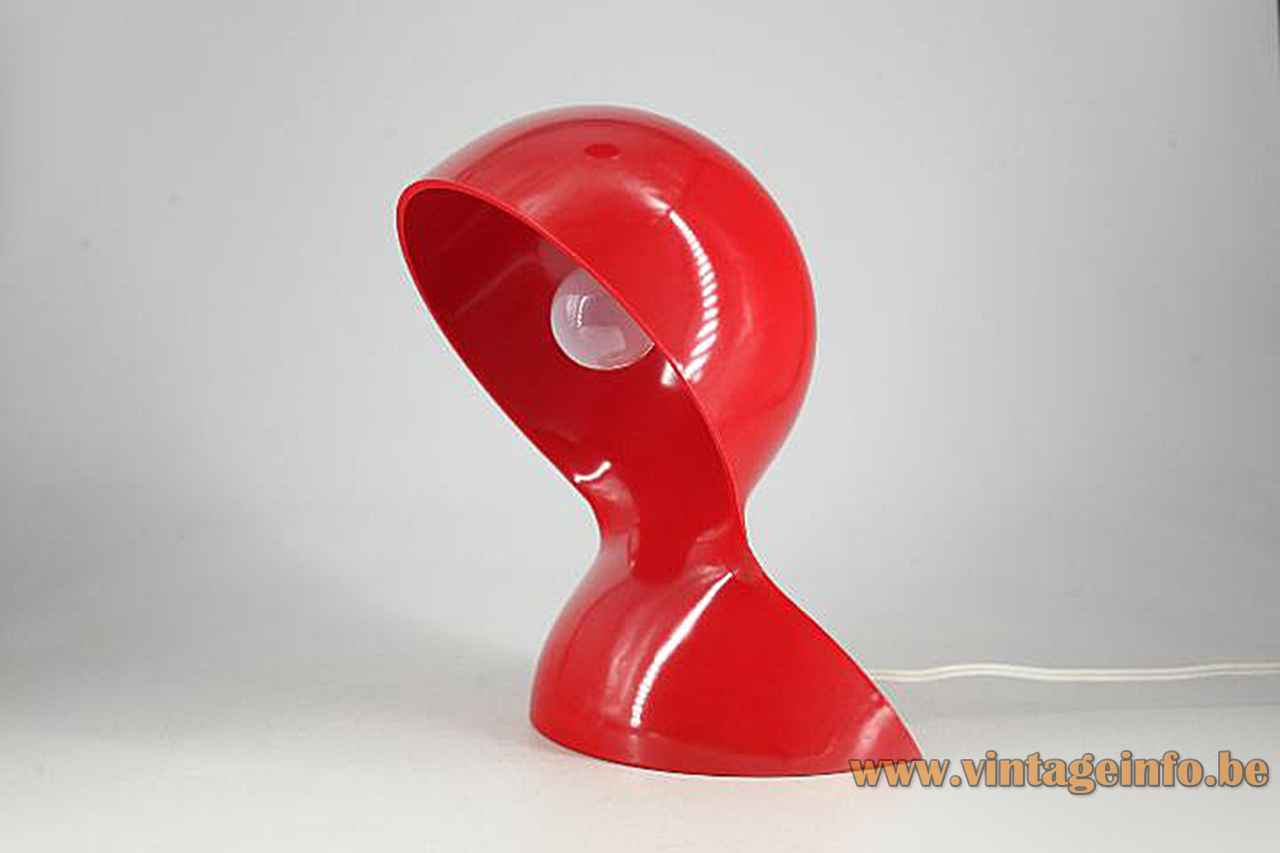
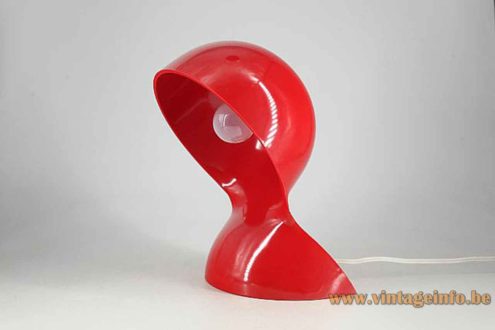
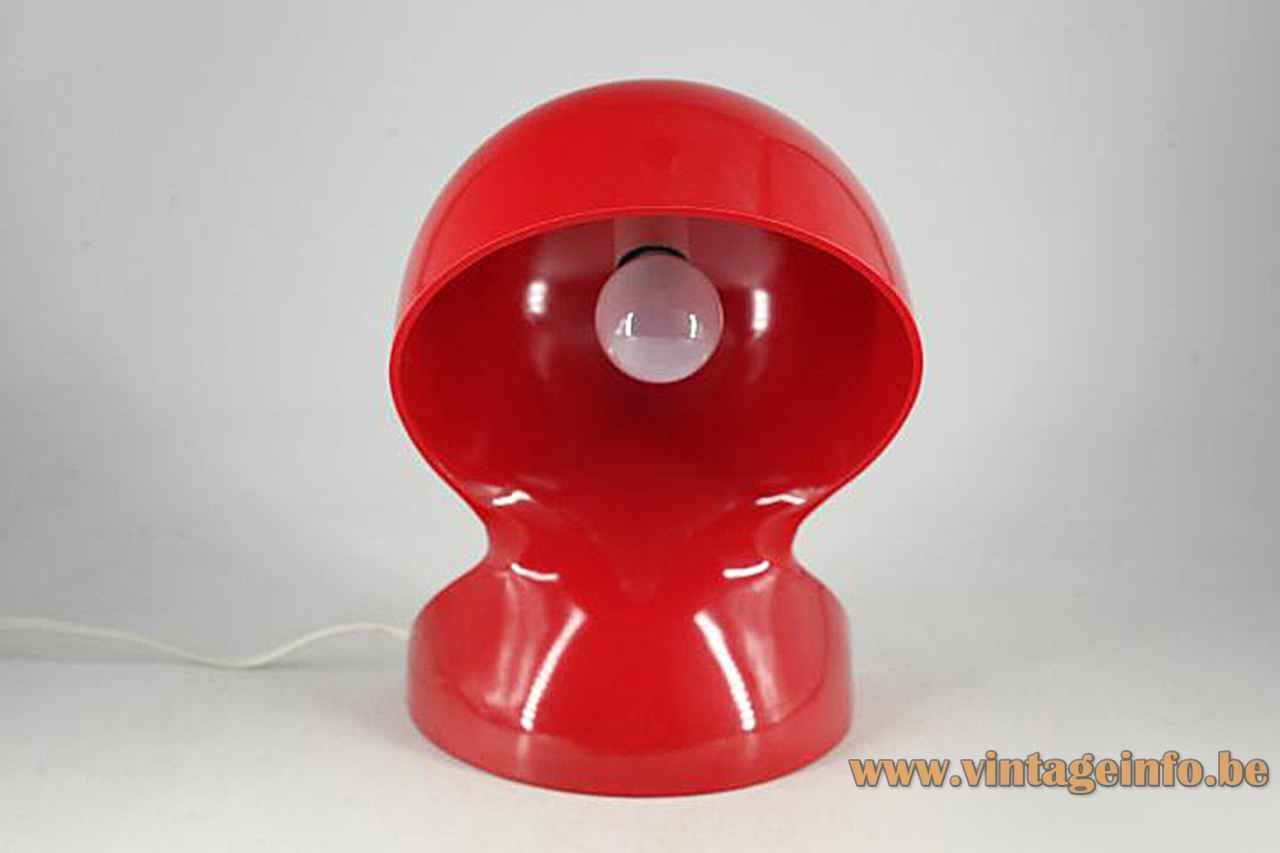
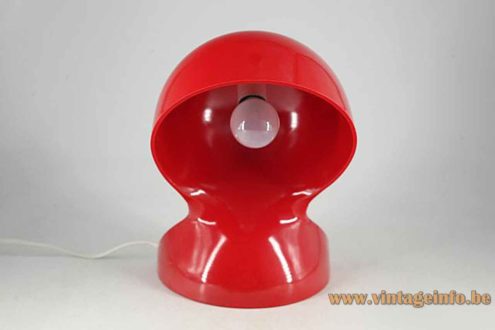
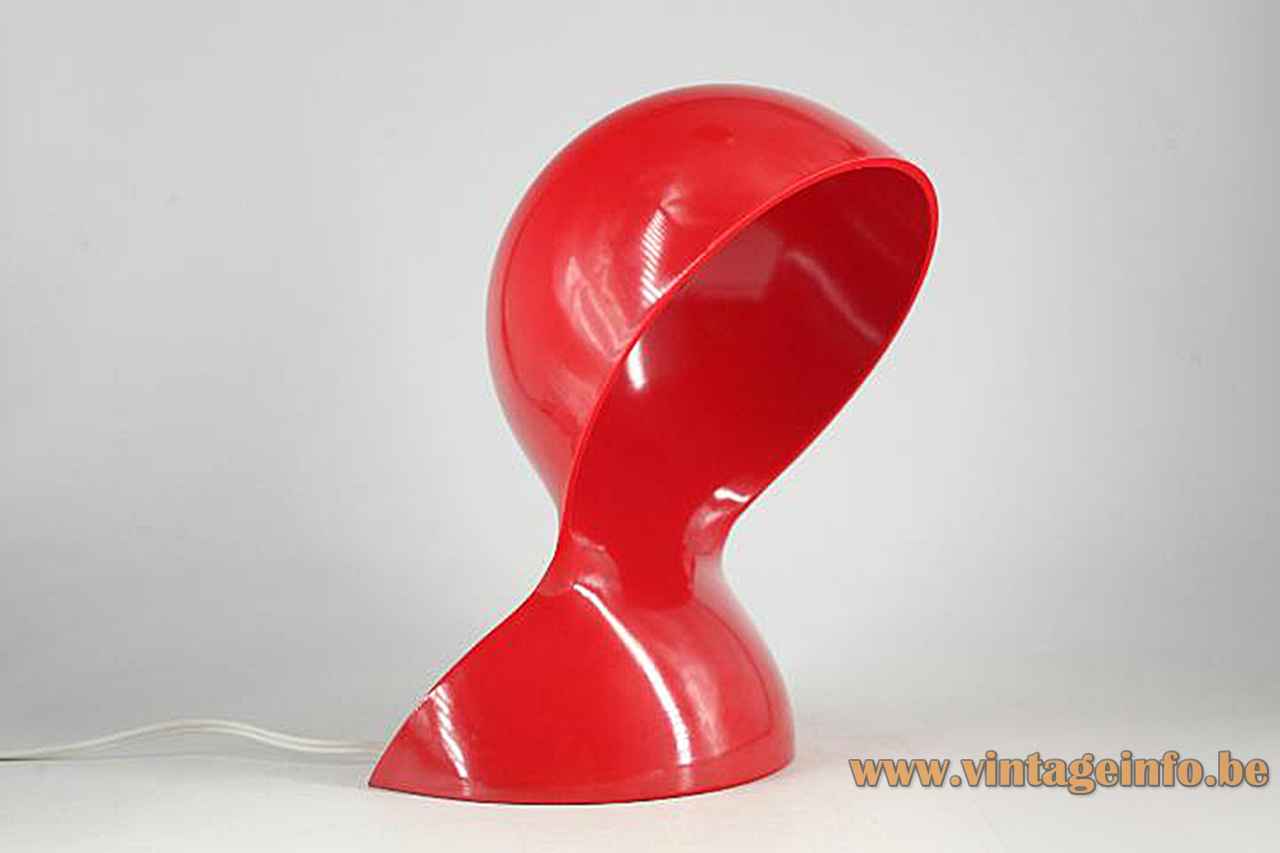
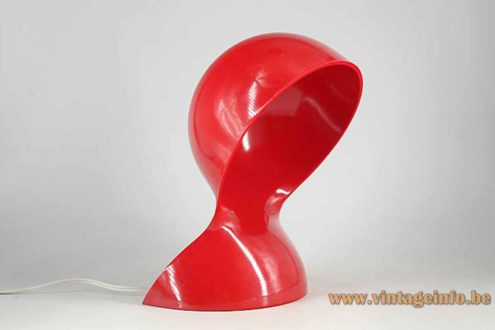
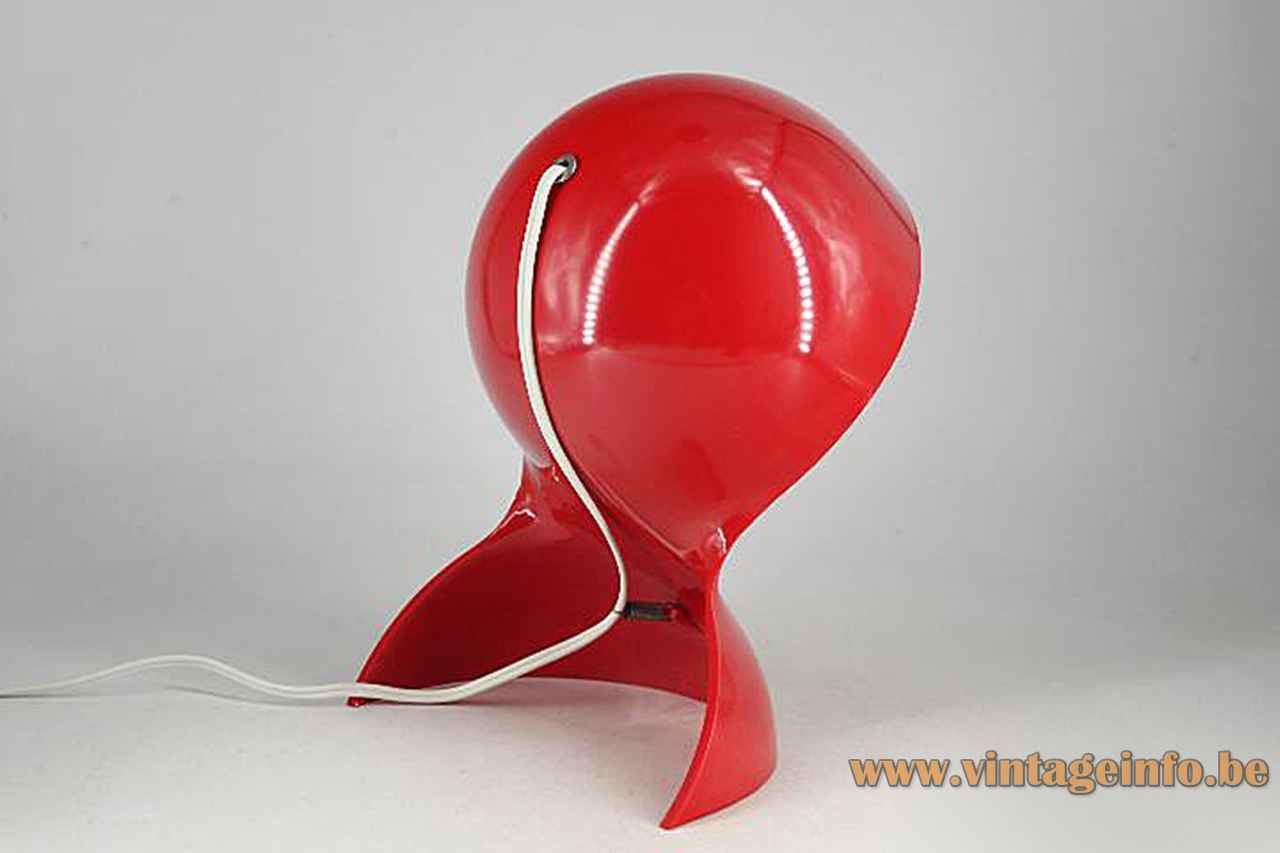
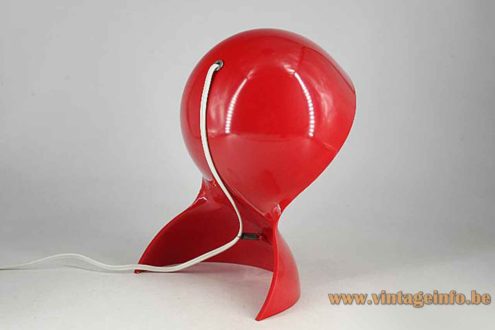
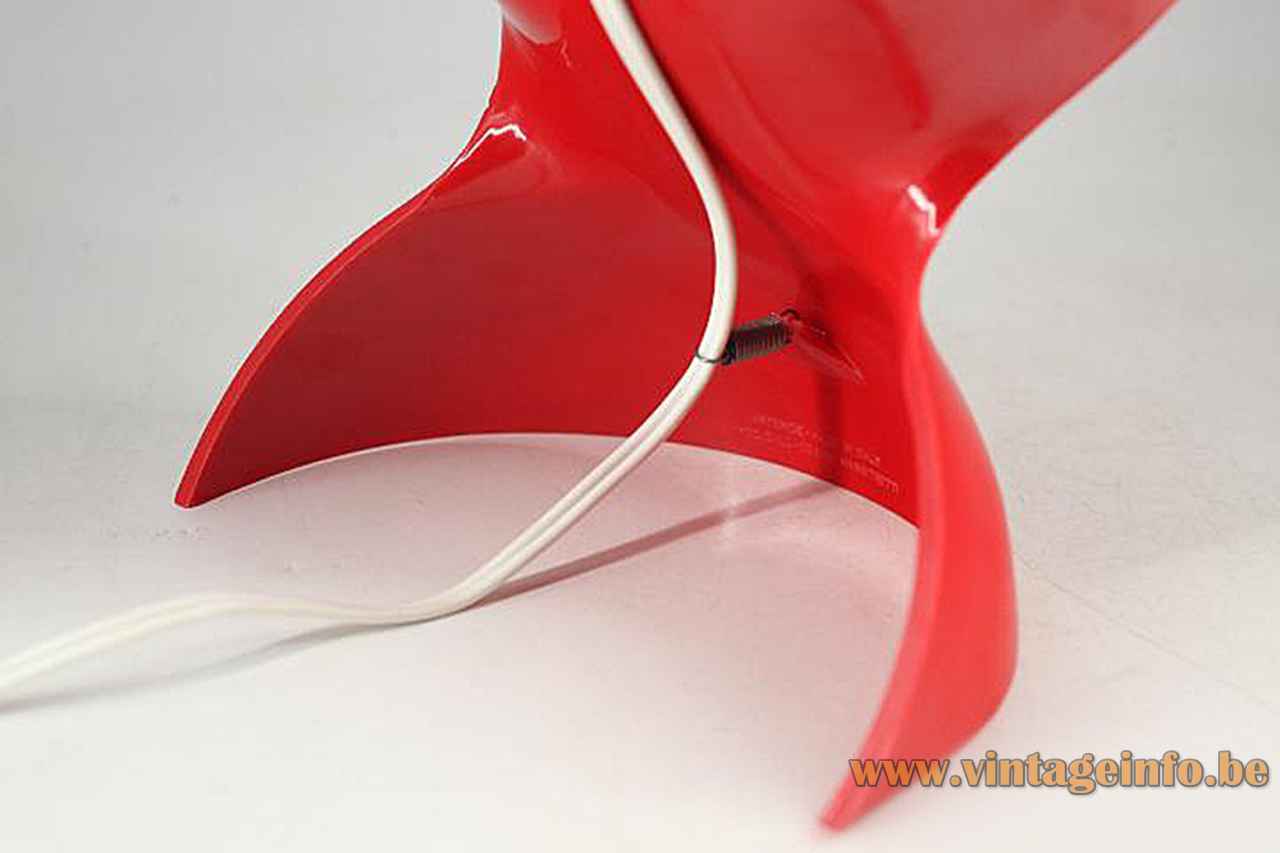
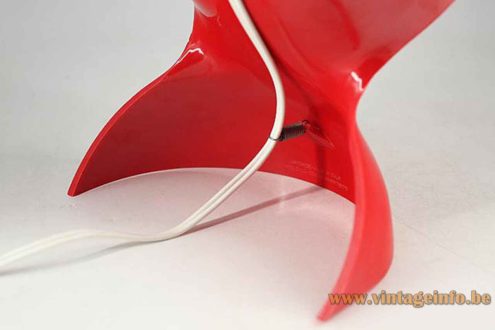
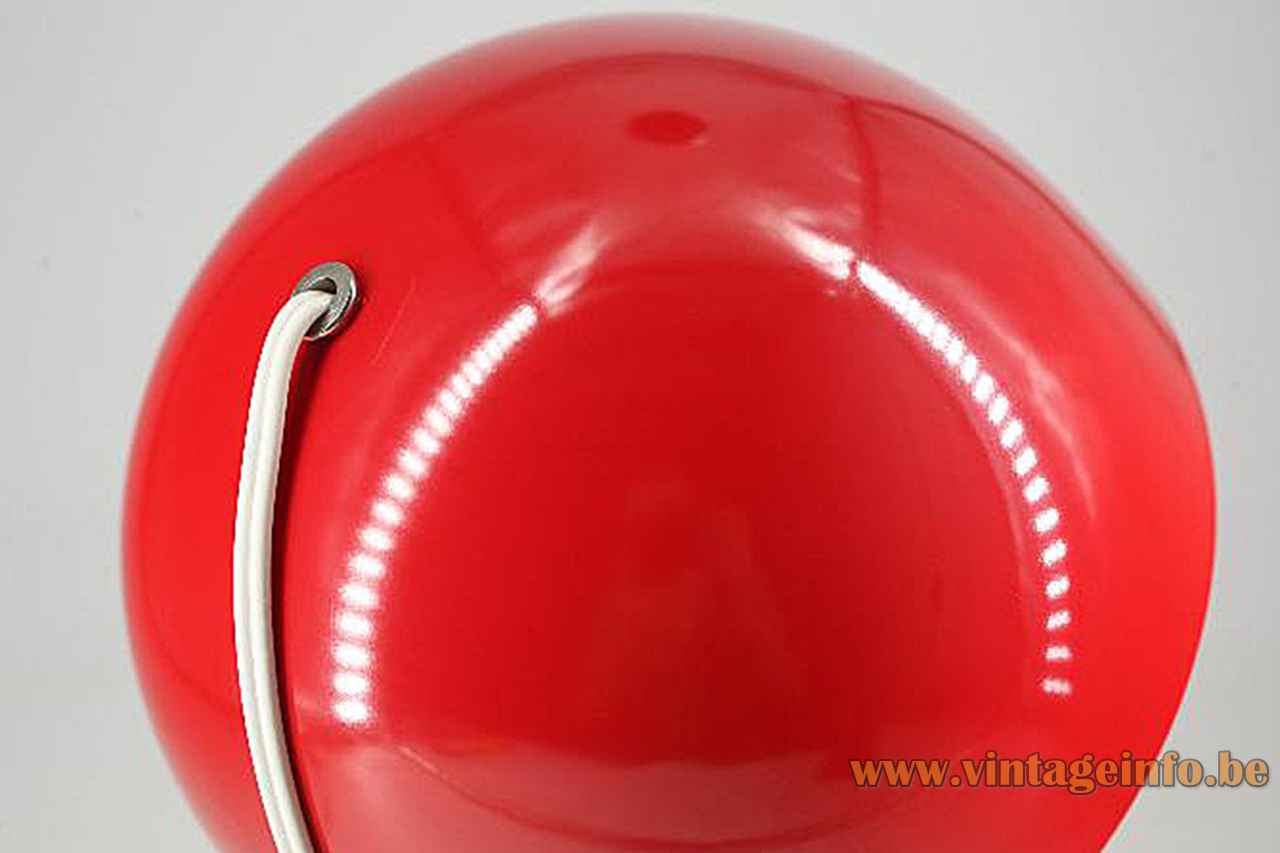
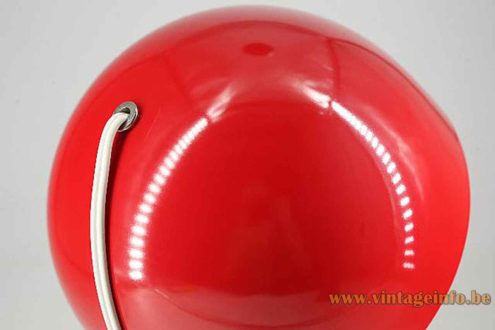
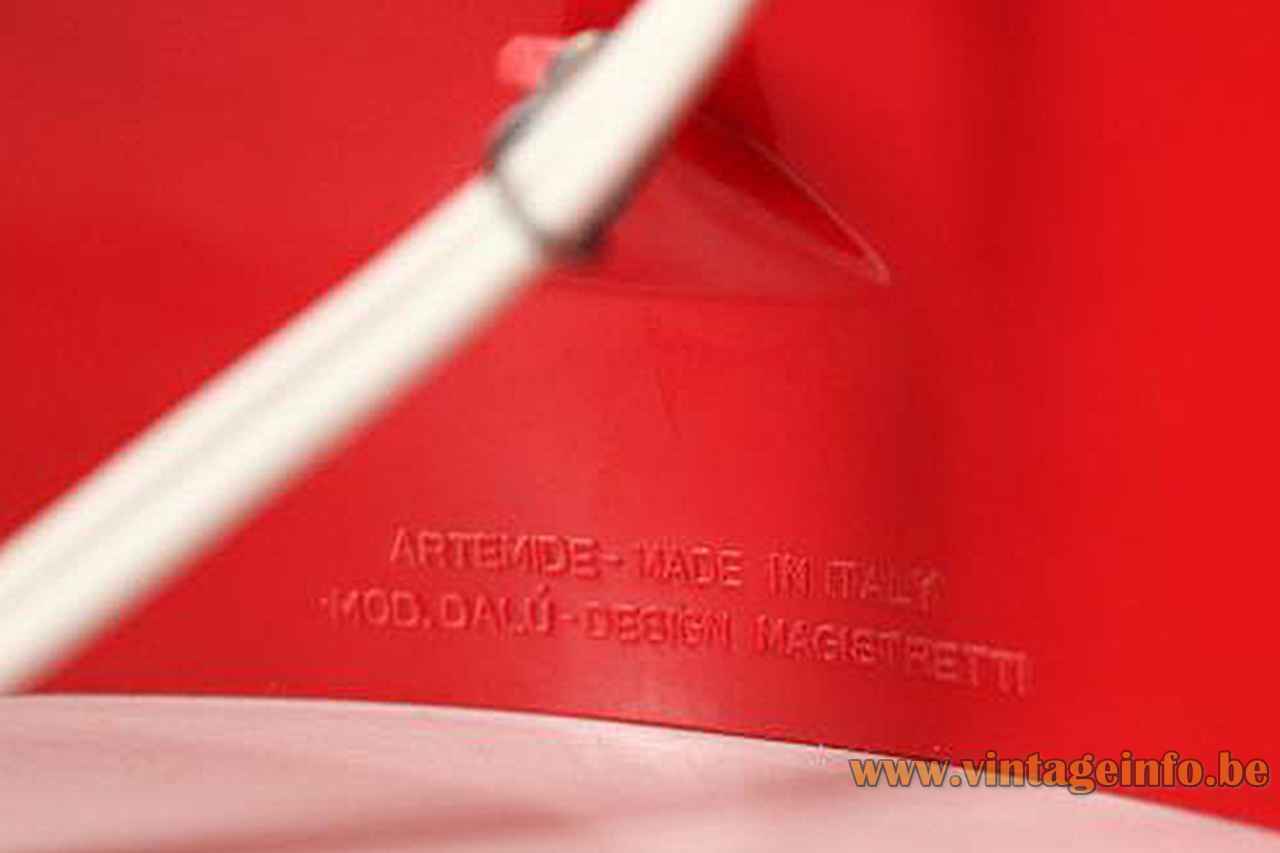
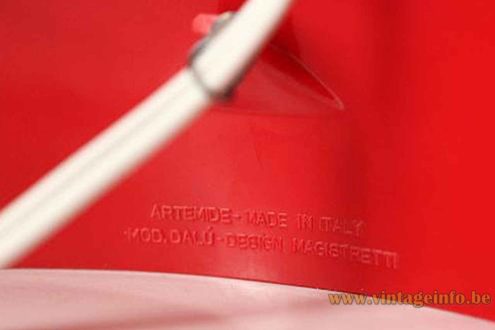
Artemide Dalù Table Lamp – 1973 Catalogue Picture
Presented in several languages and a photo with a red, orange and white version.
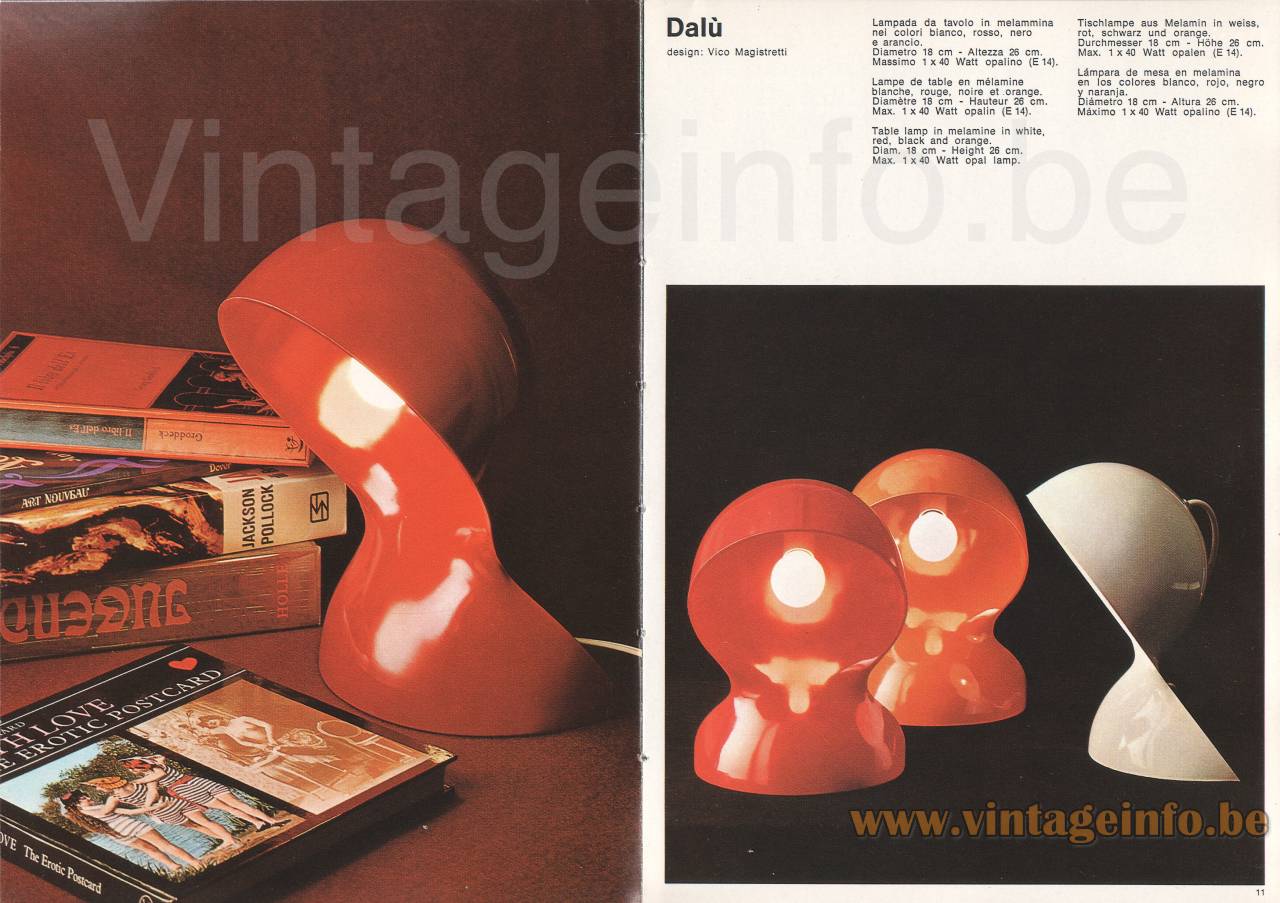
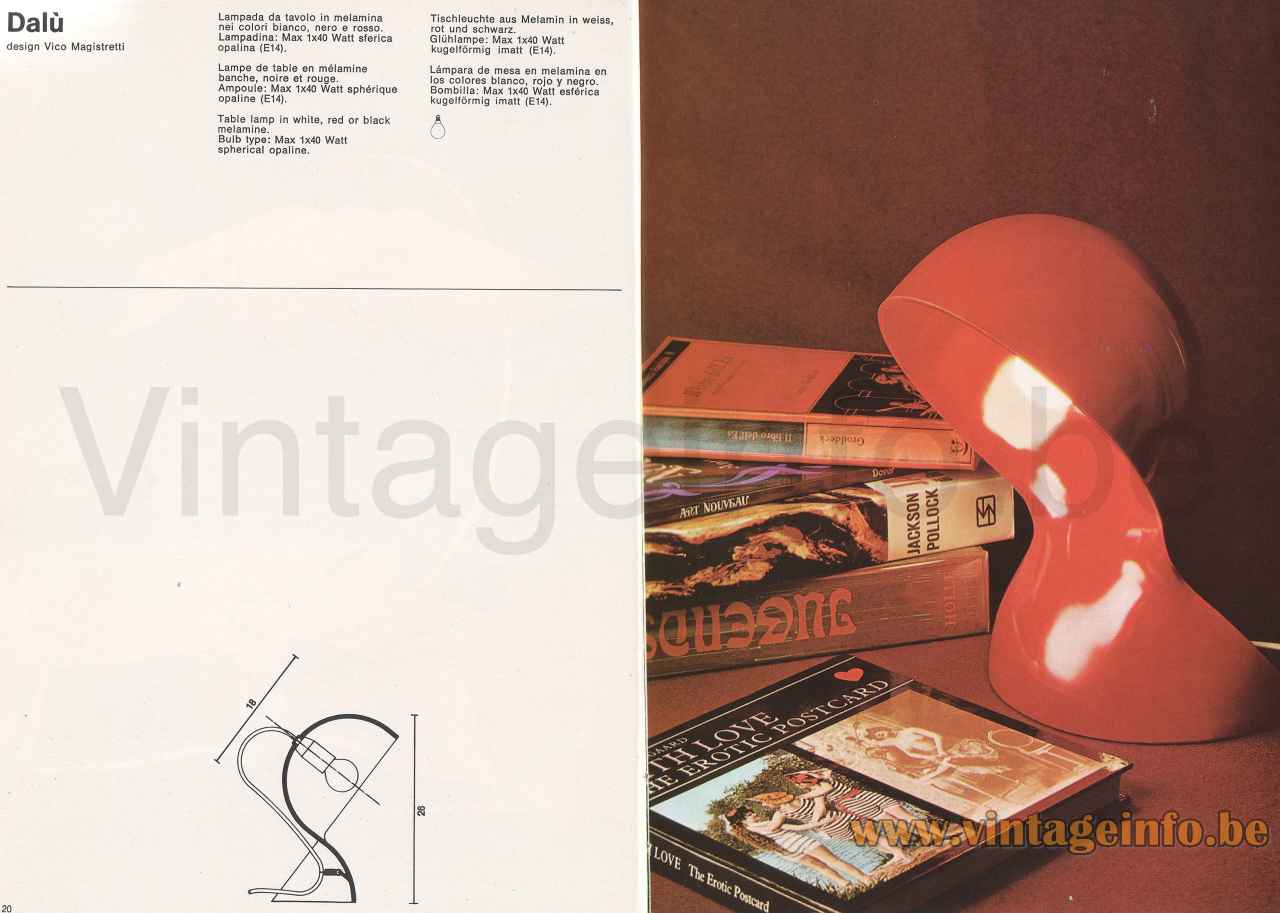
Artemide Dalù Table Lamp – 1976 Catalogue Picture
The same photo was used for this catalogue, a scheme with the dimensions is added in this picture.
Vico Magistretti – Artemide Lamps
For Vico Magistretti, lighting design for Artemide began in the early 1960s and resulted in a series of lamps that would become landmarks of Italian post-war design.
Lamps designed for Artemide include, among others:
Lambda (1961, wall lamp), Omicron (1961–1966, wall and floor lamp), Omega (1962, pendant lamp), Mania and Grande Mania (1963, wall lamps), Clitunno (1964, floor lamp), Erse (1964, table lamp), Veio (1965, table lamp), Cirene (1966, pendant and ceiling lamp), Cirene Giardino (1966, outdoor floor lamp), Dalù (1966, table lamp), Demetrio (1966, table lamp), Clinio (1967, wall lamp), Eclisse (1967, table lamp), Triclinio, Pentaclinio and Eptaclinio (1967, chandeliers), Telegono (1968, table lamp), Cetra (1969, pendant lamp), Giunone (1969, floor lamp), Ecatombe (1969, chandelier), Chimera (1969, floor lamp), Mezzachimera (1969, table lamp), Arcadia (1970, table lamp), Stadio (1970, table lamp), Teti (1970, wall and ceiling lamp), Triteti (1970, wall and ceiling lamp), Gaudì (1971, table lamp), Vicario (1971, table lamp), Impiccato (1972, pendant and ceiling lamp), Tessera and Mezzatessera (1972, wall lamps), Armilla (1975, table lamp), Troco (1975, table lamp), Porsenna Tavolo (1977, table lamp), Porsenna Parete (1977, wall lamp), Dui (1979, wall and ceiling lamp), Nemea (1979, table lamp), Kalea (early 1990s, chandelier).
There may be additional Artemide models not included here, and design dates can differ from catalogue publication or production dates.
Many thanks to Lluís fromEclectique Vintagefor the photos.
Many thanks to Artemide for the 2015 catalogue photo and the help.
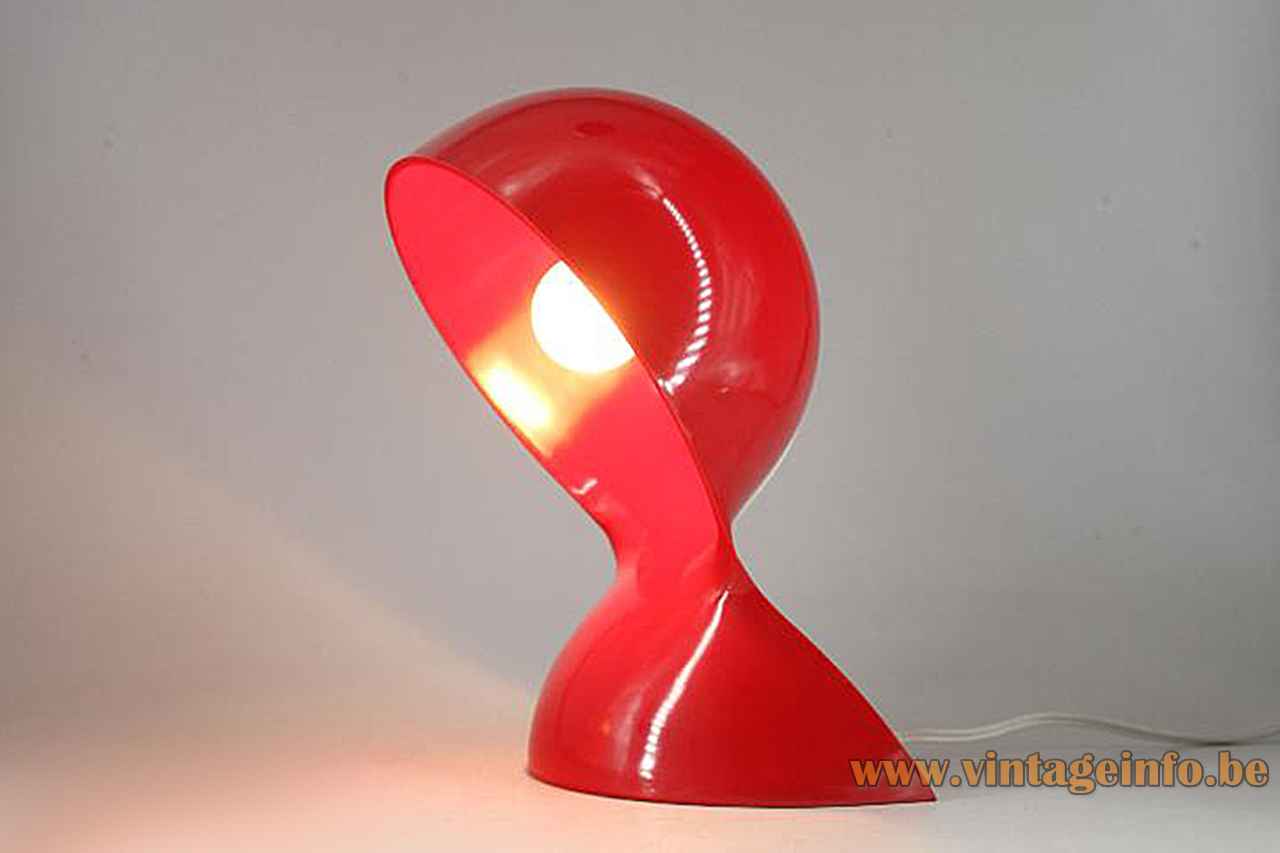
Artemide Dalù Table Lamp
Materials: Made in one piece of two curved semi-sphere red plastic (melamine) base & lampshade. Chromed metal spring. Bakelite E14 lamp socket.
Height: 26 cm / 10.23”
Lampshade: 18 cm / 7.08”
Base: 18,4 cm / 7.24”
Electricity: 1 bulb E14, 1 x 40 watt maximum. 110/220 volt.
No specific type of light bulb is required; different types can be used.
Period: 1969 – 1980, 2005 – until now – Mid-Century Modern.
Designer: Vico Magistretti in 1966.
Manufacturer: Artemide, Pregnana Milanese, near Milan, Italy.
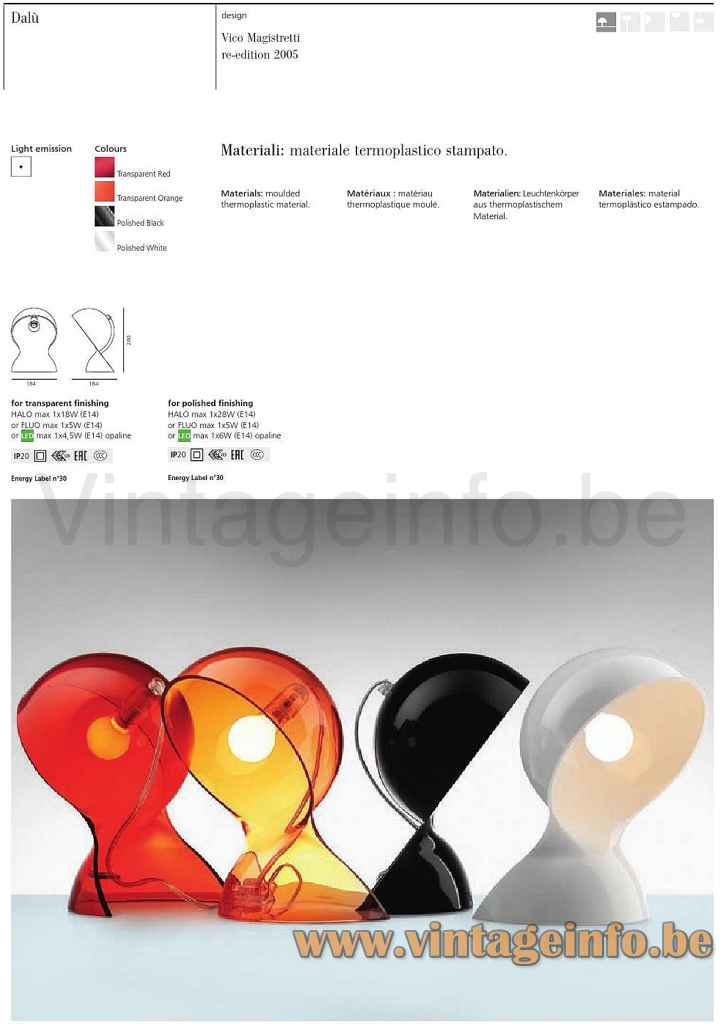
Other versions: This Artemide Dalù table lamp was first made in white, red and black. the re-edition is made in transparent orange and red and also in black and white.
The idea for this lamp already existed in 1962 – 1963, but the final design came in 1966.
The re-edition that is made since 2005 doesn’t have a spring on the back to hold the electrical wire at the base. It also has a new wiring with a different switch, plug, and socket, of course. The translucent versions were made until 2016. Today (2022) white, black and orange lamps are in production.
A limited edition translucent + speckled version was also available in 2013.
Some, or possibly all, of the new lamps were or are made in Hungary. Sometimes they carry a label that says: Made in Hungary.
Vico Magistretti
Vico Magistretti (1920–2006) was one of the most influential Italian designers of the 20th century, best known for his radical yet timeless approach to industrial design, furniture and lighting. Trained as an architect in Milan, Magistretti belonged to the post-war generation of designers who reshaped Italian design by combining rational thinking, technical innovation and poetic simplicity.
Although his work spans architecture, furniture and everyday objects, lighting design plays a central role in Magistretti’s legacy. From the late 1950s onward, he explored light not as decoration, but as a functional and sculptural element, often reducing a lamp to its absolute essence. His designs are characterised by clean geometries, intelligent use of materials, and ingenious technical solutions that remain visually light and accessible.
Magistretti collaborated extensively with Artemide, for whom he designed some of the most iconic lamps of the post-war period. Among these are the Eclisse table lamp (1965), a compact, playful design that allows the user to “eclipse” the light source, and this Dalù and Mezzachimera lamps, which further explore form, shadow and diffused light. Many of these designs are still in production today, underlining their enduring relevance.
Another key collaboration was with Oluce, where Magistretti created the legendary Atollo table lamp in 1977. With its pure geometric composition of cylinder, cone and hemisphere, Atollo has become one of the most recognisable lamps in design history and is often cited as a perfect synthesis of form and function.
In addition, Magistretti designed several important lamps for Candle (FontanaArte). Across all these collaborations, his lighting designs demonstrate a rare balance between intellectual rigor and everyday usability.
Beyond his design practice, Magistretti was also an influential teacher and thinker, shaping generations of designers through his lectures and writings. His work is preserved and documented by the Vico Magistretti Foundation in Milan, which houses his archive and studio and continues to promote his ideas and design philosophy. The museum (Via Conservatorio, 20, 20122 Milano, Italy) is open on Tuesday, on Thursday and on Saturday. More info on the website, click here.
Artemide Dalù Table Lamp – 2015 Catalogue Picture
Artemide
In 1960, near Milan, Ernesto Gismondi and Sergio Mazza laid the foundation of Artemide. Right from the start, the company combined technological research with a strong sense of Italian design. Their very first iconic lamp was the Alfa — hence the name — designed around 1959–1960. Emma Schweinberger, Gismondo’s wife, designed the Chi table lamp in 1962. From there, Artemide quickly began collaborating with leading designers. The mid-1960s saw the company make waves with Vico Magistretti’s Eclisse, awarded in 1967, as well as Enzo Mari’s early contributions such as the Polluce floor lamp, designed together with Anna Fasolis in 1965. The Dalù table lamp (1966 – Vico Magistretti) and the Nesso (1965), designed by Giancarlo Mattioli & Gruppo Architetti Urbanisti Città Nuova, further established Artemide’s reputation during this formative decade. Other notable designs from the late 1960s include the Lesbo table lamp, a 1967 design by Angelo Mangiarotti, Vico Magistretti’s Telegono (1968), the Pallade pendant by Studio Tetrarch, the Electra table lamp, designed by Giuliana Gramigna in 1968, all reflecting the experimental spirit of the era.
As the 1970s arrived, Artemide introduced what would become one of its most recognisable icons: the Tizio desk lamp, designed by Richard Sapper in 1972. Around the same period, Gae Aulenti designed the Pileino and Mezzopileo lamps, followed by Mezzoracolo in 1973. The famous Sintesi lamp series was designed by Ernesto Gismondi in 1975 and the Area 50 lamp series, a Mario Bellini design from 1975. The decade also saw the introduction of the Onfale lamp in 1978, designed by Luciano Vistosi, marking Artemide’s growing interest in glass and sculptural forms.
The 1980s marked a phase of international expansion. By 1980, Artemide had established a presence in the United States and continued to attract prominent designers, including Ettore Sottsass. His Callimaco floor lamp and Pausania table lamp, both designed during the 1980s, became distinctive statements within Artemide’s catalogue. Other important designs from this decade include the Polifemo floor lamp by Carlo Forcolini (1983). In 1987, Artemide launched the Tolomeo, designed by Michele De Lucchi and Giancarlo Fassina, which quickly became an icon of functional and timeless design.
During the 1990s, Artemide further expanded its scope by acquiring VeArt, bringing Murano glass expertise into the company. In 1996, Artemide introduced its “The Human Light” philosophy, focusing on the relationship between light, people and their environment. By the late 1990s, Artemide Architectural was established, bridging product design and large-scale architectural lighting projects. From the 2000s onward, Artemide increasingly focused on LED innovation while reissuing its historic designs within the “Modern Classic” collection.
In essence, Artemide represents a rich tapestry of Italian lighting history. Whether defined by the minimalist engineering of the Tizio, the organic curves of the Nesso, or the expressive presence of the Callimaco, Artemide has consistently blended design innovation with a deeply human approach to light. It is precisely this balance that makes these lamps — including the Pausania and many others — enduring icons of modern design.
Designers that collaborated with Artemide include, among others, Vico Magistretti, Emma Schweinberger, Gae Aulenti, Richard Sapper, Michele De Lucchi, Giancarlo Fassina, Ettore Sottsass, Enzo Mari, Gio Ponti, Sergio Mazza, Angelo Mangiarotti, Joe Colombo, Sergio Asti, Sergio Favre, Mario Marenco, Adelaide Bonati, Silvio Bonatti, Enrico De Munari, Carla Federspiel, Livio Castiglioni, Piero Castiglioni, Nanda Vigo, Luigi Caccia Dominioni, Mario Botta, Carlo Forcolini, Luciano Vistosi, Neri&Hu, Carlotta de Bevilacqua, Jean Nouvel, Karim Rashid, Neil Poulton, Studio Tetrarch, Zaha Hadid, Ron Arad, Herzog & de Meuron, Issey Miyake, Naoto Fukasawa, Aldo Rossi, Adrien Gardère, Stephen Philips, Carlo Colombo and Giulia Foscari.
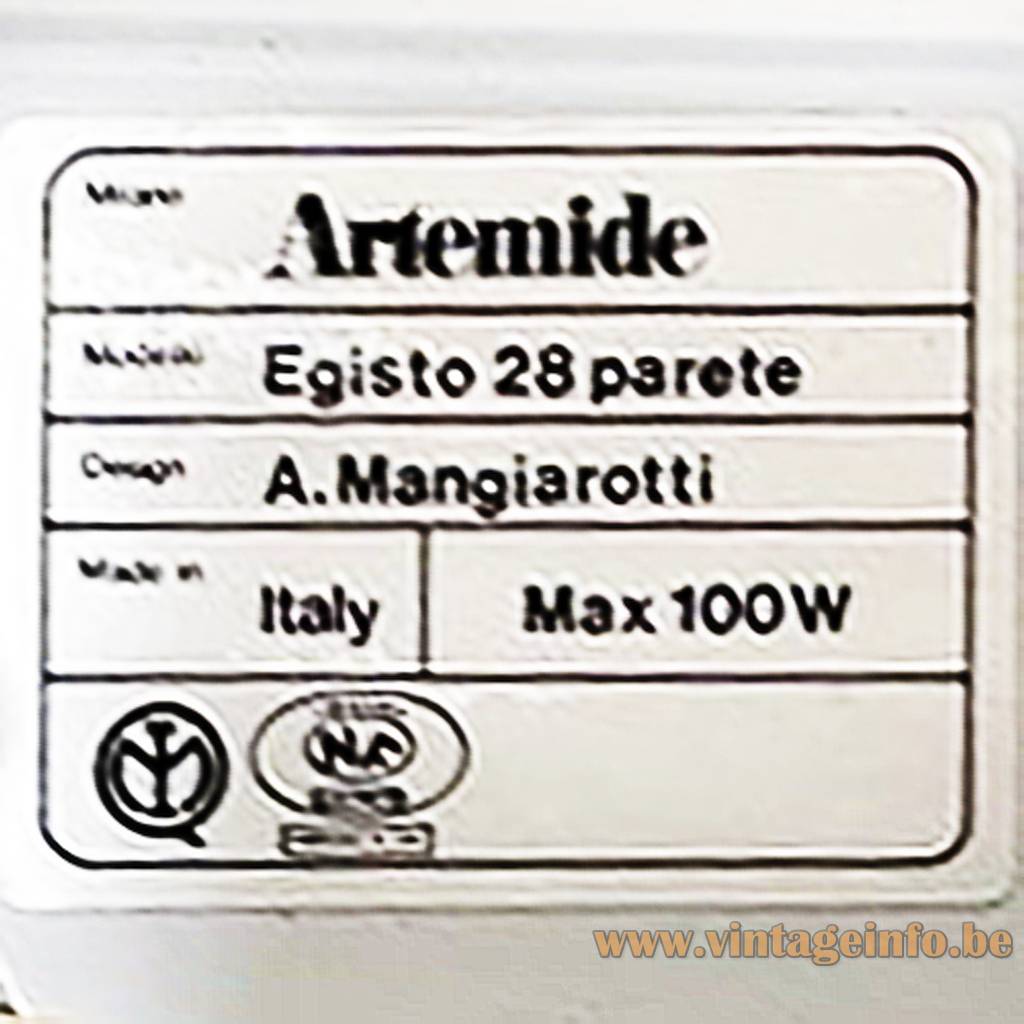
Artemide Dalù Table Lamp – Company Labels & Logos