- Categories
- Categories
Last 5 Viewed
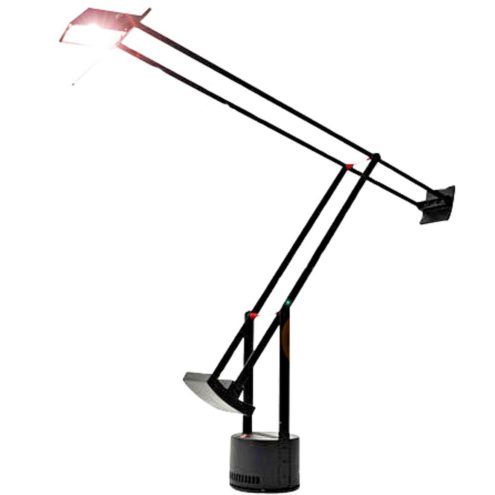

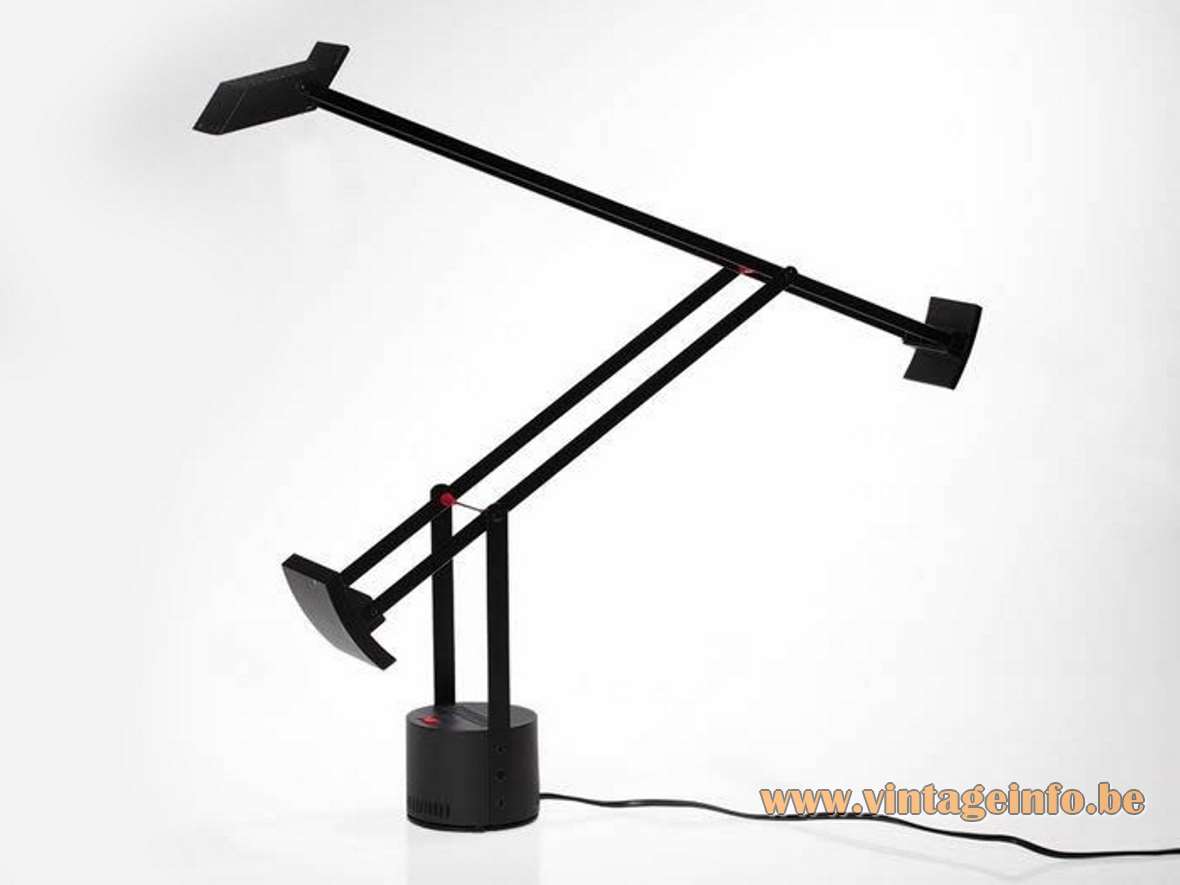
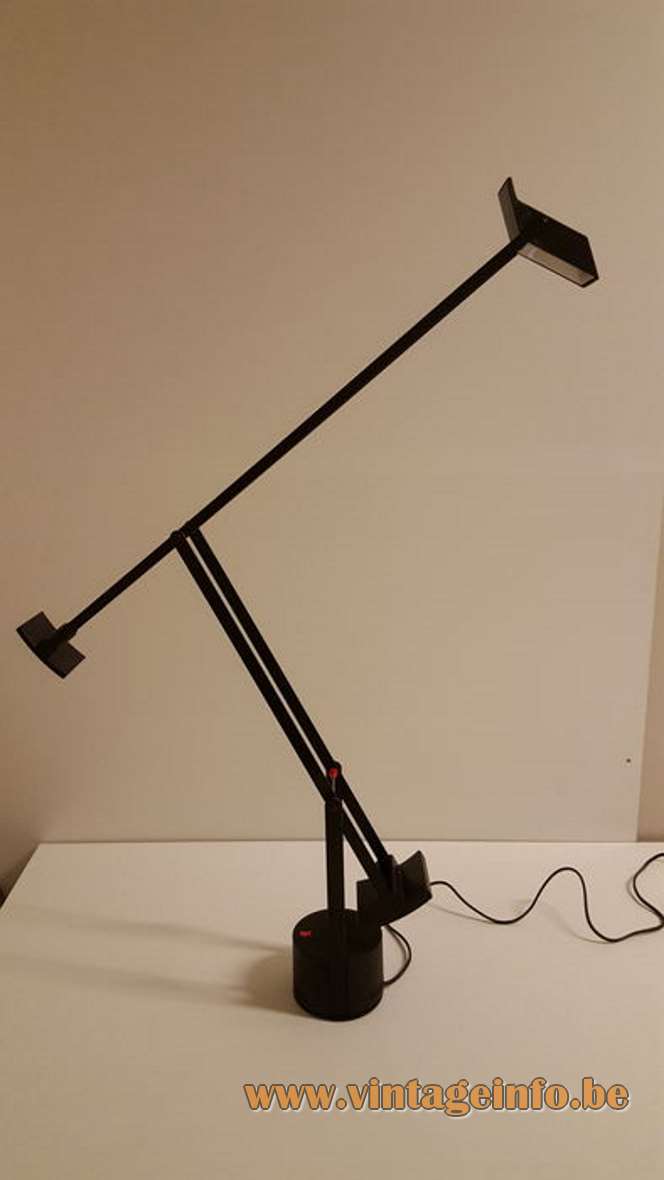
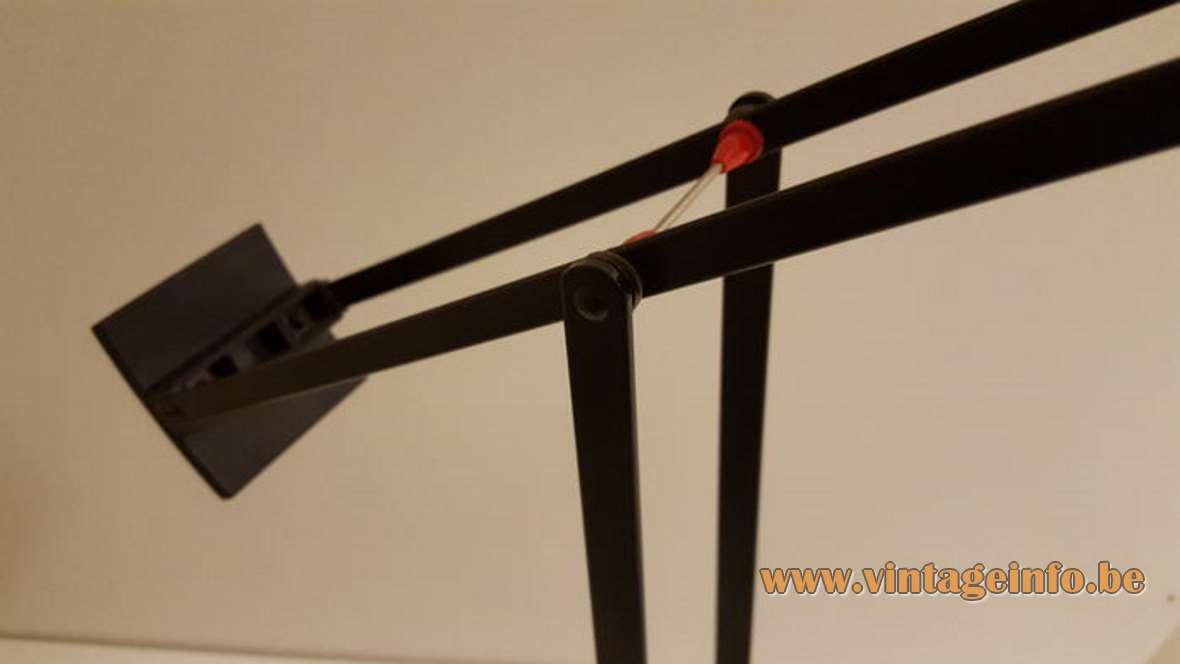

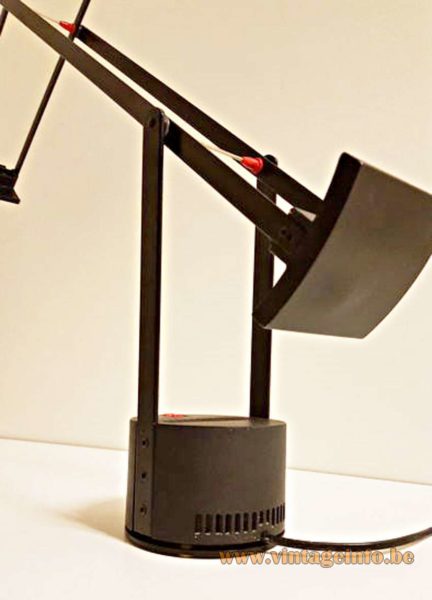
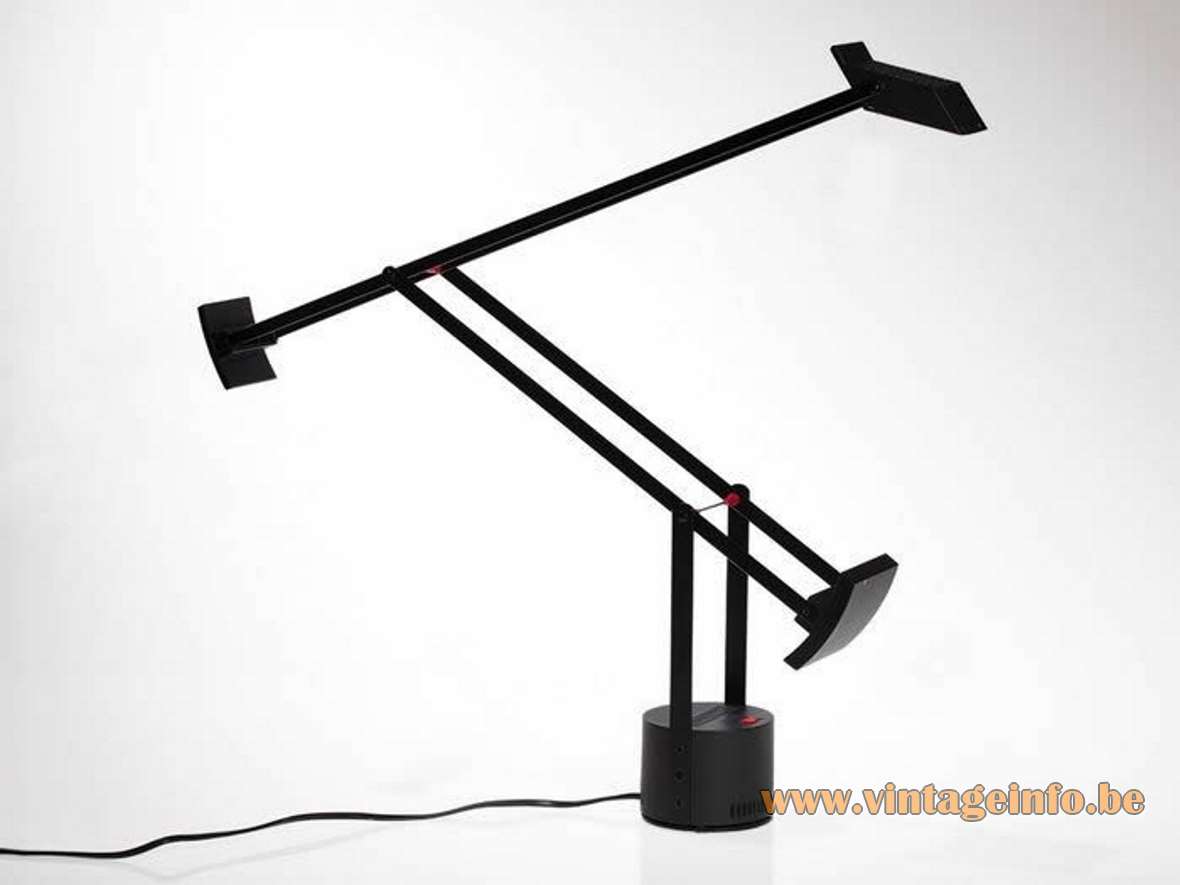
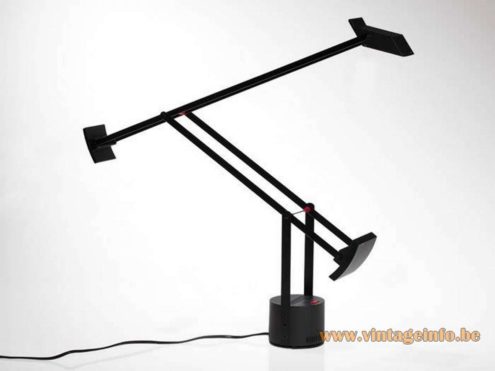
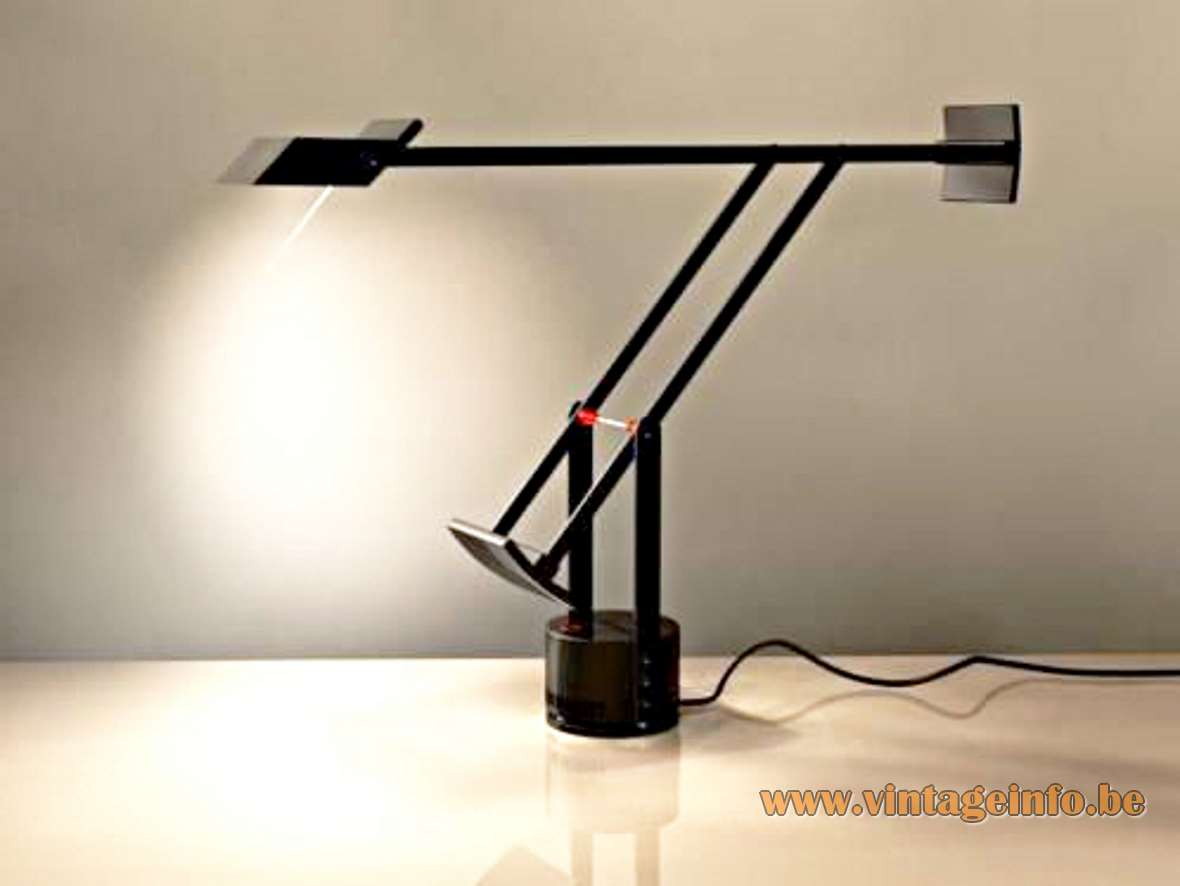
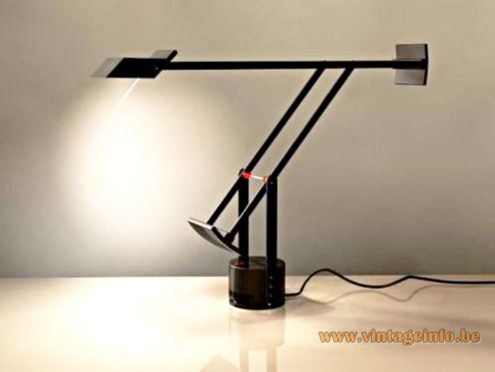
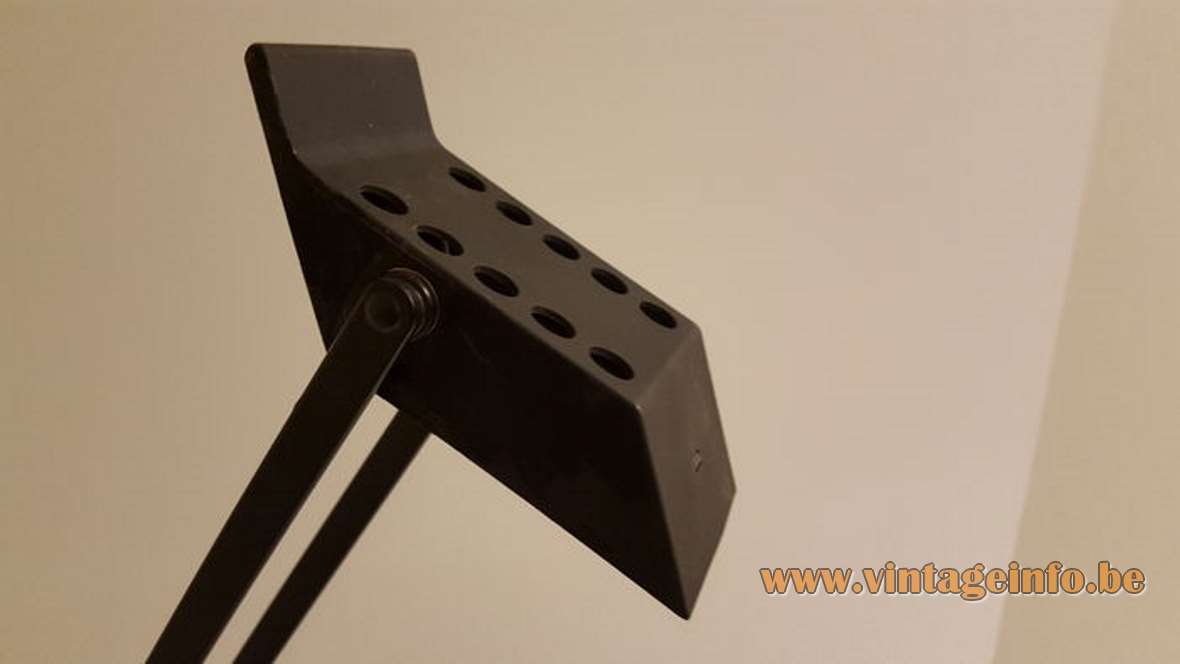
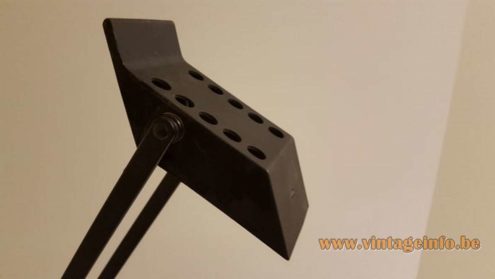
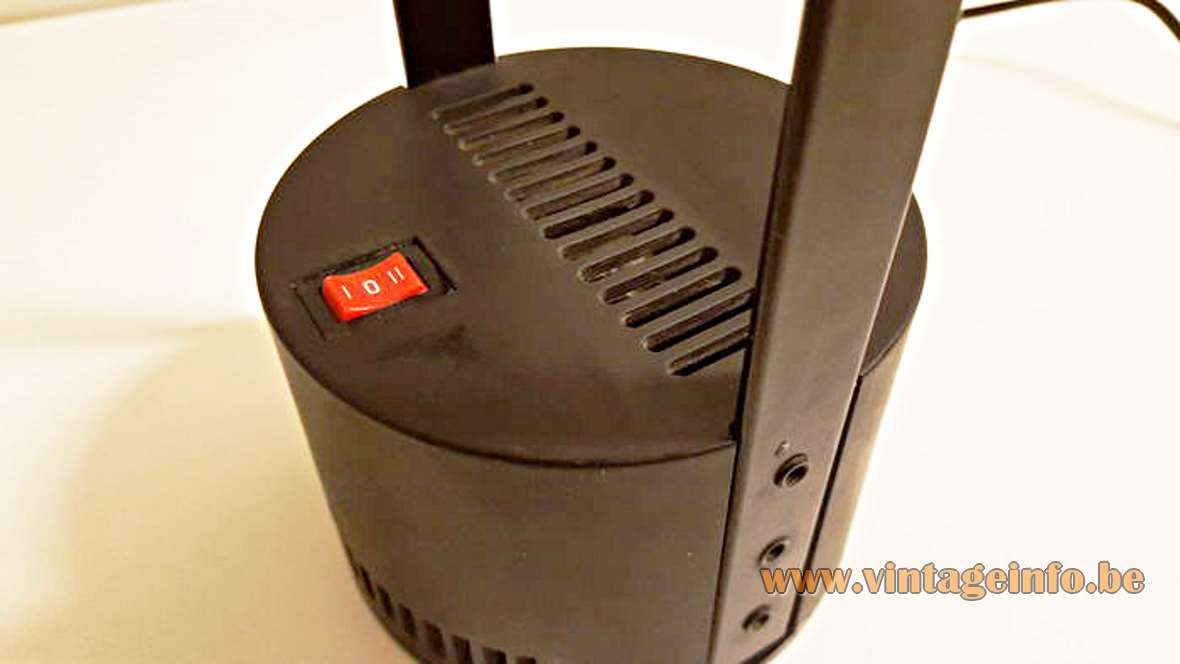

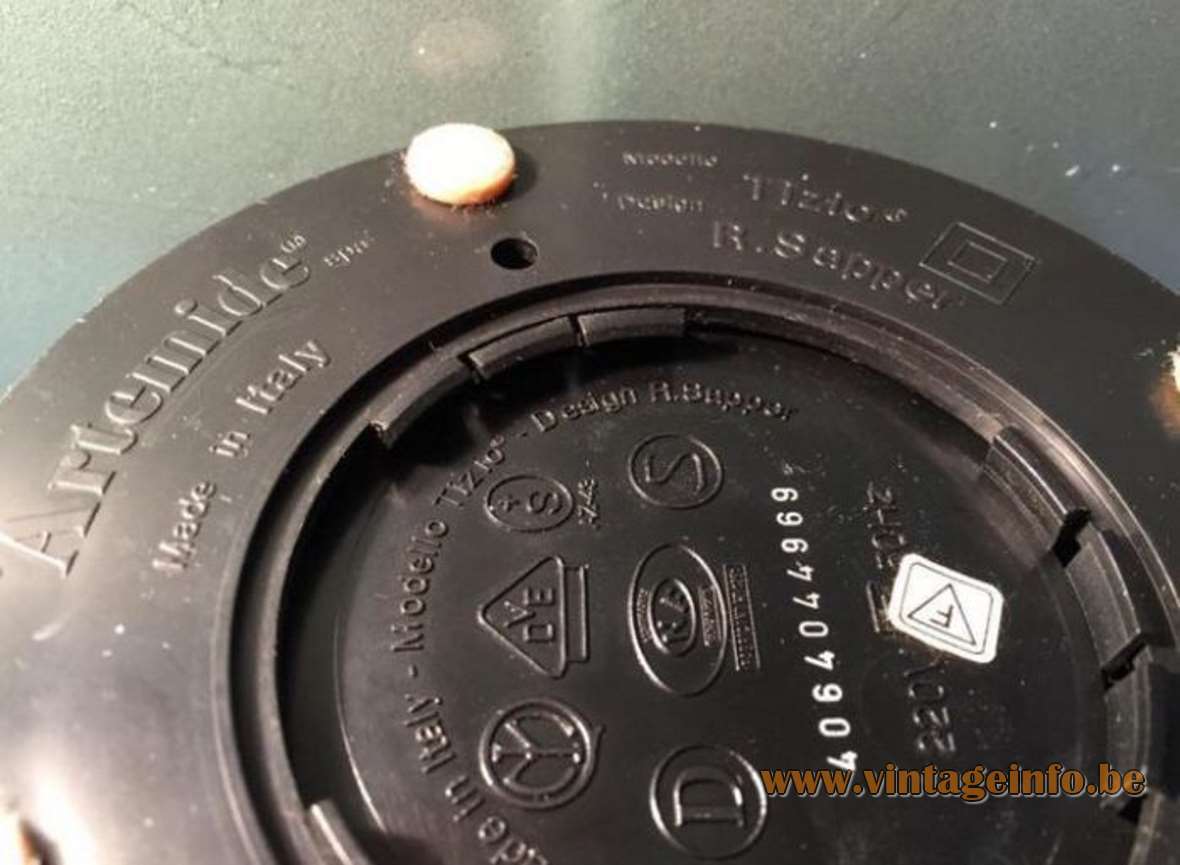
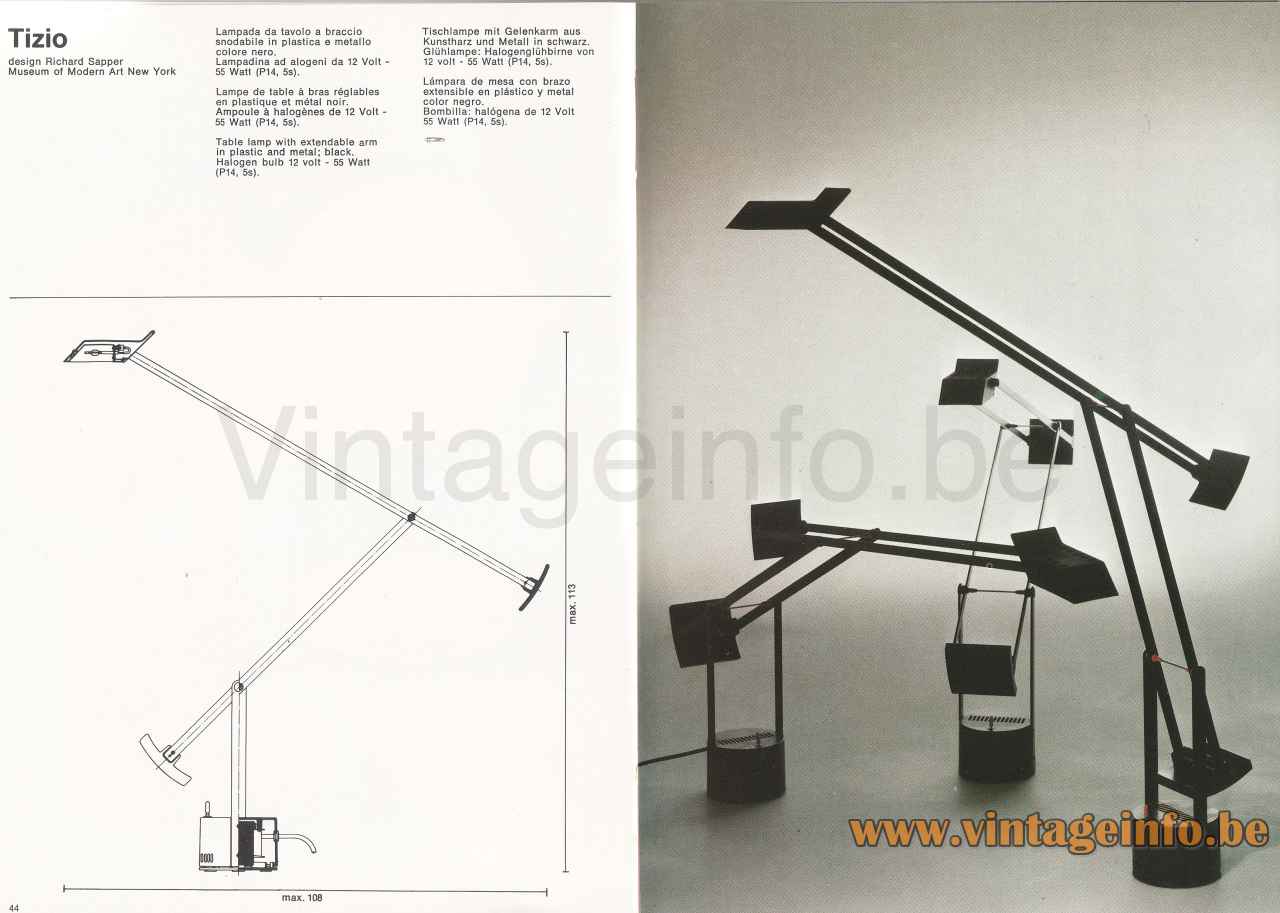
Artemide Tizio 50 Desk Lamp – 1976 Catalogue Picture
The 3 models of the Tizio on this page of the 1976 catalogue.
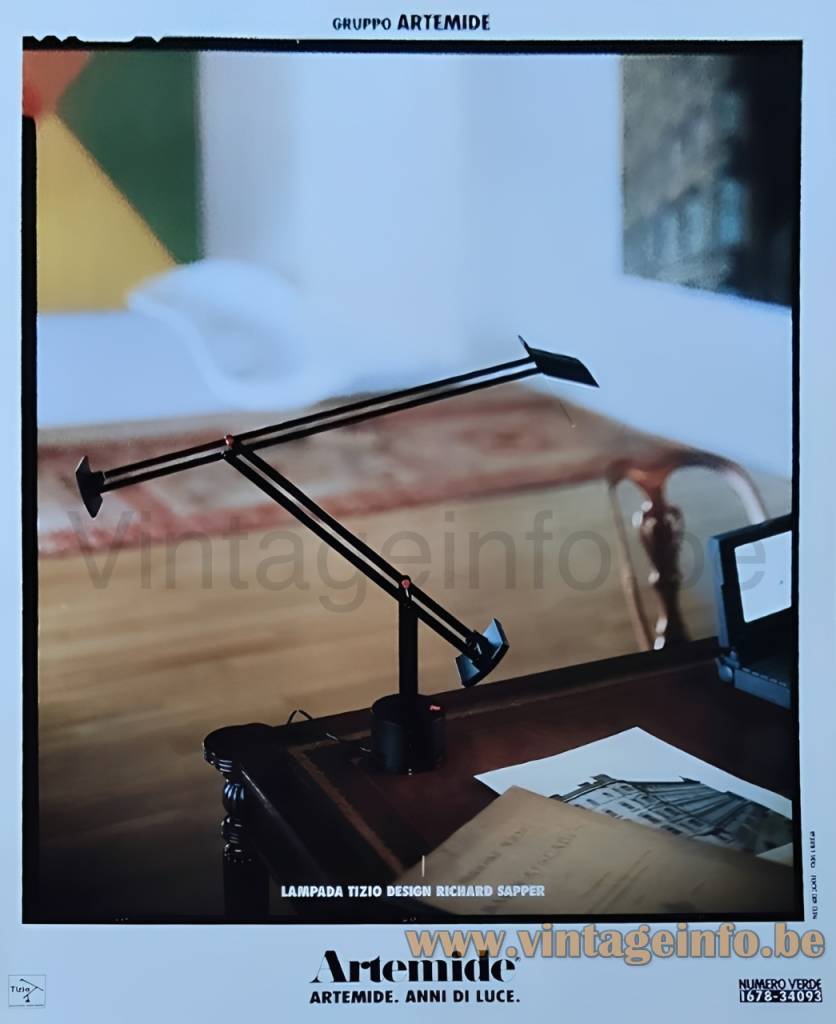
Artemide Tizio 50 Desk Lamp – 1993 Publicity
Lamps In The Movies
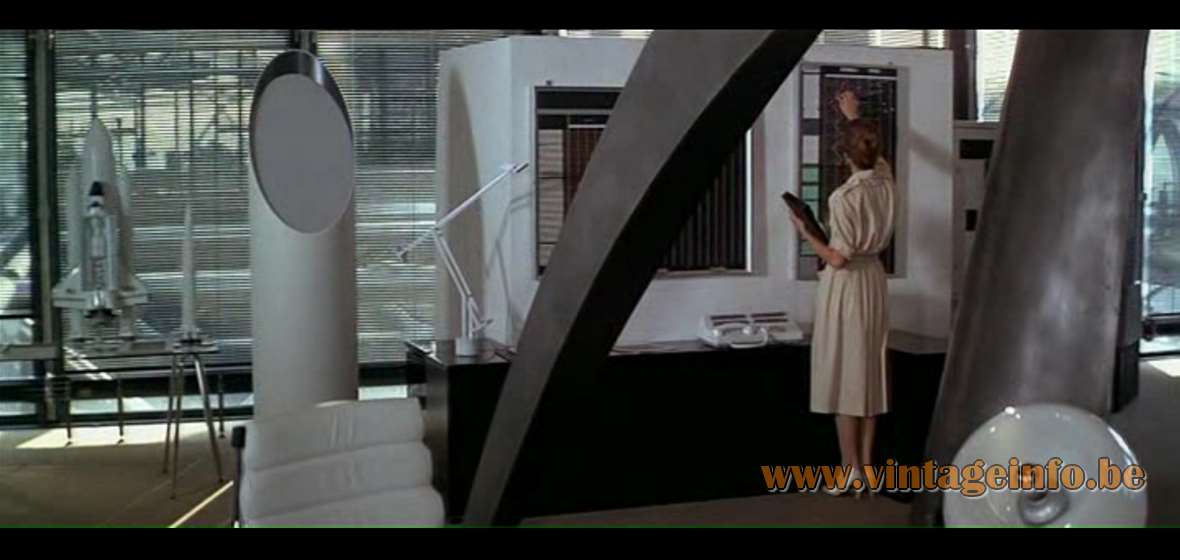
Moonraker (1979)
A white version of the Artemide Tizio 50 desk lamp was used as a set decoration in the 1979James Bond film Moonraker with Roger Moore. This is the eleventh Bond film, the fourth with Roger Moore in the lead. The round white lamp on the right is the Artemide Vacuna. It was designed in 1968 by Eleonore Peduzzi Riva (born in Milan in 1939).
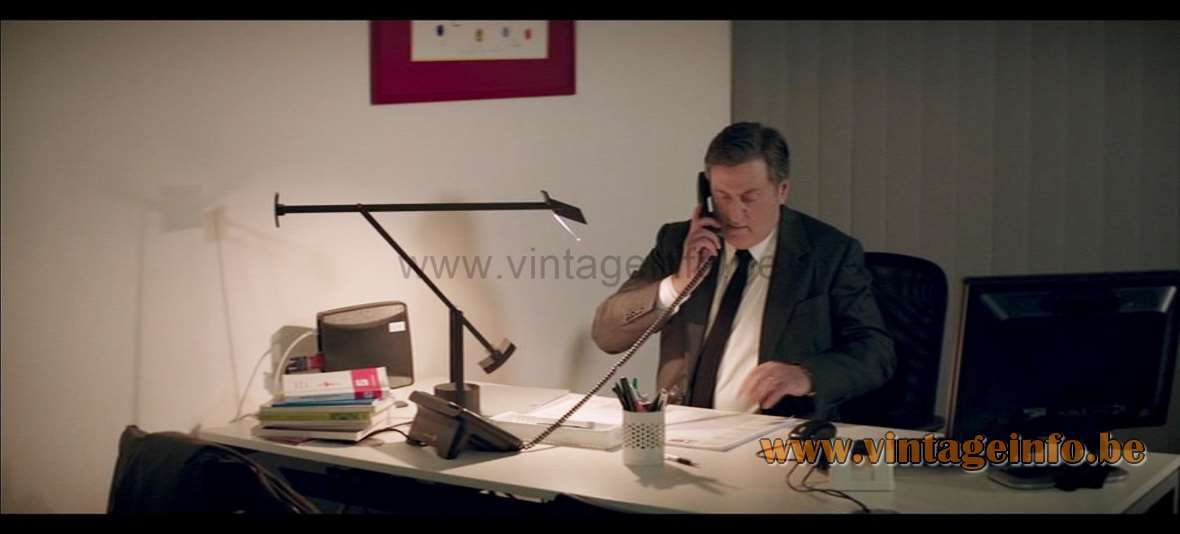
Avant l’Hiver (2013) – Before the Winter Chill
An Artemide Tizio 50 desk lamp was used as a set decoration in the French drama film Avant l’Hiver (Before the Winter Chill) from 2013. Starring Daniel Auteuil, Kristin Scott Thomas and Leïla Bekhti. The movie was directed by Philippe Claudel.
Le Professionnel (1981) – The Professional
An Artemide Tizio 50 desk lamp was used as a set decoration in the 1981 French action film Le Professionnel (The Professional). A movie directed by Georges Lautner. Starring Jean-Paul Belmondo as secret agent Josselin Beaumont. The soundtrack was composed by Ennio Morricone.

Roman J. Israel, Esq. (2017)
An Artemide Tizio 50 desk lamp was used as a set decoration in the 2017 legal drama film Roman J. Israel, Esq. A movie written and directed by Dan Gilroy. Starring Denzel Washington, Colin Farrell, and Carmen Ejogo.
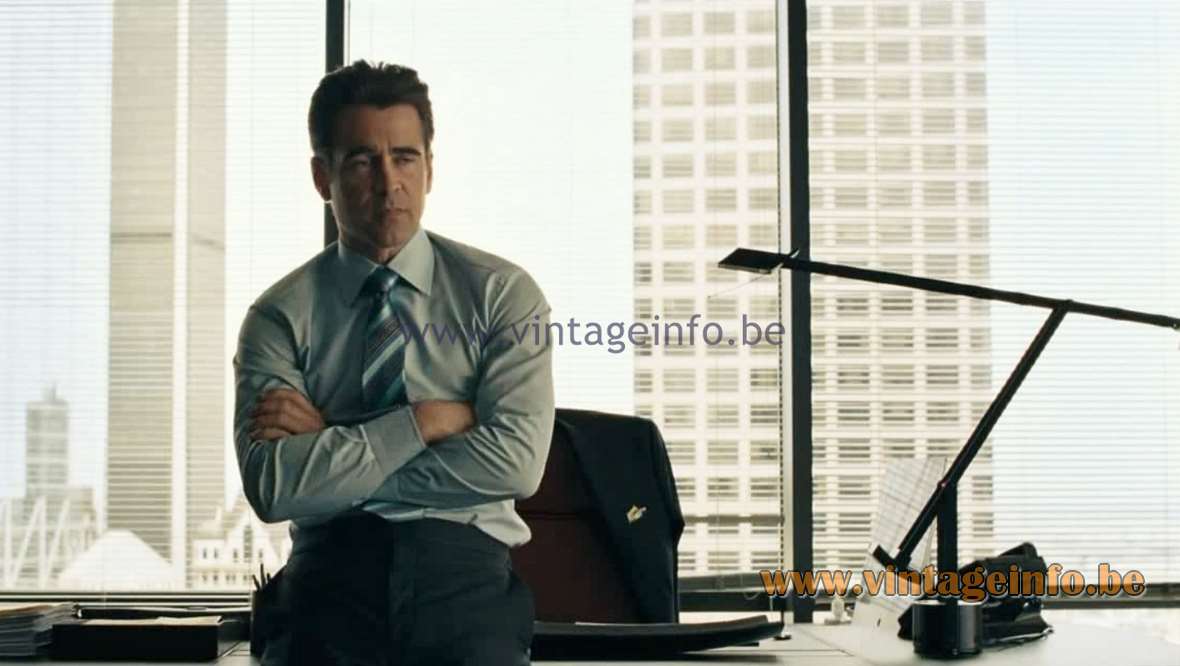
Nocturnal Animals (2016)
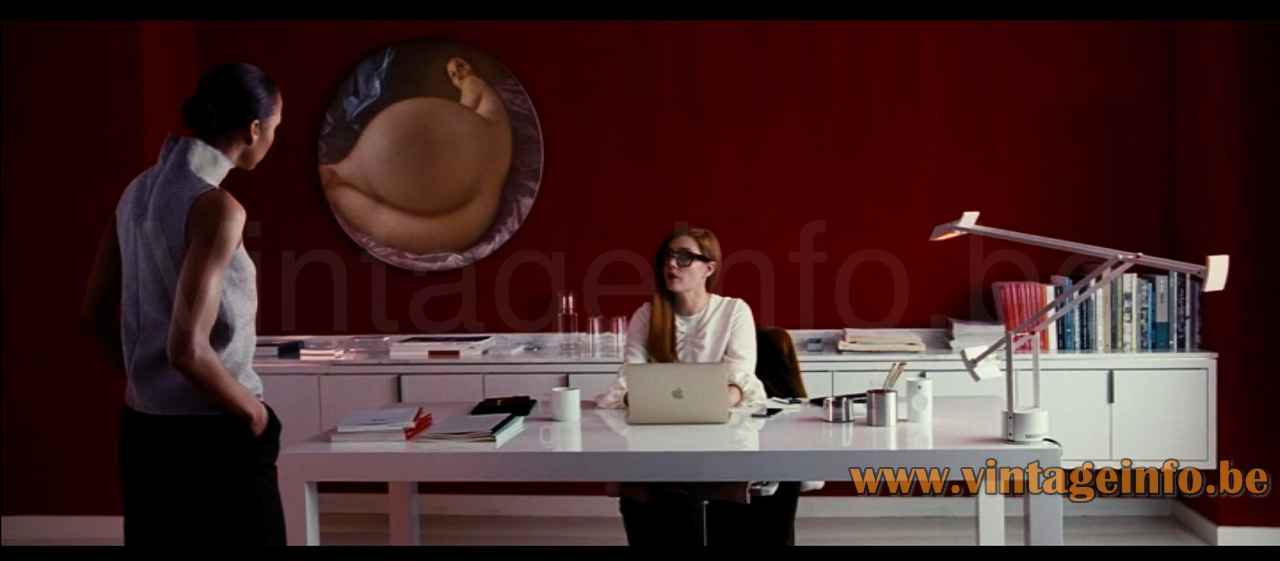
A white Artemide Tizio 50 desk lamp was used as a set decoration in the 2016 American neo-noir psychological thriller Nocturnal Animals. Starring Amy Adams, Jake Gyllenhaal and Michael Shannon.
Links (external links open in a new window)
Biography of Richard Sapper on his website
Wikipedia about Richard Sapper
Richard Sapper biography on the Artemide website
Tizio in V&A (Victoria and Albert Museum London)
Tizio in MoMA (Museum Of Modern Art New York)
James Bond Moonraker with Roger Moore – Wikipedia
Roman J. Israel, Esq. (2017) – Wikipedia
Roman J. Israel, Esq. (2017) – IMDb
Nocturnal Animals (2016) Film – Wikipedia
Nocturnal Animals (2016) Film – IMDb
Avant l’Hiver (2013) – Wikipedia
Le Professionnel (1981) – Wikipedia
Le Professionnel (1981) – IMDb
Vintageinfo
Many thanks to Marjan from Vintage Drachten for the pictures.
Many thanks to Artemide for the help.
Artemide Tizio 50 Desk Lamp
Materials: Round black ABS plastic base with a red built-in switch and a transformer inside. Black painted aluminium rods. Black painted counterweights. Parallelogram lampshade. Porcelain halogen socket.
Height: 108 cm / 42.51”
Width: 11 cm / 4.33”
Electricity: Halogen bulb 12 volt. Maximum 55 Watt, 110/220 Volt. Switch with two settings, high and low (6 and 12 volt).
Period: 1970s – Mid-Century Modern.
Designer: Richard Sapper (1932 – 2015).
Manufacturer: Artemide S.p.A., Pregnana Milanese, near Milan, Italy.
Other versions: The smaller version of the Tizio is the “Tizio 35“. The floor lamp version is named “Tizio Terra 50“. These lamps are still in production and all spare parts are for sale.
The Tizio was produced with or without a small handle on the lampshade, depending on the period in which it was made. The handle does not appear in catalogues. Lamps from the 1990s have it, but some early examples do as well. A version with a dimmer also exists.
This desk lamp was designed in 1971 and went into production in 1972. It can be found in the Artemide catalogue from 1973, available here on Vintageinfo, and also in the Artemide catalogue from 1976, over here.
The Tizio 50 can be positioned in any way the user desires. Its two counterweights always keep the lamp in balance. Electricity runs from the base through the metal arms to the light source, so no cord is visible, except for the one running from the base to the electrical socket. This was quite ground-breaking at the time the lamp was designed. It is absolutely not dangerous: the power is transformed in the base to very low voltage (12 volts).
The Tizio desk lamp received several awards:
Gold Medal, Triennale XV, 1974
Grand Prix, Triennale XV, 1974
Selection, Compasso d’Oro, 1979
Gold Medal, BIO 9, Ljubljana, 1981
Richard Sapper stated that he designed the Tizio desk lamp because he could not find a work lamp that suited him:
“I wanted a small head and long arms; I didn’t want to have to clamp the lamp to the desk because it’s awkward. And I wanted to be able to move it easily.”
Richard Sapper
Richard Sapper (30 May 1932 – 31 December 2015) was a German industrial designer who spent most of his career in Milan, where he became one of the key figures of post-war Italian industrial design. After pursuing courses in subjects such as philosophy, anatomy and engineering, he graduated with a business degree from the University of Munich.
Sapper began his career in the styling department at Mercedes-Benz in Stuttgart, but in 1958 he moved to Milan, initially working with Gio Ponti. From 1959 onwards he collaborated for many years with Italian designer Marco Zanuso, creating a series of influential products—especially for Brionvega—that helped define the look of modern consumer electronics in the 1960s.
He is widely regarded as one of the most important designers of his generation. His work typically combines technical innovation, clarity and simplicity of form, and a characteristic touch of wit and surprise. Among his best-known designs are this Artemide Tizio desk lamp, celebrated for its engineering elegance, and the Alessi 9091 kettle (1983), famous for its distinctive whistle.
Over the course of his career, Sapper received numerous international awards, including multiple Compasso d’Oro prizes, and his designs entered the permanent collections of major museums worldwide, including The Museum of Modern Art (MoMA) in New York and the Victoria and Albert Museum (V&A) in London.
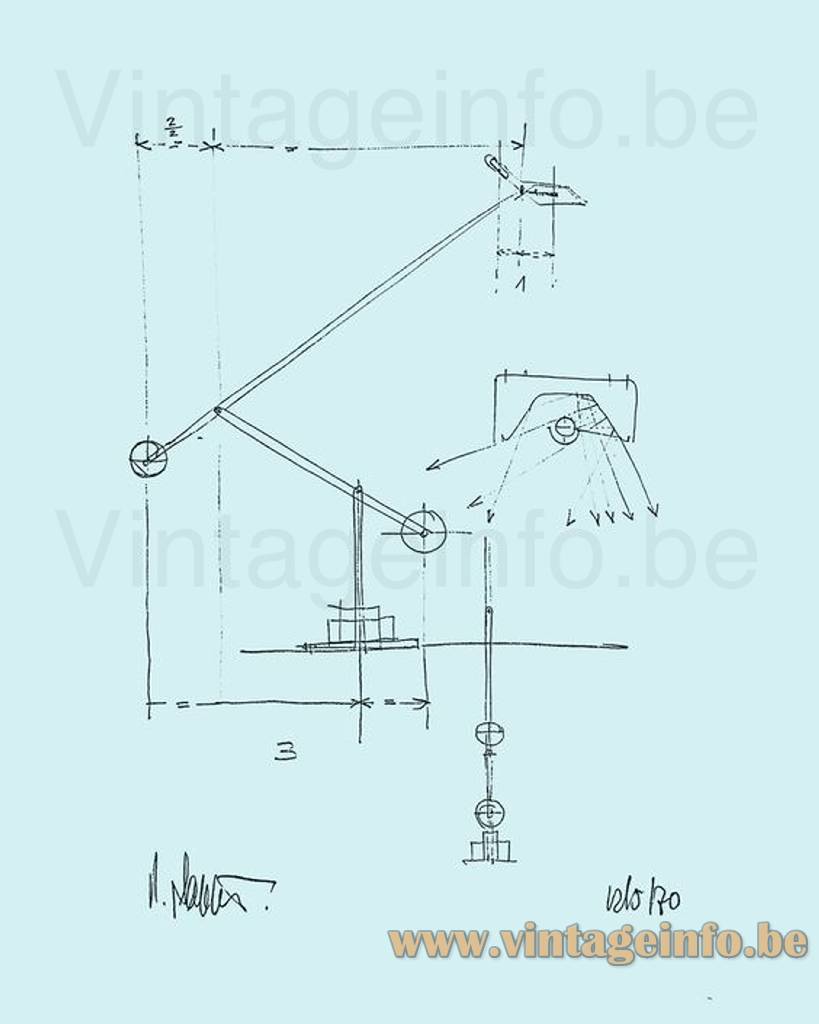
Artemide Tizio 50 Desk Lamp – Scheme
Artemide Tizio 50 Desk Lamp – Origin
The idea for the Tizio was born in 1970, during a conversation between Ernesto Gismondi (Artemide’s founder) and Richard Sapper. They were both keen sailors, and their talk quickly turned to a very practical problem: the classic desk lamp simply did not behave the way a true work light should. Sapper wanted a lamp that would stay perfectly balanced, would not slowly “sag” as joints loosened over time, and could be moved and aimed with ease—always keeping the beam exactly where it was needed, over the working area and the user’s hand.
From the start, the goal was not to design another decorative object, but to rethink the mechanics of task lighting: a compact head, long arms, stability in every position, and a clean structure without visual clutter. The result became Tizio—an engineered solution that looked effortless, yet was radically new for its time.
Even the name came directly from Gismondi: “Tizio”—the Italian equivalent of “some guy / Tom, Dick and Harry”—chosen to suggest a lamp meant for everyone, and with the hope that it might later grow into a whole family of related designs.
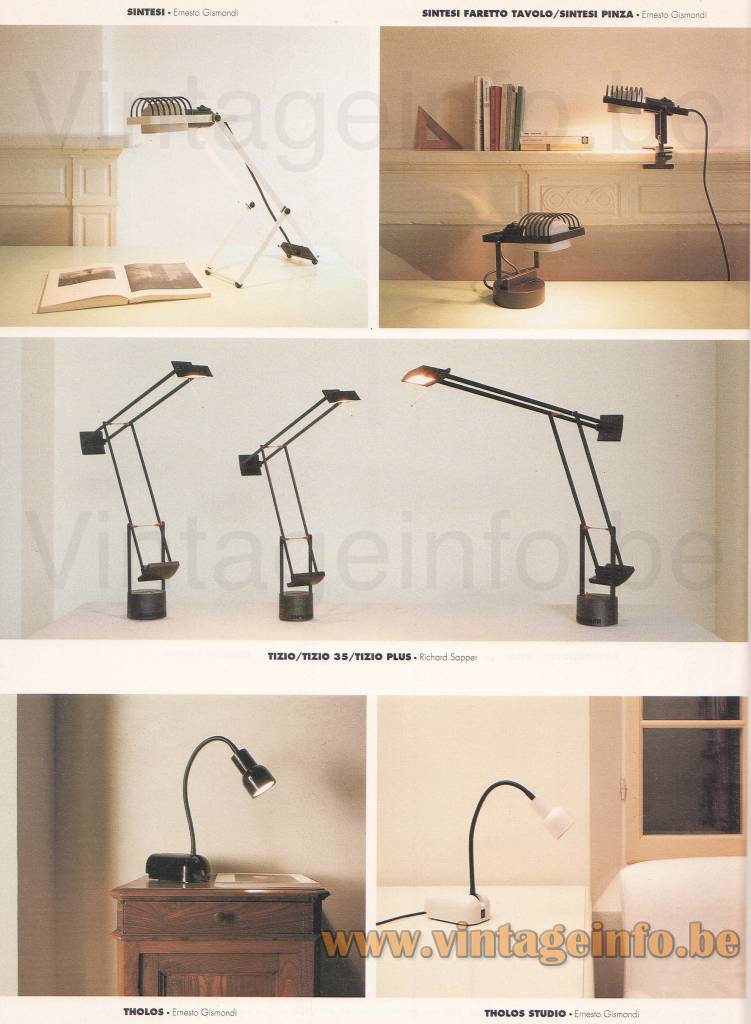
Artemide Tizio 50 Desk Lamp – 1992 Catalogue Picture
Several models of the Tizio in this catalogue picture together with lamp models Sintesi and Tholos, both designed by Ernesto Gismondi.
Artemide
In 1960, near Milan, Ernesto Gismondi and Sergio Mazza laid the foundation of Artemide. Right from the start, the company combined technological research with a strong sense of Italian design. Their very first iconic lamp was the Alfa — hence the name — designed around 1959–1960. Emma Schweinberger, Gismondo’s wife, designed the Chi table lamp in 1962. From there, Artemide quickly began collaborating with leading designers. The mid-1960s saw the company make waves with Vico Magistretti’s Eclisse, awarded in 1967, as well as Enzo Mari’s early contributions such as the Polluce floor lamp, designed together with Anna Fasolis in 1965. The Dalù table lamp (1966 – Vico Magistretti) and the Nesso (1965), designed by Giancarlo Mattioli & Gruppo Architetti Urbanisti Città Nuova, further established Artemide’s reputation during this formative decade. Other notable designs from the late 1960s include the Lesbo table lamp, a 1967 design by Angelo Mangiarotti, Vico Magistretti’s Telegono (1968), the Pallade pendant by Studio Tetrarch, the Electra table lamp, designed by Giuliana Gramigna in 1968, all reflecting the experimental spirit of the era.
As the 1970s arrived, Artemide introduced what would become one of its most recognisable icons: the Tizio desk lamp, designed by Richard Sapper in 1972. Around the same period, Gae Aulenti designed the Pileino and Mezzopileo lamps, followed by Mezzoracolo in 1973. The famous Sintesi lamp series was designed by Ernesto Gismondi in 1975 and the Area 50 lamp series, a Mario Bellini design from 1975. The decade also saw the introduction of the Onfale lamp in 1978, designed by Luciano Vistosi, marking Artemide’s growing interest in glass and sculptural forms.
The 1980s marked a phase of international expansion. By 1980, Artemide had established a presence in the United States and continued to attract prominent designers, including Ettore Sottsass. His Callimaco floor lamp and Pausania table lamp, both designed during the 1980s, became distinctive statements within Artemide’s catalogue. Other important designs from this decade include the Polifemo floor lamp by Carlo Forcolini (1983). In 1987, Artemide launched the Tolomeo, designed by Michele De Lucchi and Giancarlo Fassina, which quickly became an icon of functional and timeless design.
During the 1990s, Artemide further expanded its scope by acquiring VeArt, bringing Murano glass expertise into the company. In 1996, Artemide introduced its “The Human Light” philosophy, focusing on the relationship between light, people and their environment. By the late 1990s, Artemide Architectural was established, bridging product design and large-scale architectural lighting projects. From the 2000s onward, Artemide increasingly focused on LED innovation while reissuing its historic designs within the “Modern Classic” collection.
In essence, Artemide represents a rich tapestry of Italian lighting history. Whether defined by the minimalist engineering of the Tizio, the organic curves of the Nesso, or the expressive presence of the Callimaco, Artemide has consistently blended design innovation with a deeply human approach to light. It is precisely this balance that makes these lamps — including the Pausania and many others — enduring icons of modern design.
Designers that collaborated with Artemide include, among others, Vico Magistretti, Emma Schweinberger, Gae Aulenti, Richard Sapper, Michele De Lucchi, Giancarlo Fassina, Ettore Sottsass, Enzo Mari, Gio Ponti, Sergio Mazza, Angelo Mangiarotti, Joe Colombo, Sergio Asti, Sergio Favre, Mario Marenco, Adelaide Bonati, Silvio Bonatti, Enrico De Munari, Carla Federspiel, Livio Castiglioni, Piero Castiglioni, Nanda Vigo, Luigi Caccia Dominioni, Mario Botta, Carlo Forcolini, Luciano Vistosi, Neri&Hu, Carlotta de Bevilacqua, Jean Nouvel, Karim Rashid, Neil Poulton, Studio Tetrarch, Zaha Hadid, Ron Arad, Herzog & de Meuron, Issey Miyake, Naoto Fukasawa, Aldo Rossi, Adrien Gardère, Stephen Philips, Carlo Colombo and Giulia Foscari.
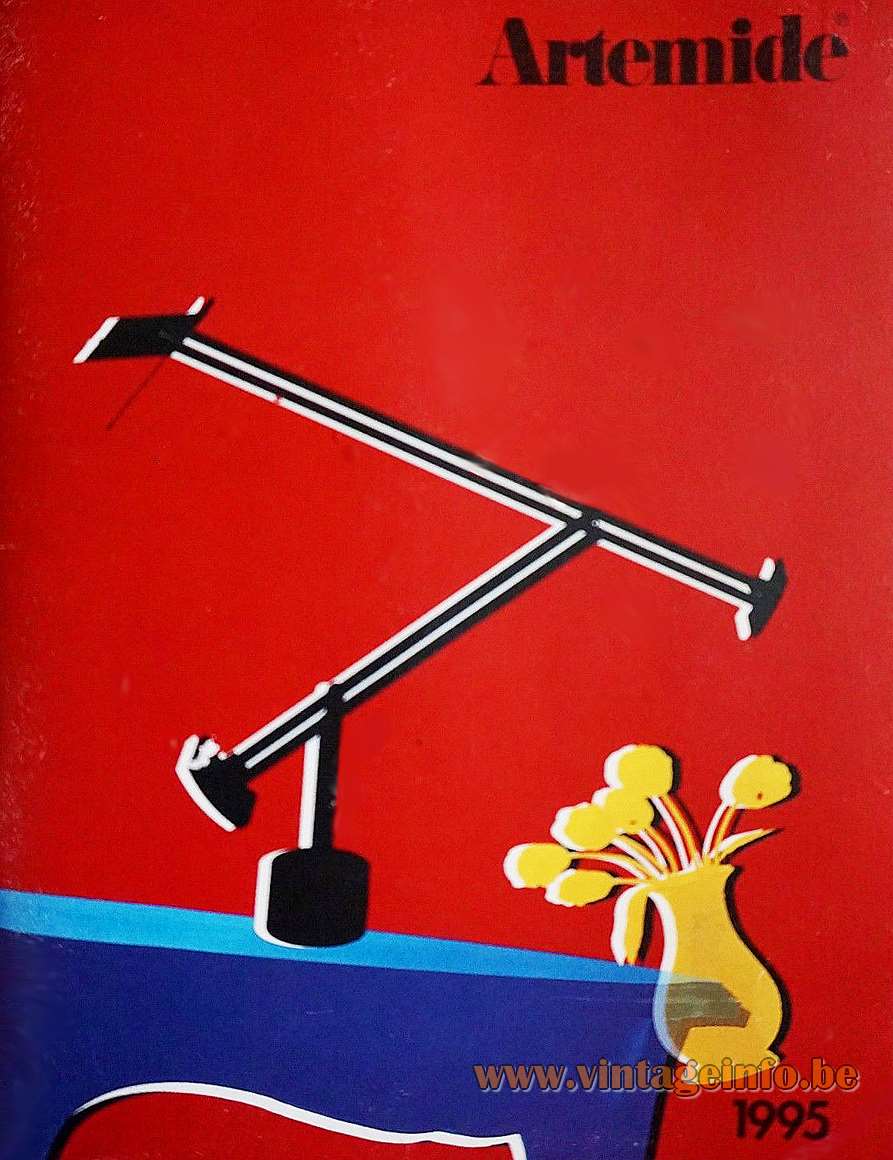
Artemide Tizio 50 Desk Lamp – 1995 Publicity
1995 Publicity with the small handle on the lampshade.
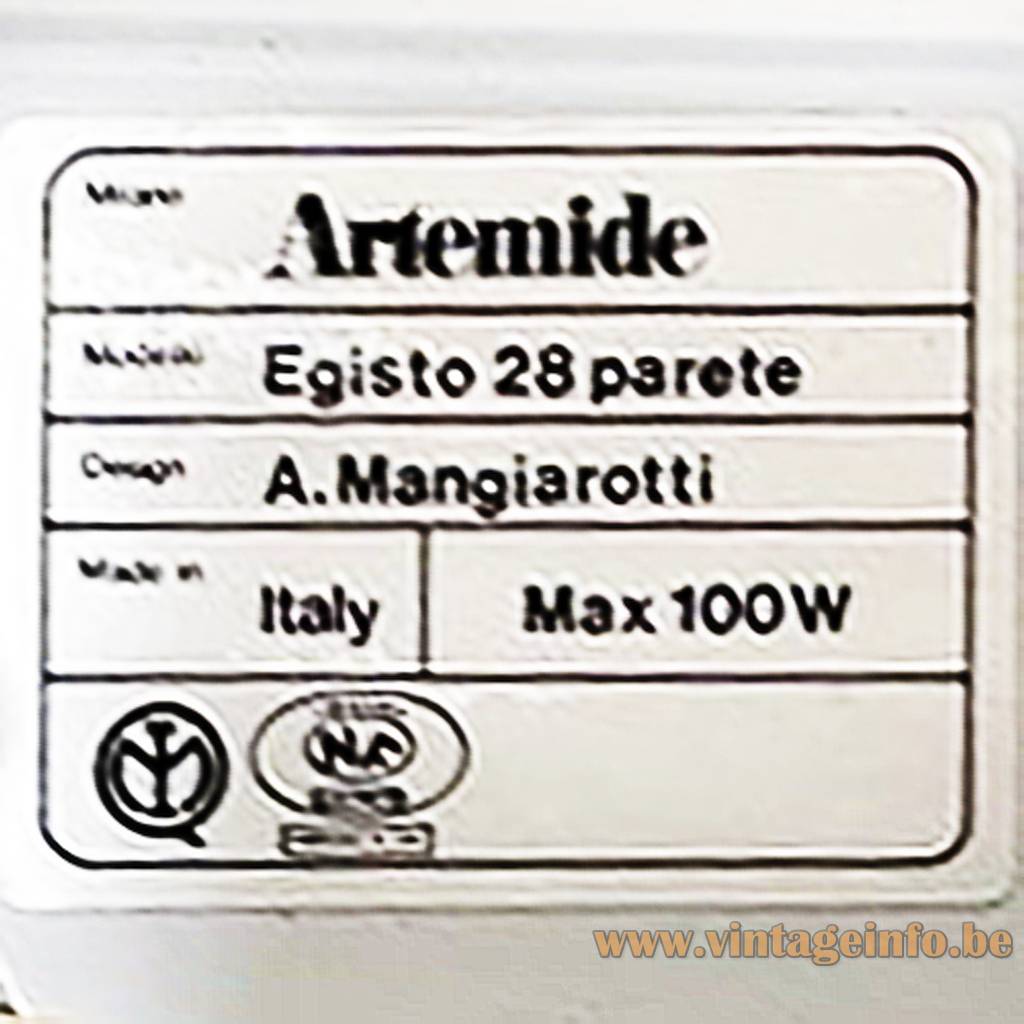
Artemide Tizio 50 Desk Lamp – Company Labels & Logos