- Categories
- Categories
Last 5 Viewed
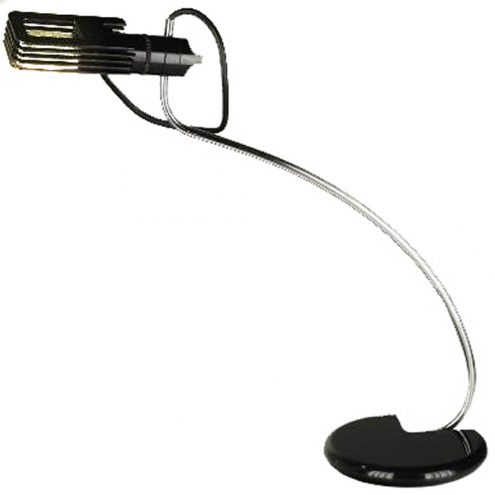
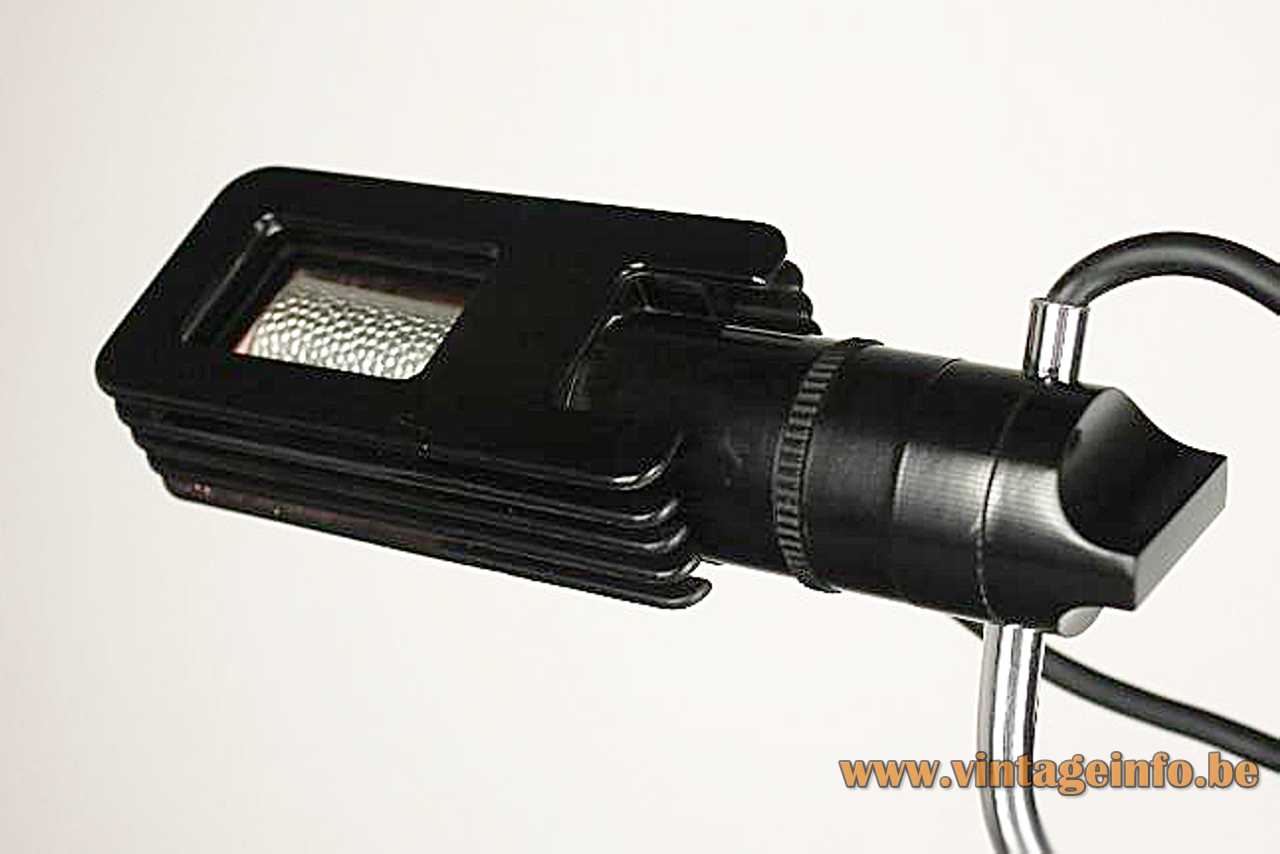
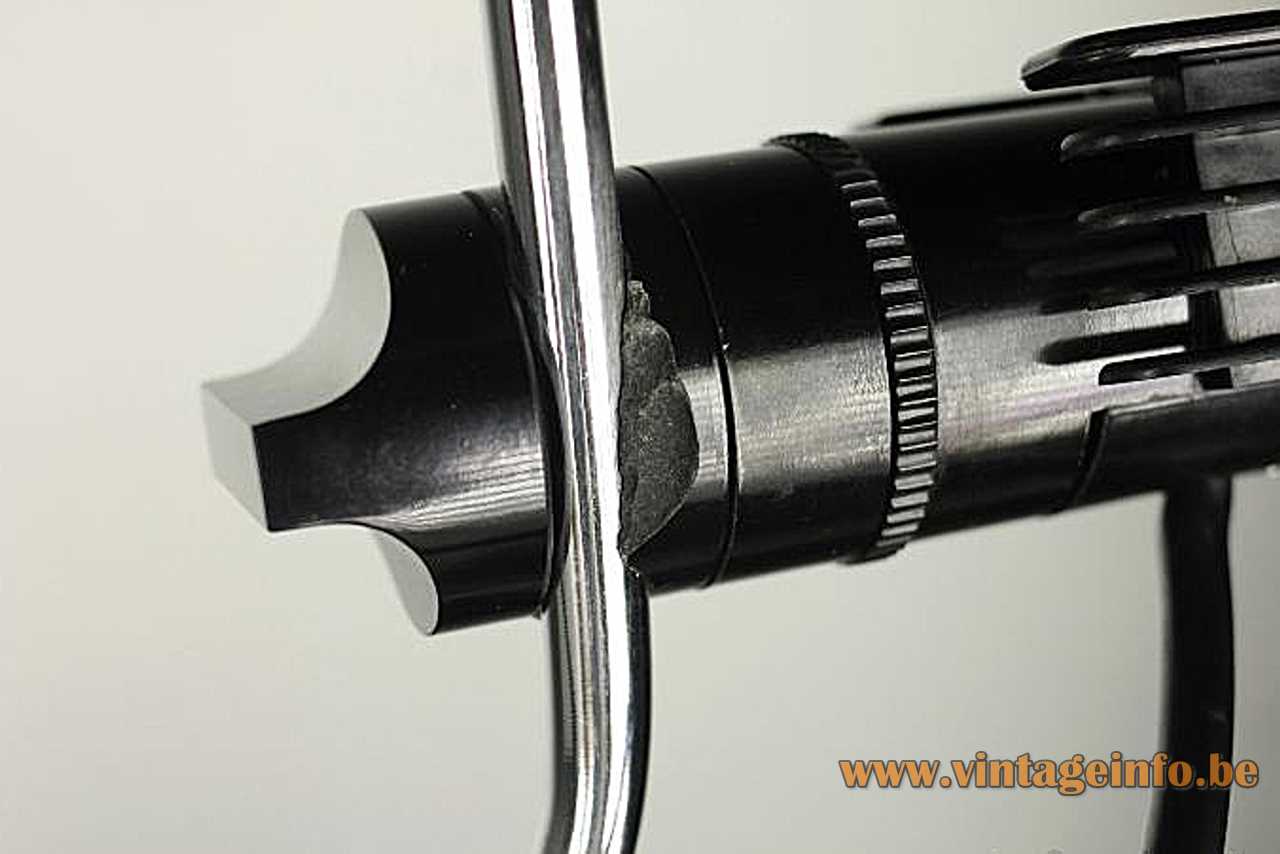

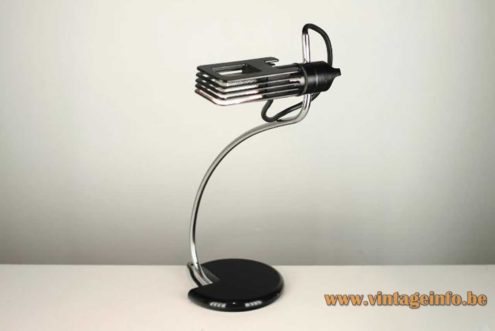

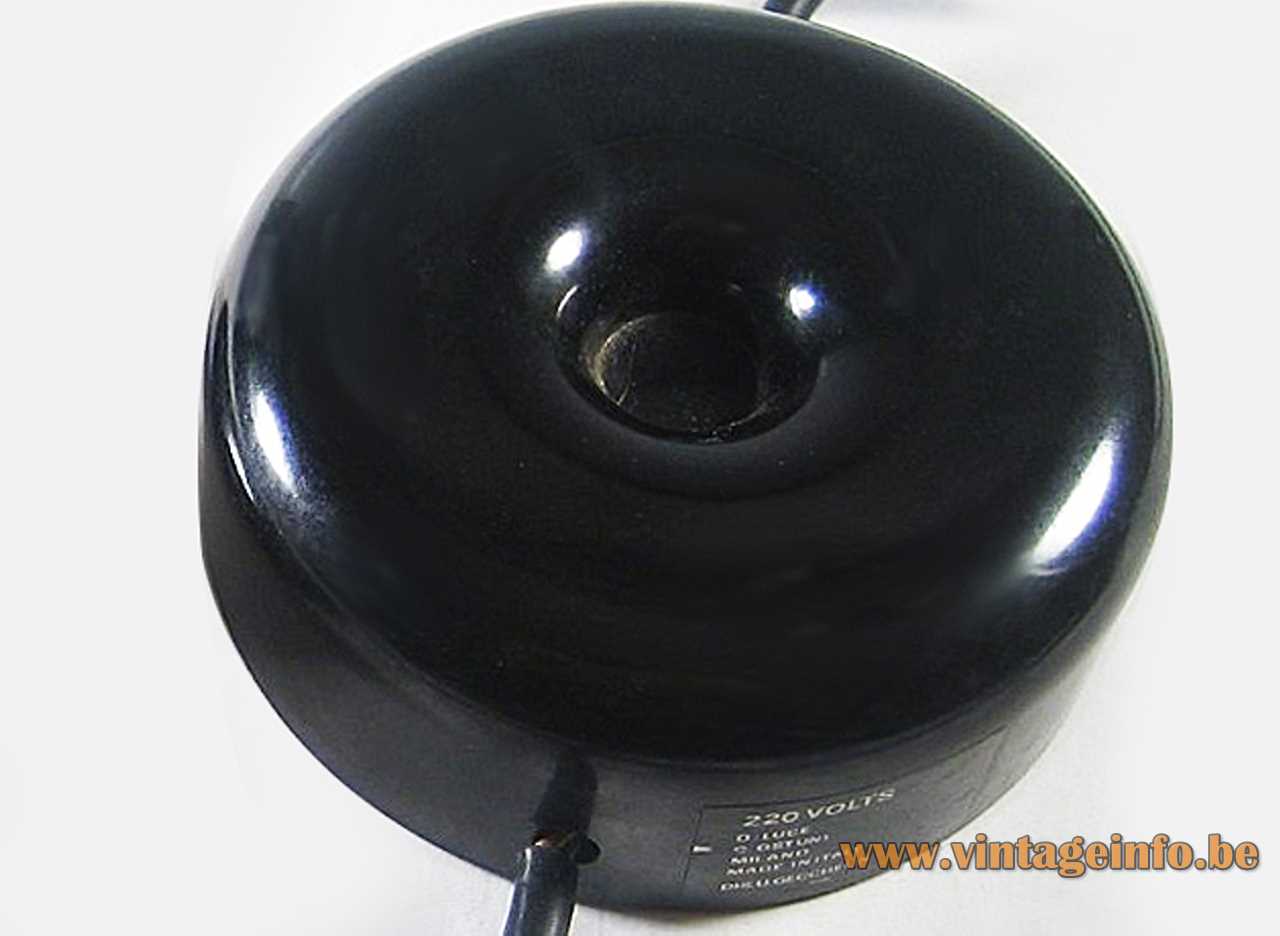
Bruno Gecchelin Wing Desk Lamp -1978 Catalogue Picture
Wing 509
Table lamp giving direct light with controlled light intensity, black lacquered steel base, chromium-plated curved arm,
adjustable reflector in thermosetting material. Dimensions: base diameter cm 18, height cm 45, width cm 55. Bulb: 1 x 50W/12V (Gz 6.35) halogen.
Wing 627
Floor lamp giving direct light with controlled light intensity, black lacquered steel base, chromium-plated curved arm, adjustable reflector in thermosetting material. Dimensions: base diameter cm 26, height cm 135, width cm 65. Bulb: 1 x 50W/12V (Gz 6.35) halogen.
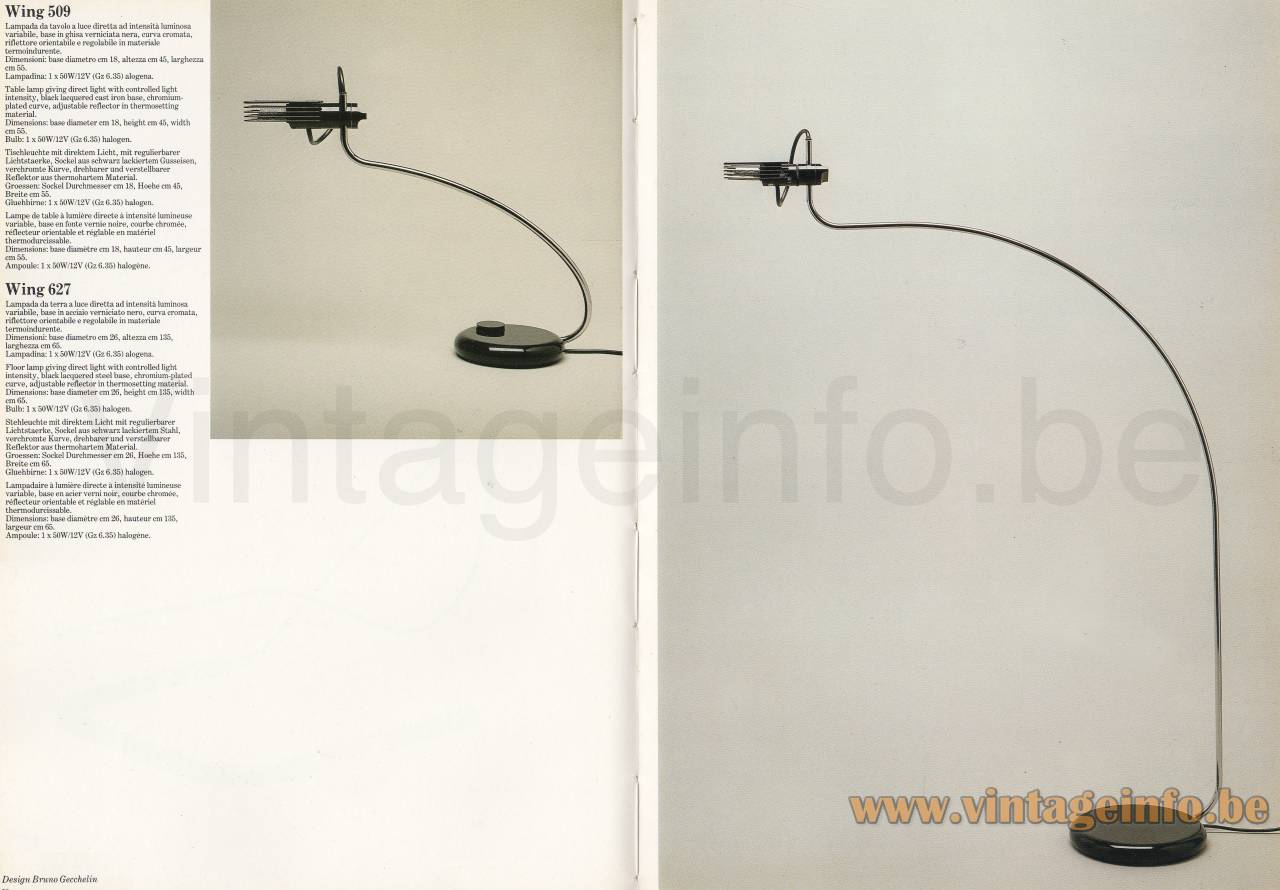
Bruno Gecchelin Wing Desk Lamp -1978 Catalogue Picture
Wing 511
Clamp table lamp giving direct light with controlled light intensity, revolving and height adjustable chromium-plated arm, black lacquered metal clamp, adjustable reflector in thermosetting material. Dimensions: height cm 100, clamp projection arc cm 60. Bulb: 1 x 50W/12V (Gz 6.35) halogen.
Museum “Die Neue Sammlung”, Munich 1983
Wing 762
Wall lamp giving direct light with controlled light intensity, revolving and height adjustable chromium-plated arm, black lacquered aluminium wall fixing, adjustable reflector in thermosetting material. Dimensions: height cm 100, wall projection arc cm 60. Bulb: 1 x 50W/12V (Gz 6.35) halogen.
Wing 628
Floor lamp giving direct light with controlled light intensity, black lacquered metal base, chromium-plated stem, height adjustable reflector in thermosetting material. Dimensions: base diameter cm 21, height cm 200. Bulb: 1 x 50W/12V (Gz 6.35) halogen.
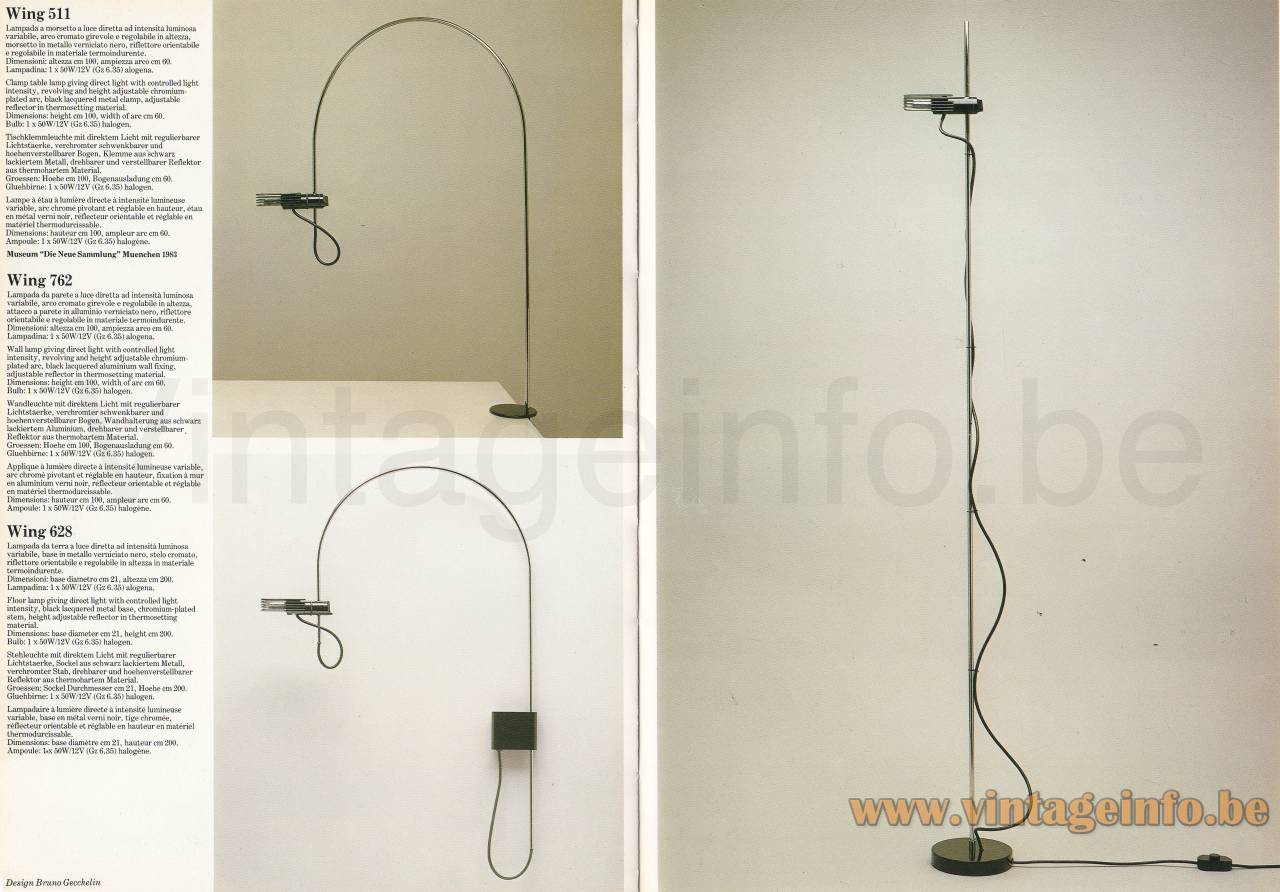
Many thanks to Lluís fromEclectique Vintage for the photos.
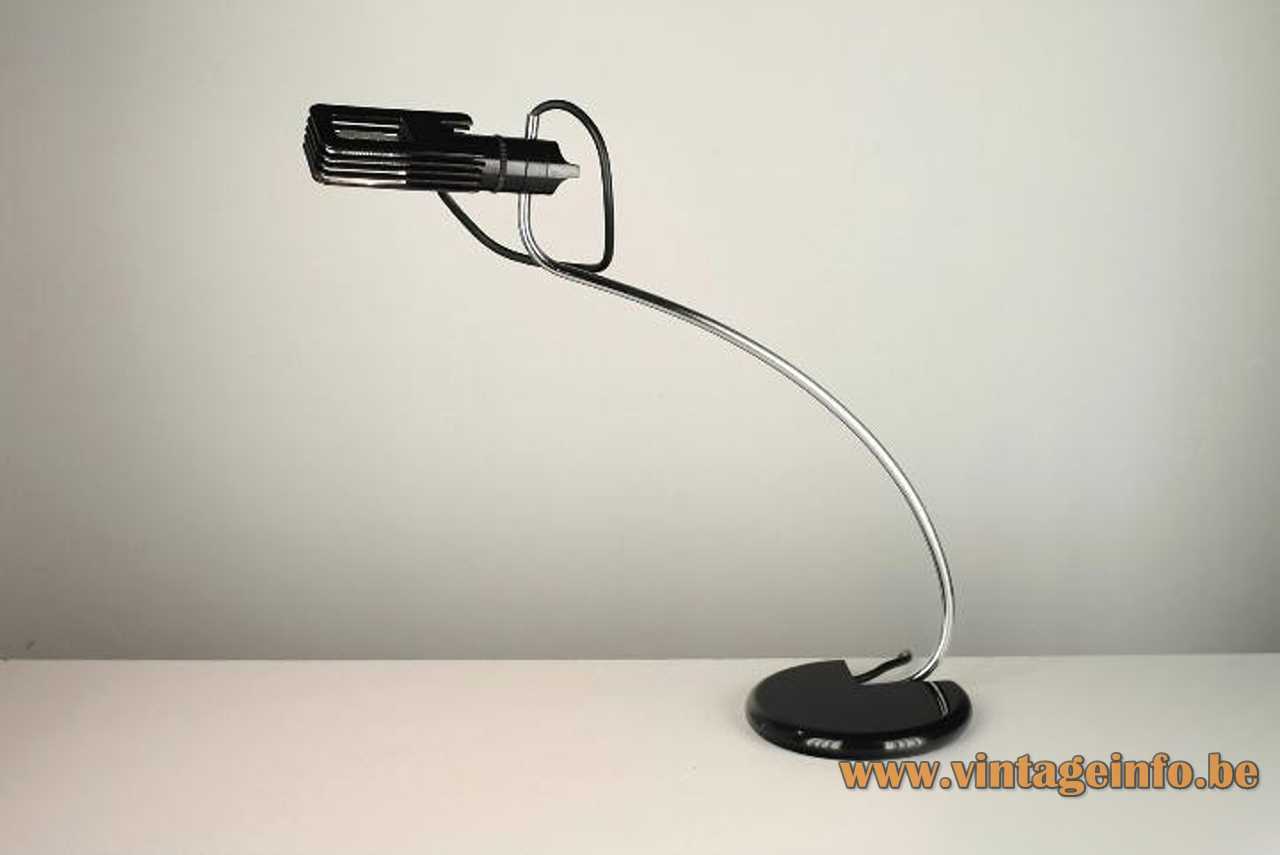
Bruno Gecchelin Wing Desk Lamp
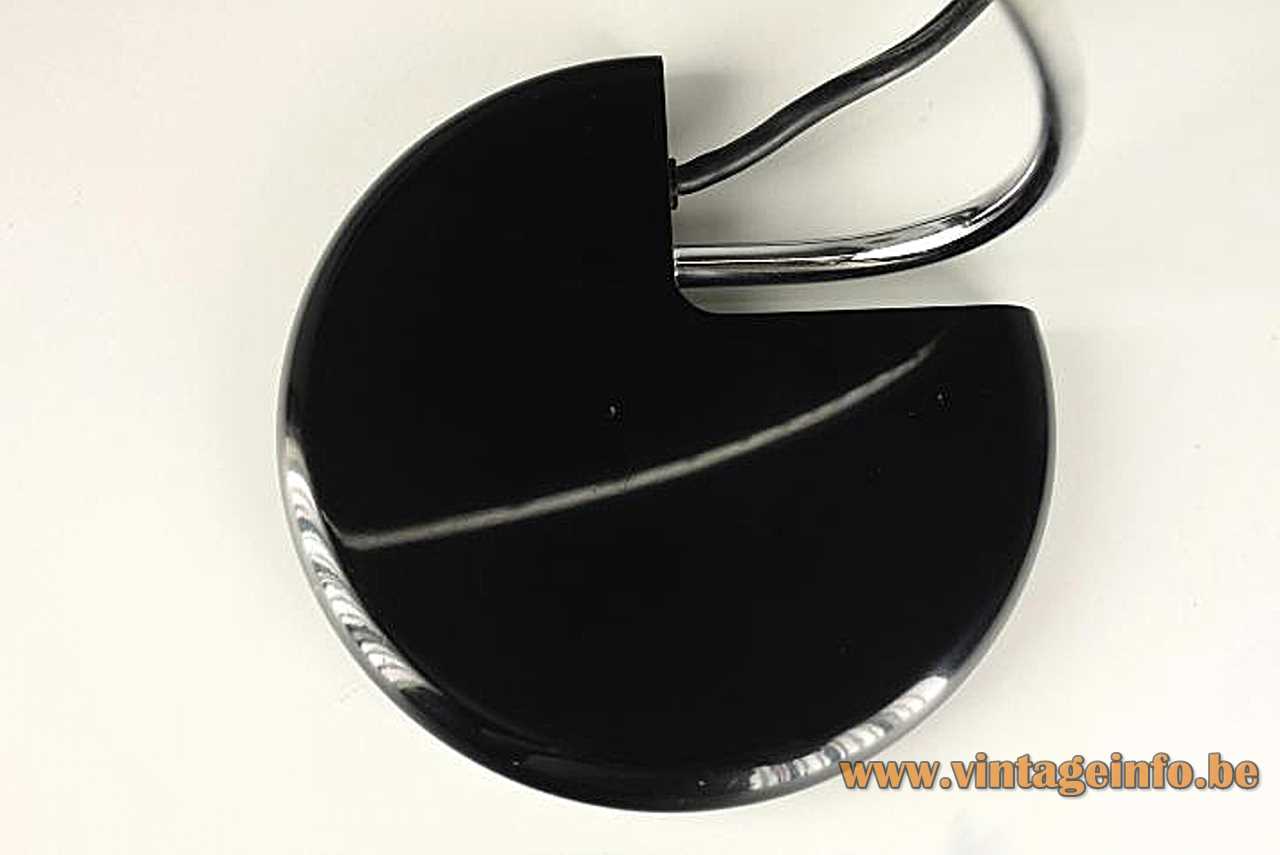
Materials: Round black painted metal base with a noch. Adjustable curved chrome rod. Black ribbed elongated Bakelite lampshade with plastic parts. Embossed aluminium reflector. Round black plastic box with a transformer. Porcelain socket.
Height: 40 cm / 15.74”
Lampshade: 17 cm / 6.69”
Width: 50 cm / 19.68”
Base: ∅ 17,5 cm / 6.88”
Electricity: 1 halogen bulb G4, 1 x 60 watt maximum,12 volt, 220 volt.
Any type of halogen bulb can be used, not a specific one preferred.
Period: 1970s – Mid-Century Modern.
Designer: Bruno Gecchelin in 1973.
Manufacturer: Oluce, Via Brescia, 2, 20097, San Donato Milan, Italy.
Other versions: This Bruno Gecchelin Wing desk lamp is model 509. The design was produced in several variants, including a wall lamp, a floor lamp and an arc floor lamp.
Various other lamps with a similar appearance exist and are therefore often confused with one another. Authentic Oluce lamps are always labelled, which remains the most reliable way to confirm attribution.
Bruno Gecchelin
Bruno Gecchelin was born in 1939 in Milan, Italy. He studied architecture at the Politecnico di Milano,
where he developed a strong interest in industrial design and the relationship between technology, function and form.
In 1962, Gecchelin began his professional career at Olivetti, working under Ettore Sottsass. This early experience placed him at the heart of Italy’s most progressive design culture, where experimentation with new technologies and production methods played a central role.
From the late 1960s onwards, Gecchelin worked across a wide range of disciplines, including office and electronic equipment, furniture, accessories, decorative objects and lighting. In 1968 he started designing lighting for Oluce, for whom he created several important models such as the Domea, Perla, Arianna, Dogale and the influential Wing series.
In 1976, Bruno Gecchelin opened his own studio, specialising in product and industrial design. His work is characterised by a rational, technical approach, often combining minimal forms with advanced materials and precise mechanical solutions.
Gecchelin received several major design awards during his career, including the Lampada d’Oro in 1980 and multiple Compasso d’Oro awards (1989 and 1991), confirming his importance within Italian industrial design. Over the years, he collaborated with numerous Italian and international companies, including Antonangeli, Arteluce, Busnelli, Fratelli Guzzini, Harvey Guzzini, iGuzzini, Frau, Fiat, Indesit, Magneti Marelli, Reggiani, Riello, Skipper, Venini, Ycami and others.
Oluce – O-Luce
The Italian lighting company Oluce was founded in 1945 by Giuseppe Ostuni. It is widely regarded as the oldest Italian design company in the lighting sector still in operation today. From the very beginning, Oluce positioned itself at the intersection of industrial innovation, architectural thinking and high-quality craftsmanship.
During the post-war years, Oluce played a key role in shaping modern Italian lighting design. The company became known for its willingness to experiment with new materials, advanced production techniques and progressive forms, often anticipating broader developments in modern and contemporary design.
One of the defining moments in the history of Oluce was its long-standing collaboration with Joe Colombo, whose radical and futuristic designs perfectly matched the company’s experimental spirit. Iconic models such as the Spider lamp (1965), which won the Compasso d’Oro in 1967, and the Coupé lamp (1967), later designed by Joe Colombo and refined by Alberto Meda, became international design classics and remain in production to this day.
Another crucial figure in Oluce’s history is Vico Magistretti, whose work for the company resulted in some of its most enduring and recognisable designs. Lamps such as the Atollo (1977), awarded the Compasso d’Oro in 1979, have become timeless icons of Italian design and are today part of the permanent collections of major international museums.
Over the decades, Oluce collaborated with an impressive roster of renowned designers and architects. Among them are Angelo Ostuni, Achille, Livio and Pier Giacomo Castiglioni, Franco Buzzi, Joe and Gianni Colombo, Marco Zanuso, Tito Agnoli, Angeletti & Ruzza, Antonia Astori & Nicola De Ponti, Bruno Gecchelin, Stefano Casciani, Francesco Rota, Victor Vasilev, Ferdi Giardini and many others.
Oluce has received numerous international design awards over the years, including several Compasso d’Oro awards, confirming its central role in the history of Italian and international lighting design.
Throughout its history, Oluce has consistently balanced innovation with continuity, maintaining a strong connection to its design heritage while continuing to work with contemporary designers. This approach has ensured the lasting relevance of the brand within the international design landscape.
For a complete overview of the company’s current collections and official history, see the Oluce website.
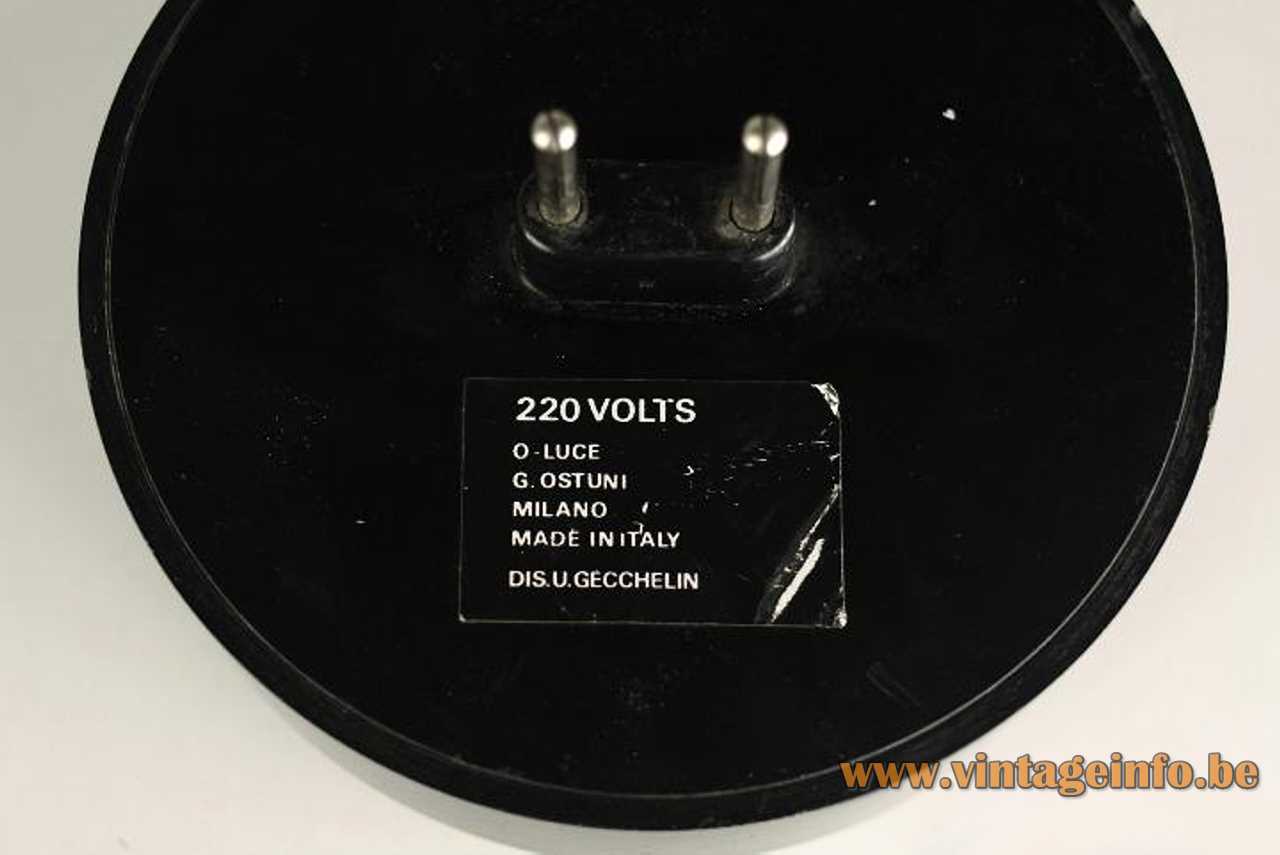
Bruno Gecchelin Wing Desk Lamp – Company Labels & Logos