- Categories
- Categories
Last 5 Viewed
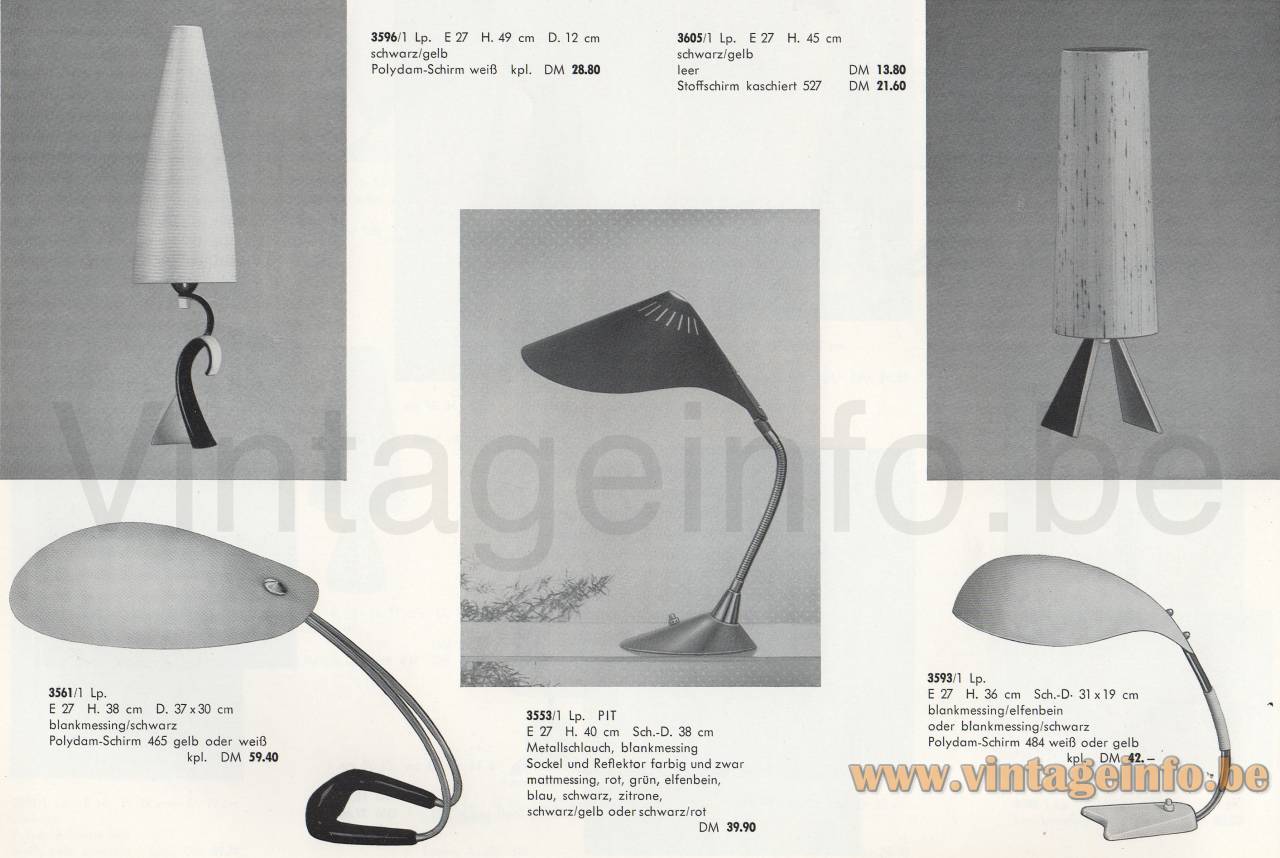
1950s Cobra Desk Lamp – Dame & Co Catalogue Picture
The Cobra desk lamp is shown in the centre. The other table lamps on this page are models 3596, 3605, and 3593. Model 3553, shown at the bottom left, is frequently attributed online to Carl Auböck, which is clearly incorrect. This lamp features the characteristic fibreglass shade made from patented Polydam, developed by Dame & Co. The Cobra was priced at DM 39.90 (German Marks), roughly equivalent to about €20 at the time.
1950s Cobra Desk Lamp – Electric Parts
BJB
The lamp holder (socket) of this desk lamp was manufactured by BJB. BJB stands for Brökelmann, Jäger & Busse (BJB GmbH & Co. KG). The company was founded in 1867 and originally produced petroleum lighting. BJB is still active today and manufactures LED lighting components, terminal blocks and connectors, lamp holders for conventional lighting, and switches. The company operates worldwide. BJB GmbH & Co. KG is based at Werler Strasse 1, 59755 Arnsberg, Germany.
VLM Components
The switch was manufactured by VLM Components. VLM Components was founded in 1945 in Buccinasco, a small town near Milan, Italy. The company is part of the Relco Group, which was established in 1967. Today, the group owns the brands Relco, Leuci, Relco Lighting, VLM Components, and Segno.
VLM Components is particularly well known for its switches designed by Achille Castiglioni in 1968.
1950s Cobra Desk Lamp – S.A. Boulanger Catalogue picture
Early 1960s S.A. Boulanger catalogue picture model 4324 in polished brass.
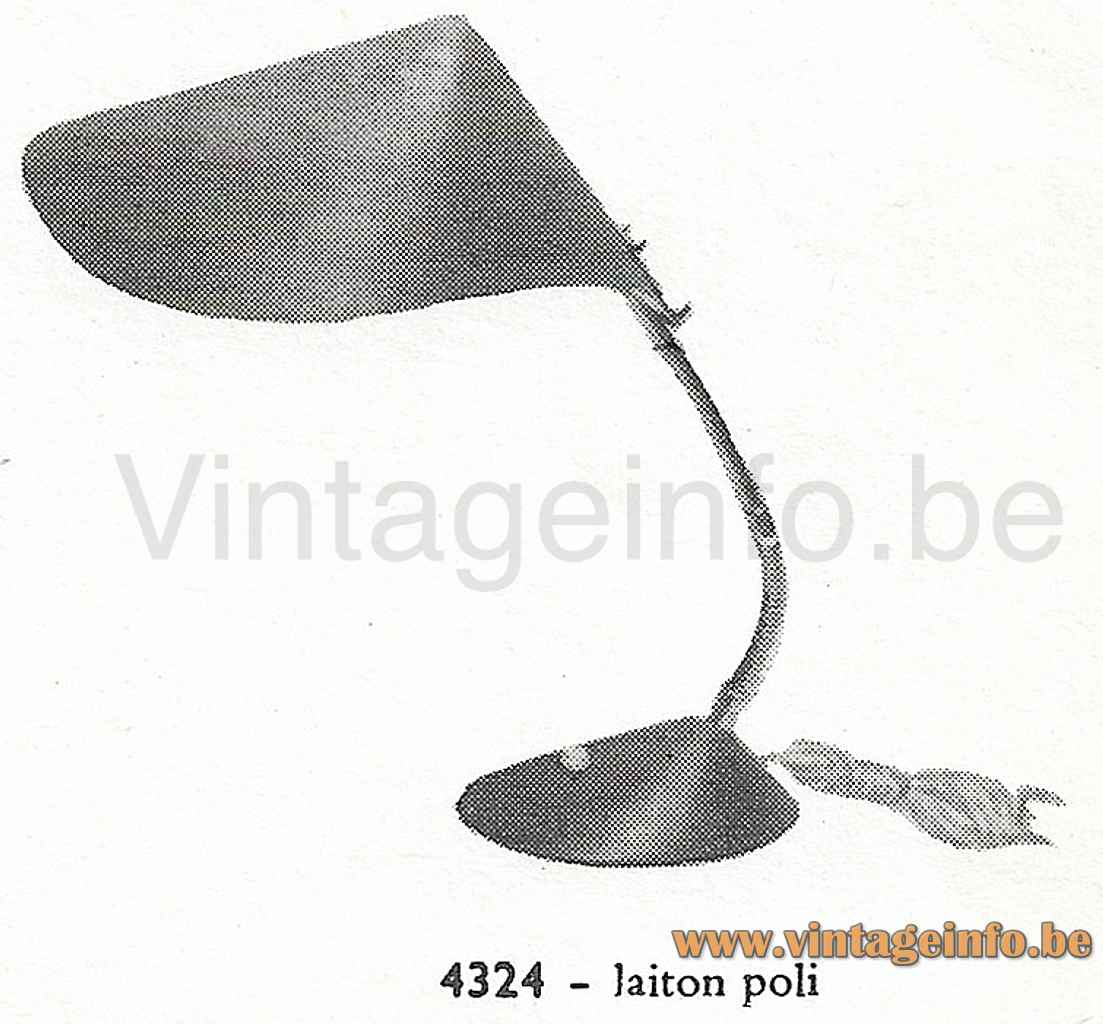
1950s Cobra Desk Lamp – S.A. Boulanger Version, Model 4324
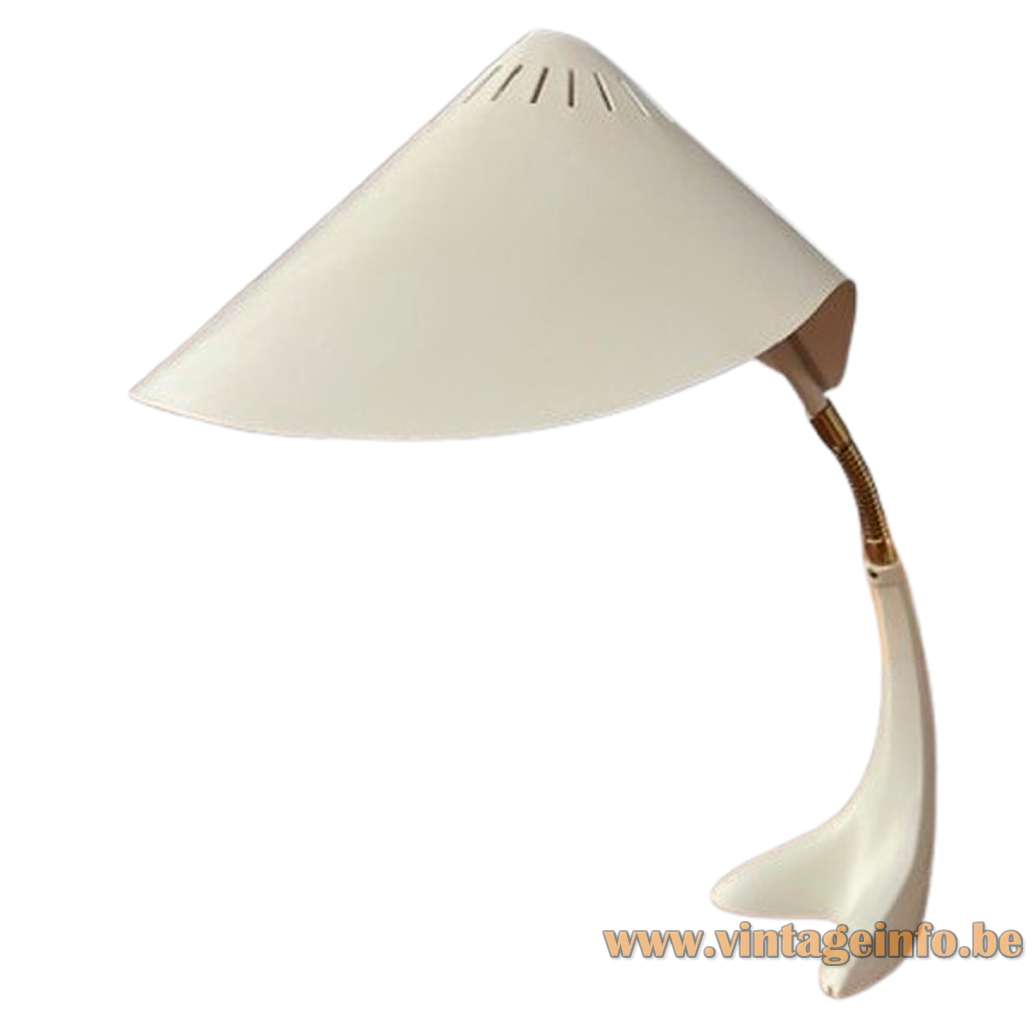
1950s Cobra Desk Lamp – Different Lamp Base Crowfoot Style
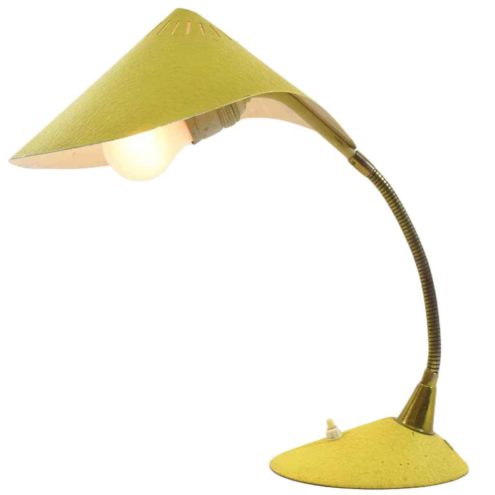
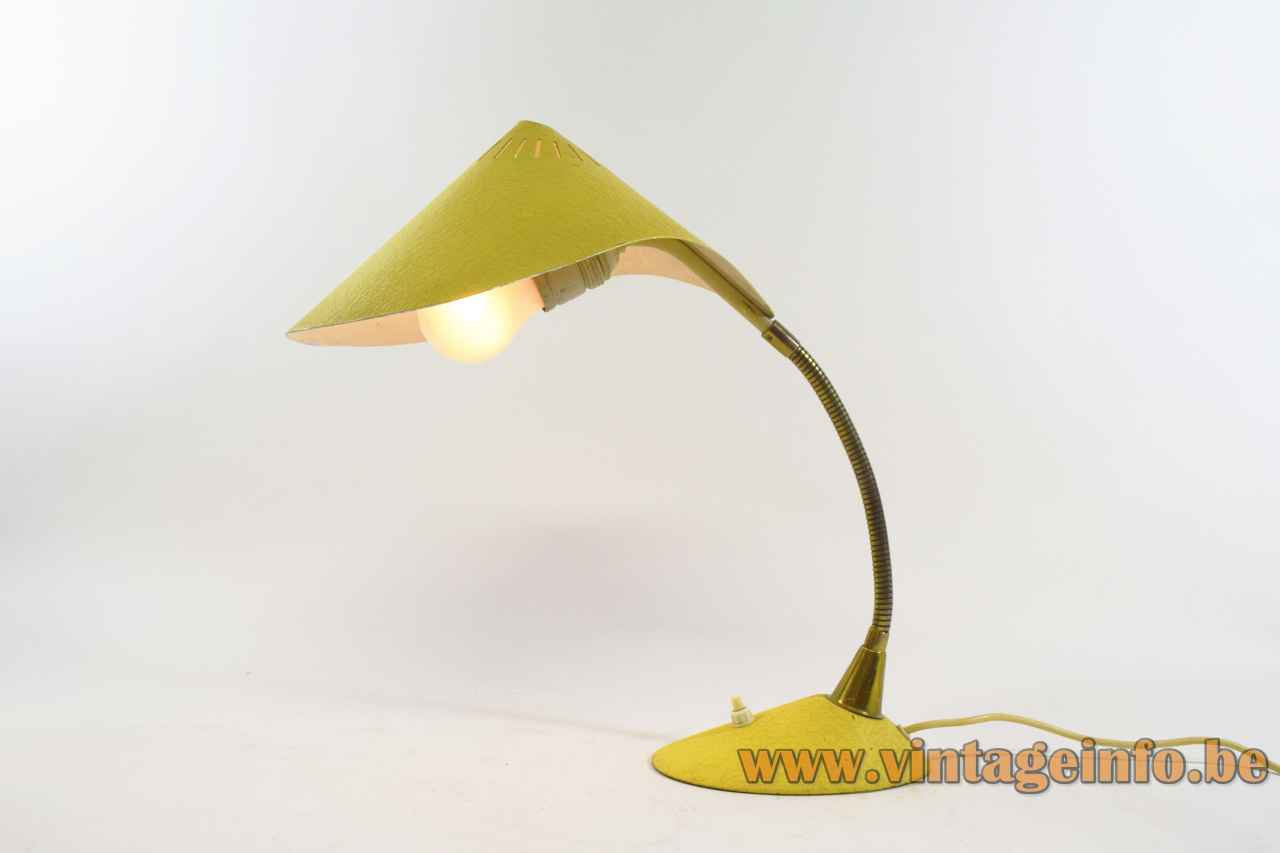
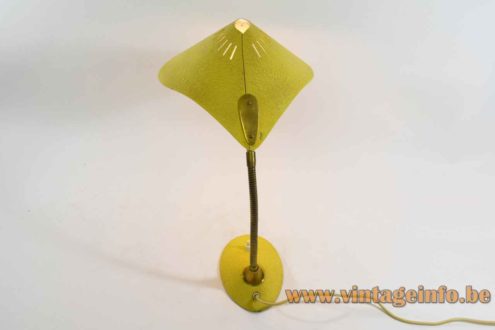
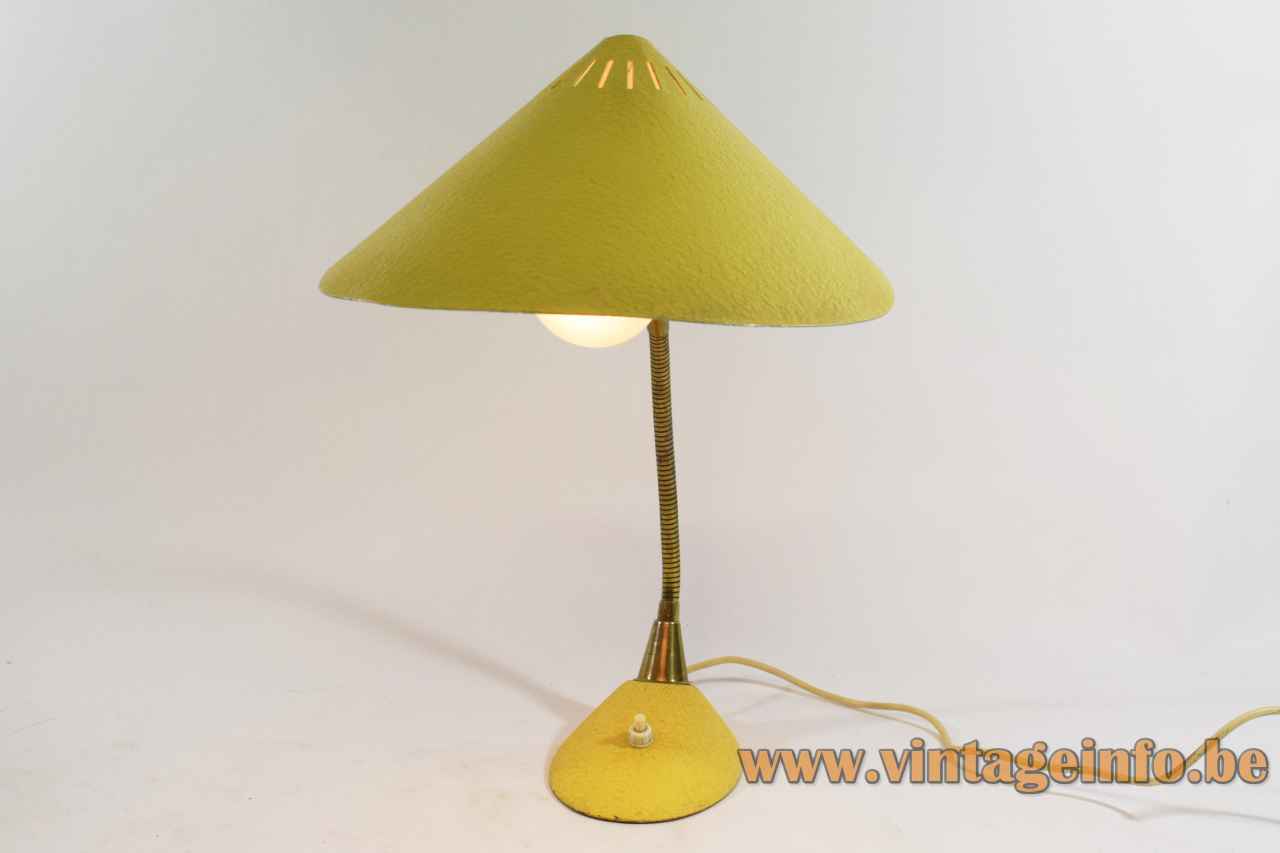
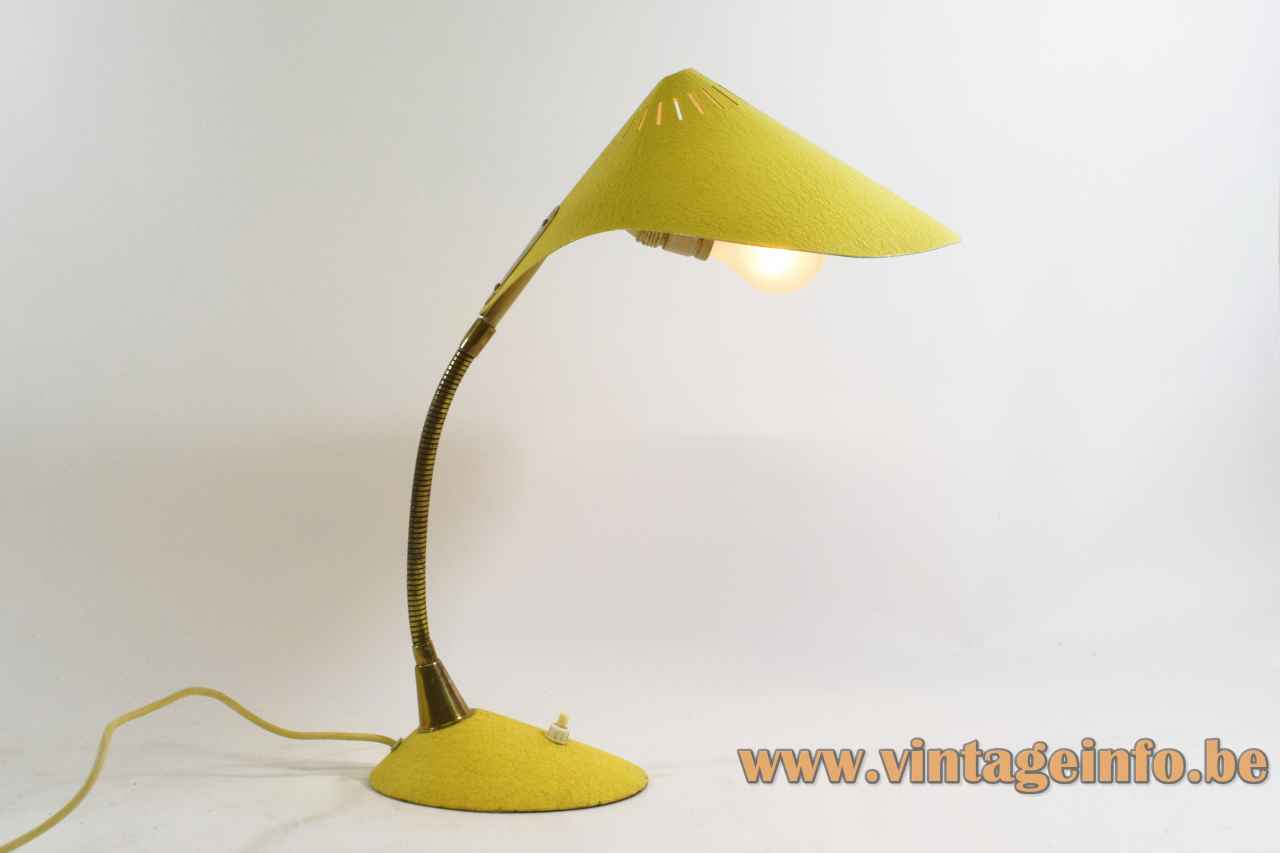
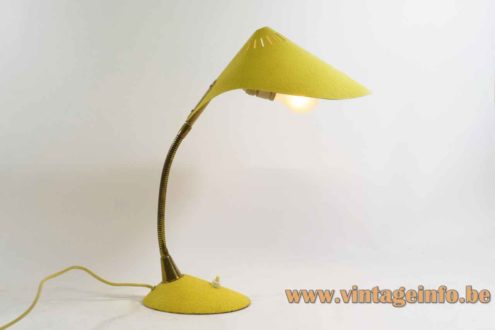
1950s Cobra Desk Lamp
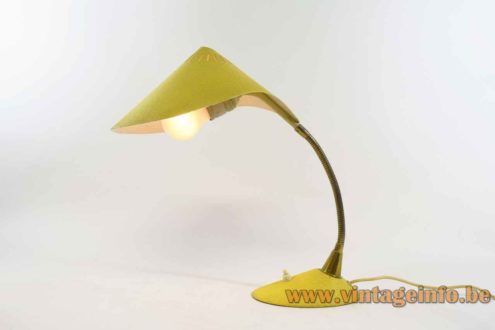
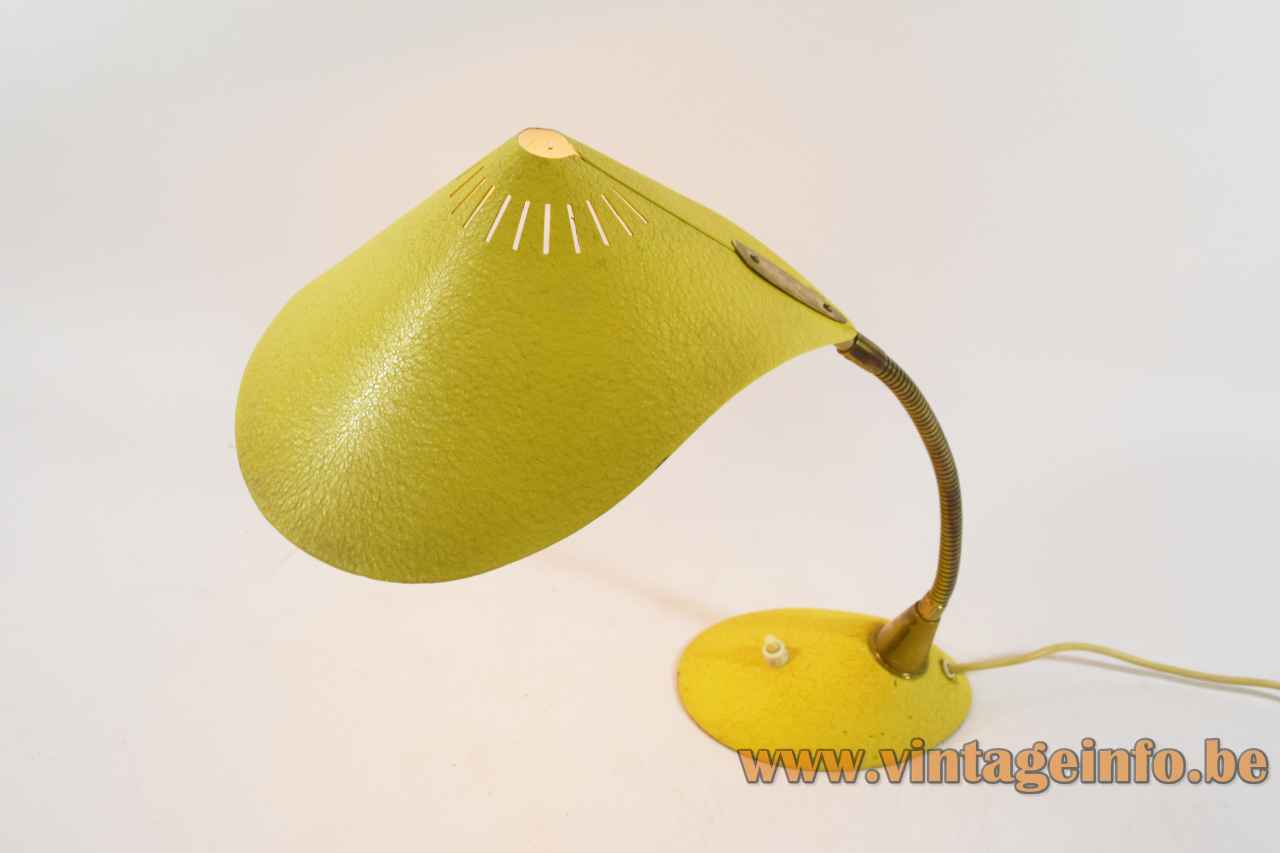
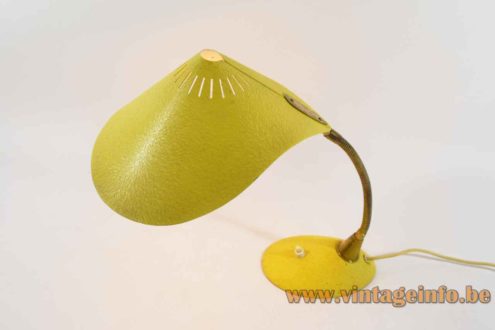
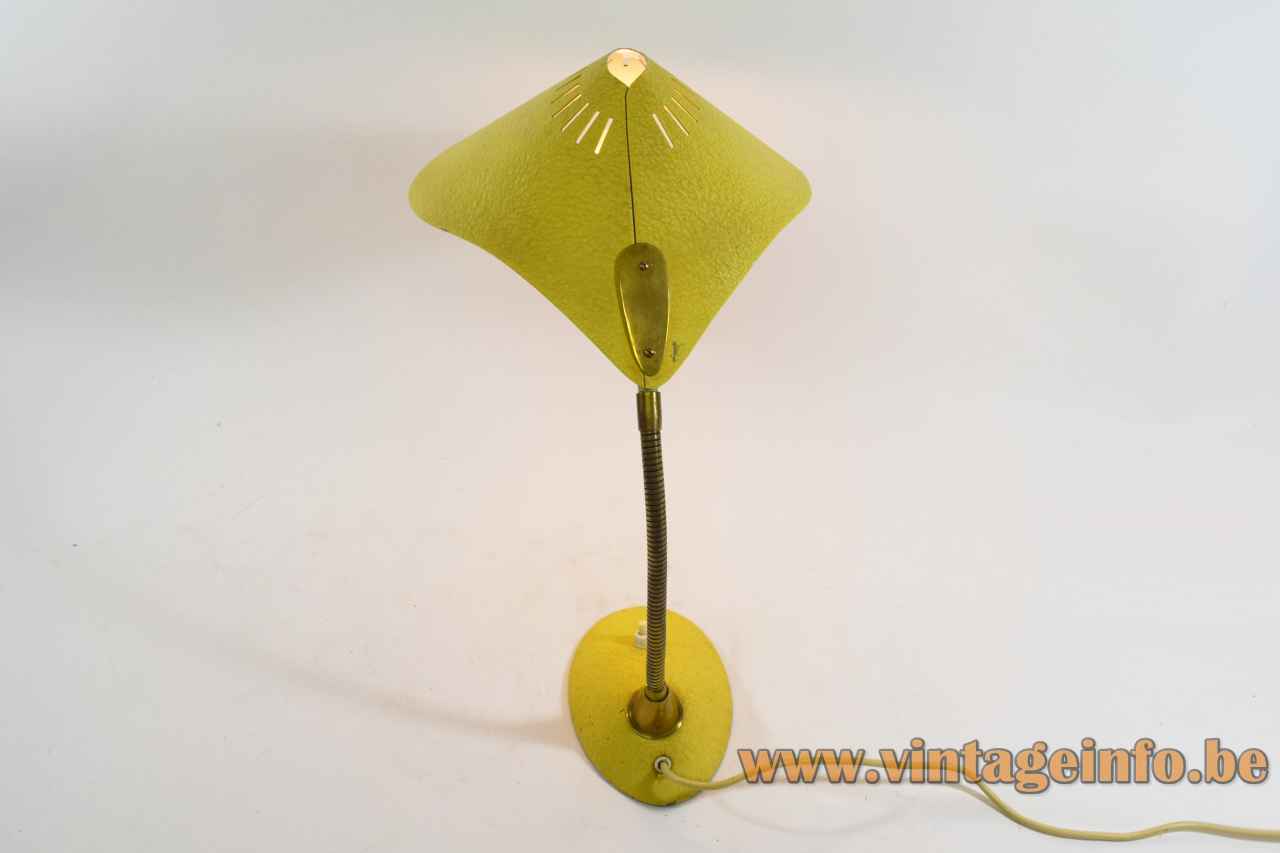
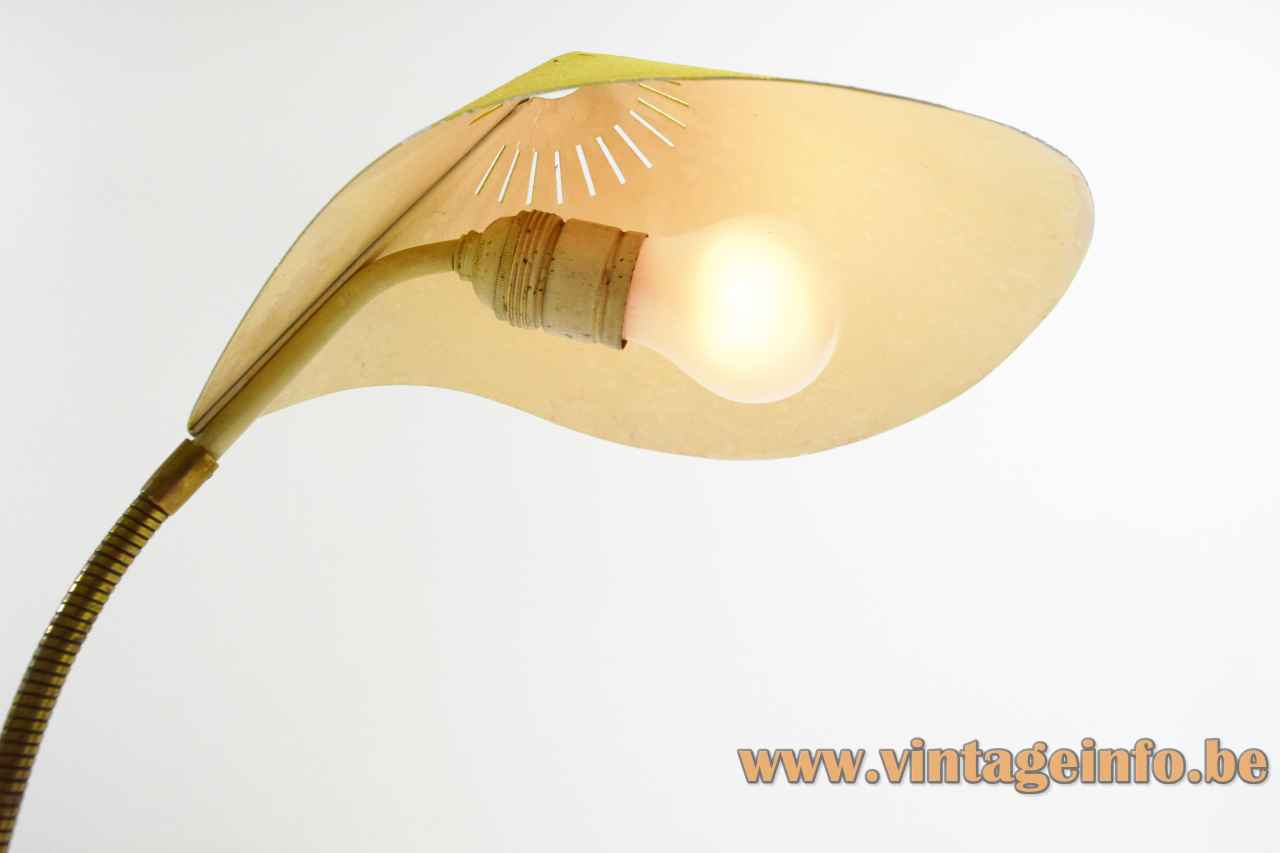
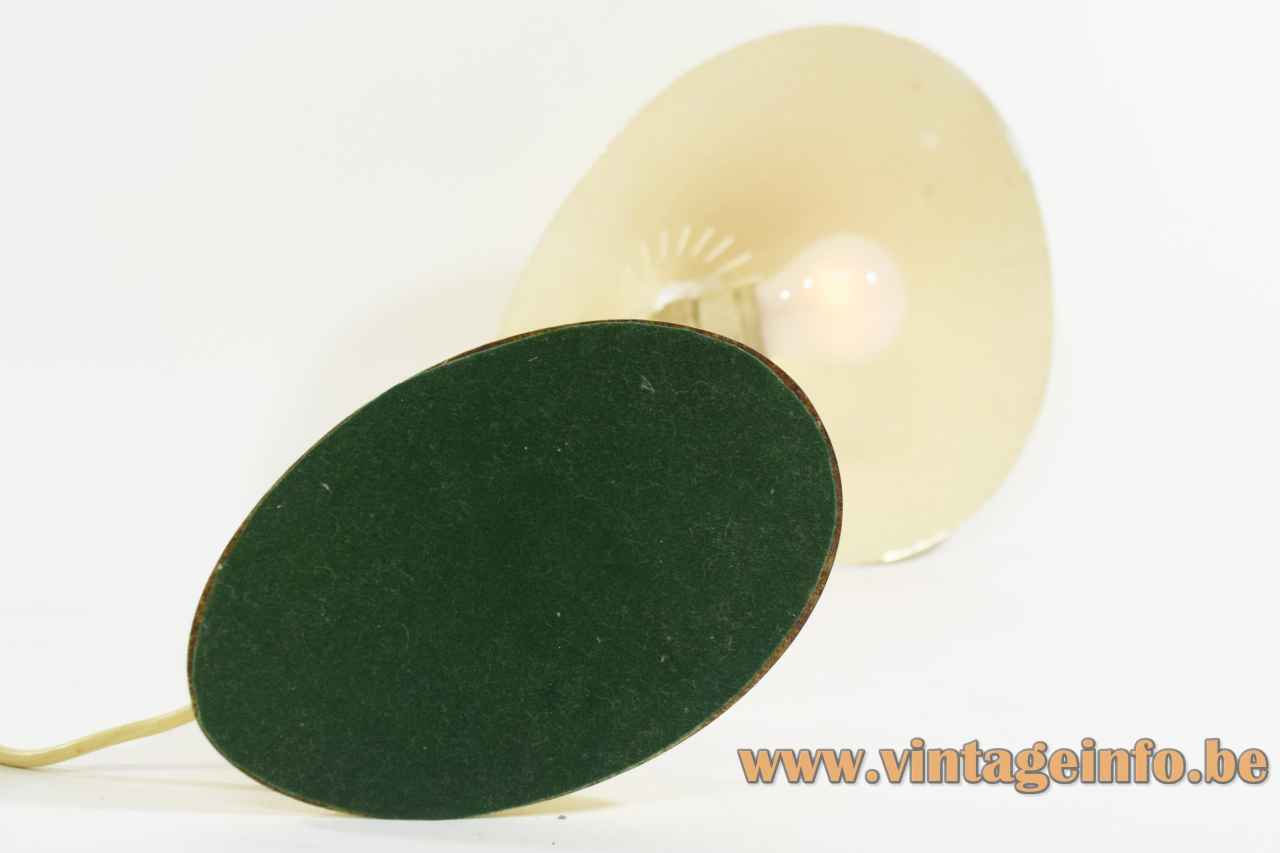
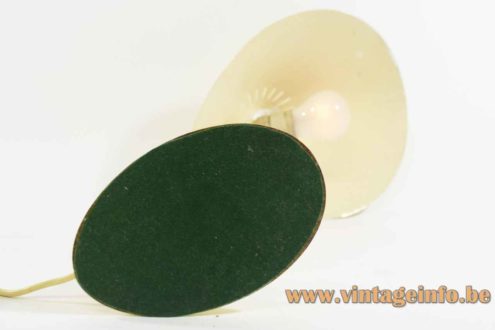
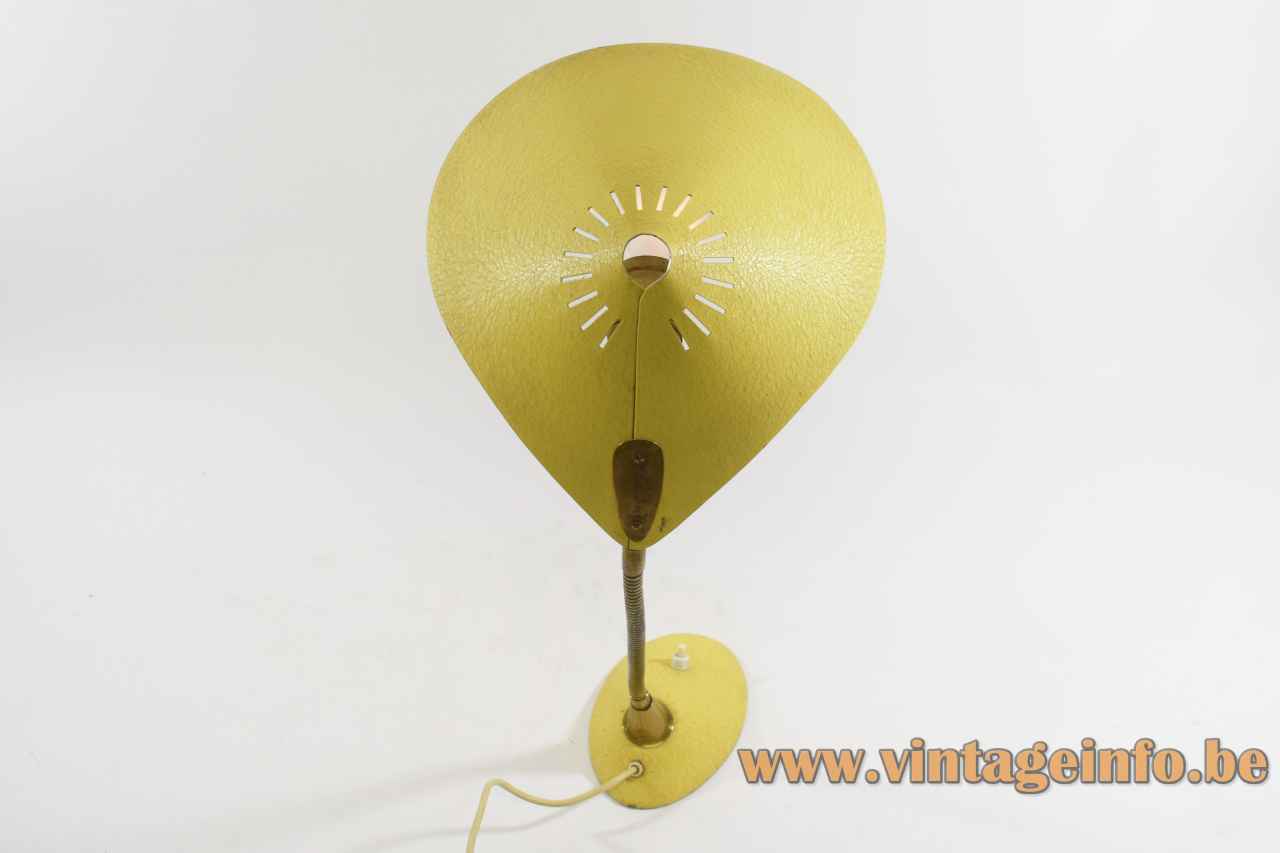
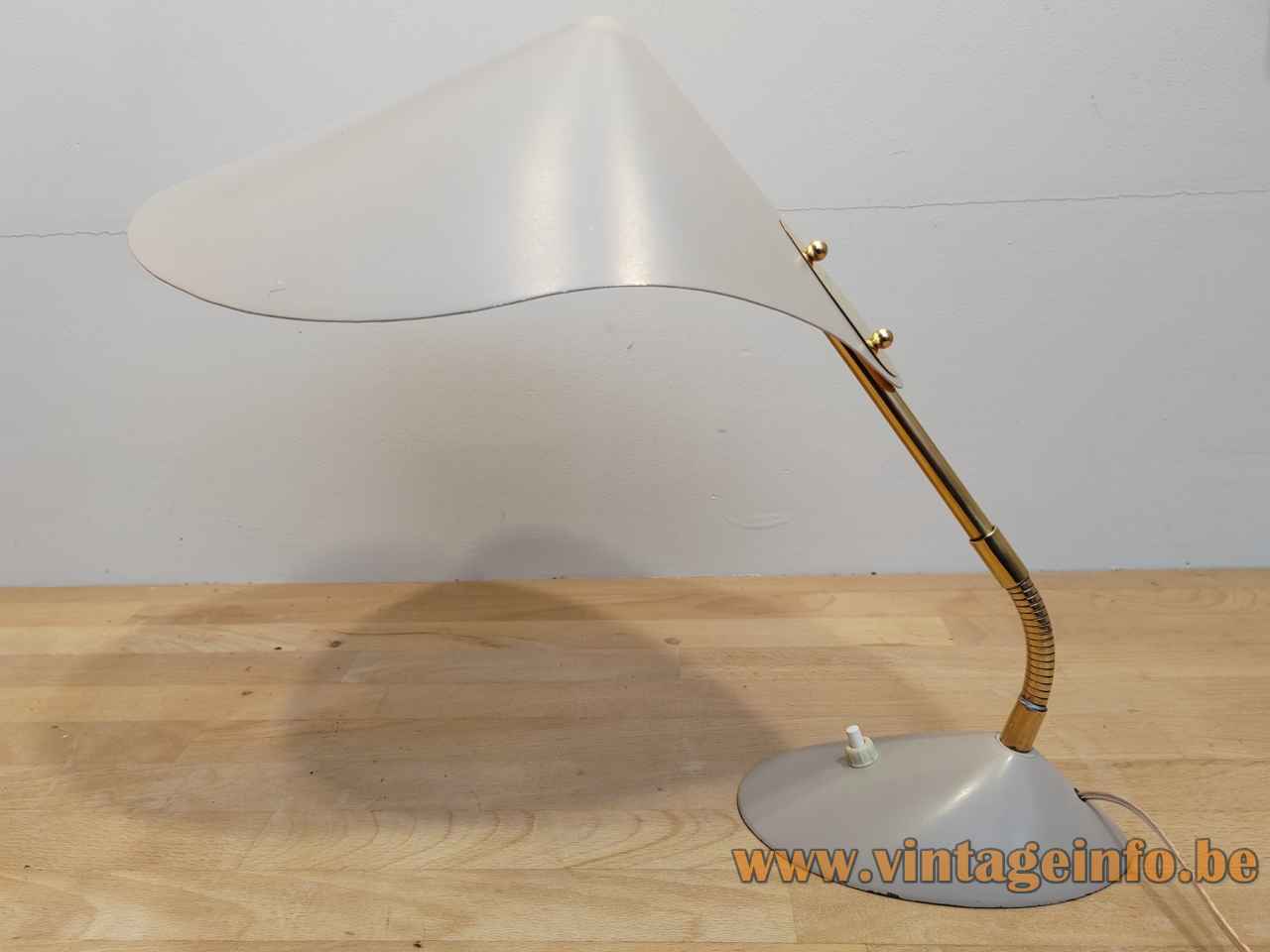
Materials: Light yellow painted oval cast iron base. Painted with wrinkle paint. Conical brass rod/tube. Brass gooseneck. Light yellow aluminium folded lampshade perforated with elongated slots, painted white inside. White painted rod and brass E27 socket.
Height: 45 cm / 17.71” – adjustable
Lampshade: 27,5 x 24 cm / 10.82 x 9.44”
Base: 16 x 11 cm / 6.29 x 4.33”
Electricity: 1 bulb E27, 1 x 75 watt maximum, 110/220 volt.
No specific type of light bulb is required; different types can be used.
Period: 1950s – Mid-Century Modern.
Designer: To be appraised.
Manufacturer: Dame & Co, Neheim-Hüsten, Germany.
Other versions: This 1950s cobra desk lamp was produced in many colours and in several variations, as shown on this page. It is likely that additional versions existed as well.
The lamp is commonly referred to as the Cobra because of its distinctive shape. There is no evidence, however, that the manufacturer used this name, as all lamps in the Dame & Co catalogues are identified only by model numbers and not by names.
The Belgian company S.A. Boulanger manufactured or marketed a version of this lamp with a closed lampshade, lacking the elongated slits and showing a few other minor differences (model 4324), as illustrated here. They may also have offered additional variants.
For a long time, the lamp was assumed to have been produced by Cosack Leuchten, another manufacturer from Neheim, but it does not appear in any known Cosack catalogues. The fact that the Belgian company Boulanger also sold this lamp fits with the common practice of the period, in which companies often marketed lamps manufactured by third parties.
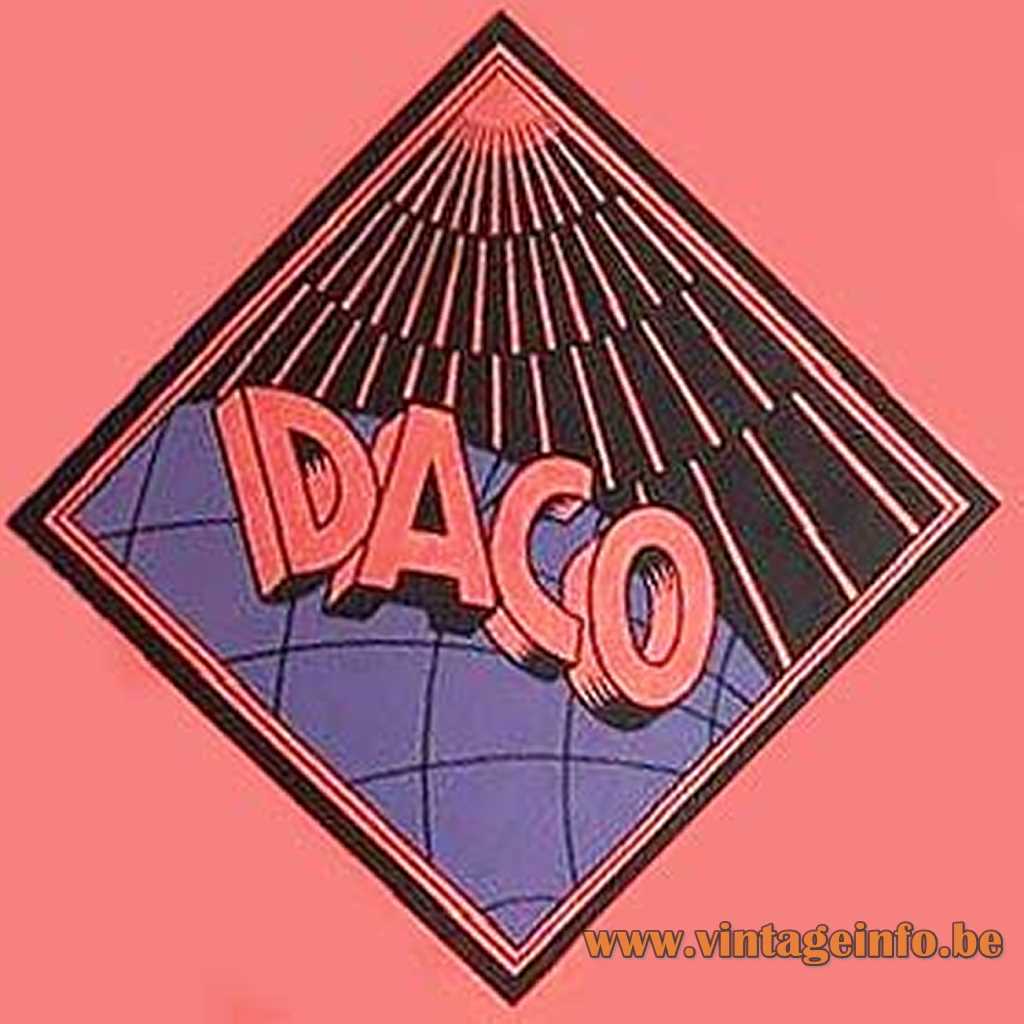
Dame & Co (DACO)
Dame & Co, also known under the abbreviated brand name DACO, was a German lighting manufacturer based in Neheim-Hüsten, one of the historic centres of the German lighting industry.
The company was founded in 1893, as confirmed by period logos bearing the inscription “DACO – gegründet 1893”.
By the interwar period, Dame & Co had grown into a large-scale industrial manufacturer.
Company letterheads from 1935 identify the firm as a Beleuchtungskörper-Fabrik, with extensive banking, postal and telecommunication facilities, indicating nationwide commercial activity.
Dame & Co regularly exhibited at major trade fairs, including the Leipzig Trade Fair, one of the most important industrial exhibitions in Europe at the time.
The company produced a wide range of lighting fixtures and issued extensive catalogues.
Catalogue numbering shows a long continuity of production, with main catalogues and supplements already exceeding number 30 by the mid-1930s, and continuing into the post-war decades.
In the 1950s, Dame & Co received international recognition when the company was awarded two iF Design Awards (1957), one for a table lamp (this one?) and one for a television lamp (Fernsehleuchte).
The iF documentation confirms the manufacturer and location, although no designer names are listed.
During the 1950s and 1960s, Dame & Co also embraced modern materials.
The company introduced lamp shades made from a proprietary fibreglass-reinforced material marketed under the name POLYDAM.
According to catalogue descriptions, POLYDAM shades were produced using PALATAL, a synthetic resin supplied by BASF, combined with glass fibre.
These shades were promoted as durable, heat-resistant, anti-static, colourfast and easy to clean.
Many Dame & Co lamps were sold without explicit designer attribution and were distributed through various retailers and wholesalers, both in Germany and abroad.
As a result, numerous models are today frequently misattributed to better-known designers or manufacturers.
Original catalogue documentation, however, clearly places these lamps within the production of Dame & Co / DACO.
The company no longer exists, and the exact date at which it ceased operations remains unclear.
Nevertheless, surviving catalogues and lamps demonstrate that Dame & Co played a significant role in German industrial lighting production from the late 19th century through the mid-20th century.
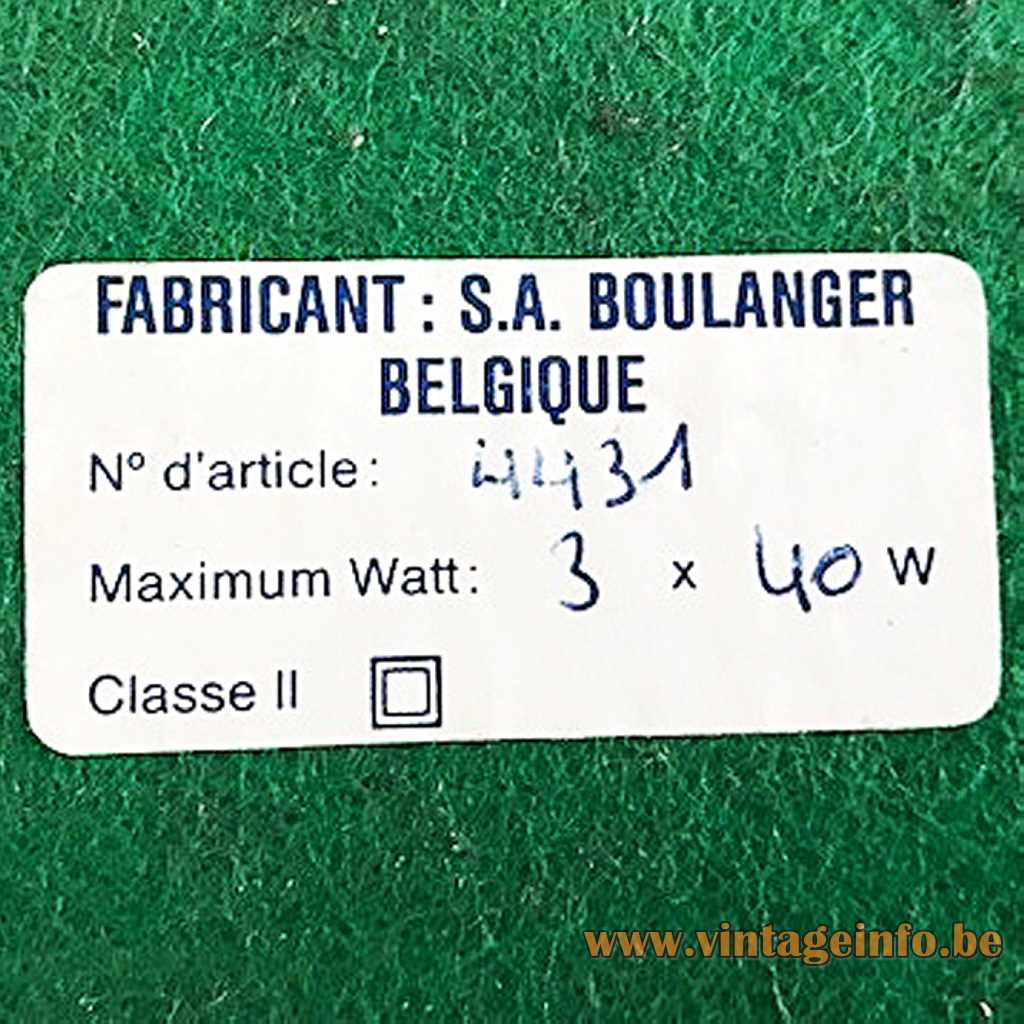
S.A. Boulanger
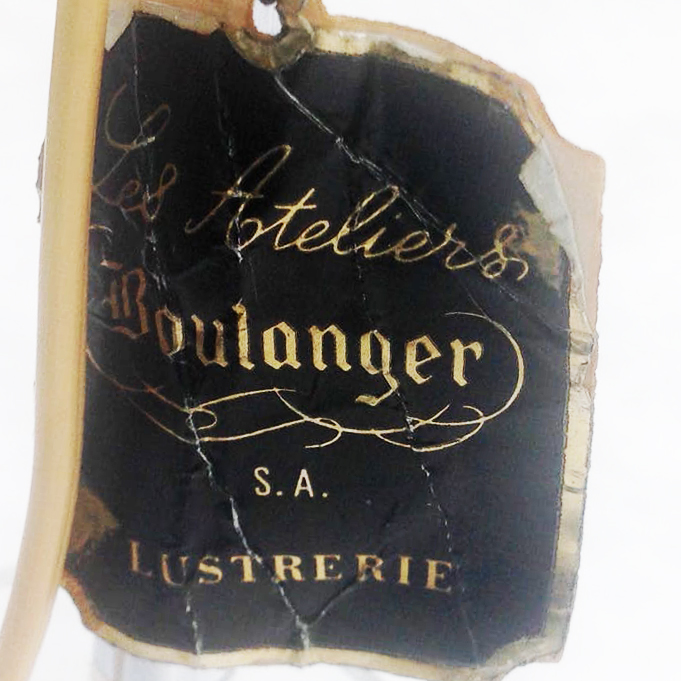
S.A. Boulanger was founded in Anderlecht, Belgium, in 1945. The company became well known for the large number of lighting designs it produced by Gaetano Sciolari. At some point in the 1980s, the company changed its name to Les Ateliers Boulanger NV.
For a long time, it was believed that S.A. Boulanger and Les Ateliers Boulanger were two separate companies. This misconception originated from a trader in Liège, Belgium, who persistently claimed that the lamps were produced in Herstal, near Liège.
In 1996, the company employed 11 people. In 1998, it relocated to Martelarenlaan 155 in 3010 Kessel-Lo, near Leuven. Between 1995 and 2001, Jean-Philippe Spalart served as CEO. During this period, he conducted feasibility studies on relocating production to China, Eastern Europe, and Africa, including a proposed manufacturing move to Zimbabwe.
Boulanger specialised in metal processing and manufactured high-end lamps and lighting fixtures. Les Ateliers Boulanger ceased operations in 2006.
Massive & Boulanger
Over the years, Massive sold several Boulanger models. The differences are limited to the typical Massive canopy or ceiling cap and a few other components.
Company description (1990s source)
“Boulanger mainly operates in the high-end lighting markets of Belgium, Germany, and Luxembourg. Growing sales in the United States and South Africa are becoming increasingly important to the company. Given the highly competitive nature of the market, offering products with high added value is essential. The intelligent lamp represents a significant advantage over competitors and is expected to substantially increase market share.
The most important local competitors are Massive, a Belgian company and European market leader (turnover of approximately €100 million), Deknudt of Deerlijk (turnover of €2.5 million), and around ten other Belgian competitors of similar size. There is also strong competition from Southern European and Asian manufacturers. Boulanger’s market share represents only a few percent of the total Belgian market. It is a small company with an annual turnover of approximately €300,000.”
“Most Boulanger lamps are low-voltage halogen models (220V up to 300W or 12V up to 50W). The products are sold through retail outlets. In Belgium, around 300 retail shops carry Boulanger products, with approximately 40 additional retailers abroad, including Luxembourg, Germany, France, and South Africa.”
Links (external links open in a new window)
Neheim, lamp capital of Germany – Wikipedia
Brökelmann, Jäger und Busse – Wikipedia
Switches in the Relco webstore
Vintageinfo
1950s gold coloured pendant lamps
Many thanks to Gael for the image of the S.A. Boulanger desk lamp.
Many thanks to Max from AfterMidnight for the catalogue pictures.
1950s Cobra Desk Lamp – Company Labels & Logos