- Categories
- Categories
Last 5 Viewed
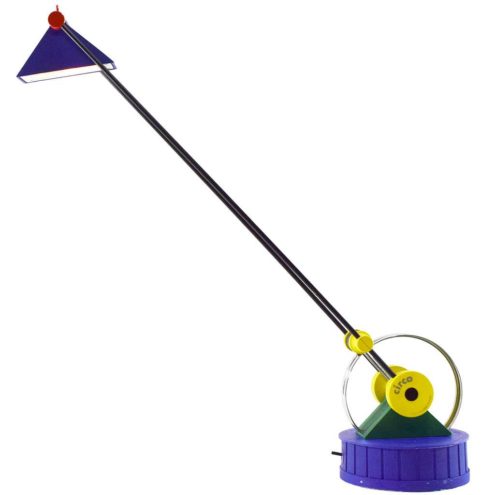
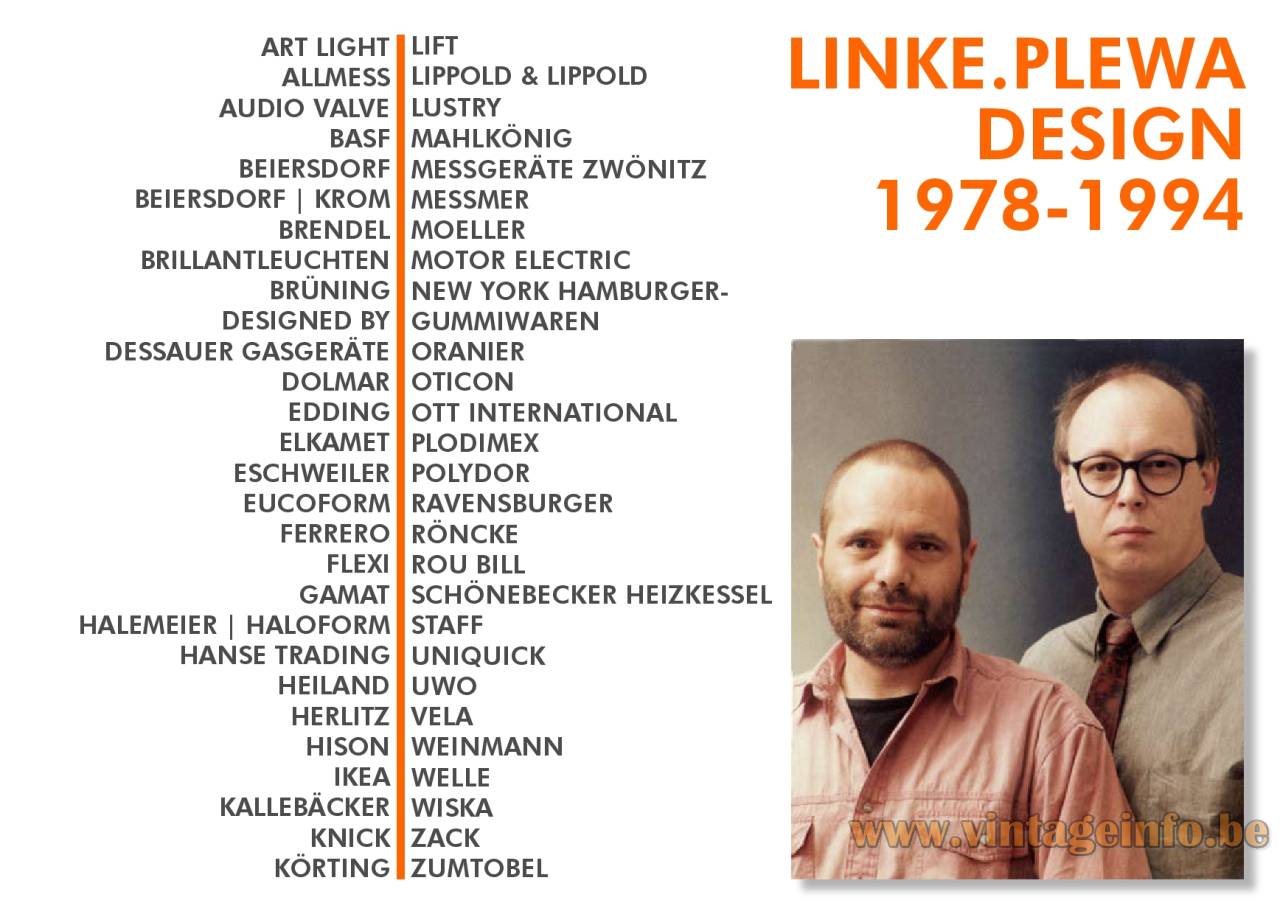
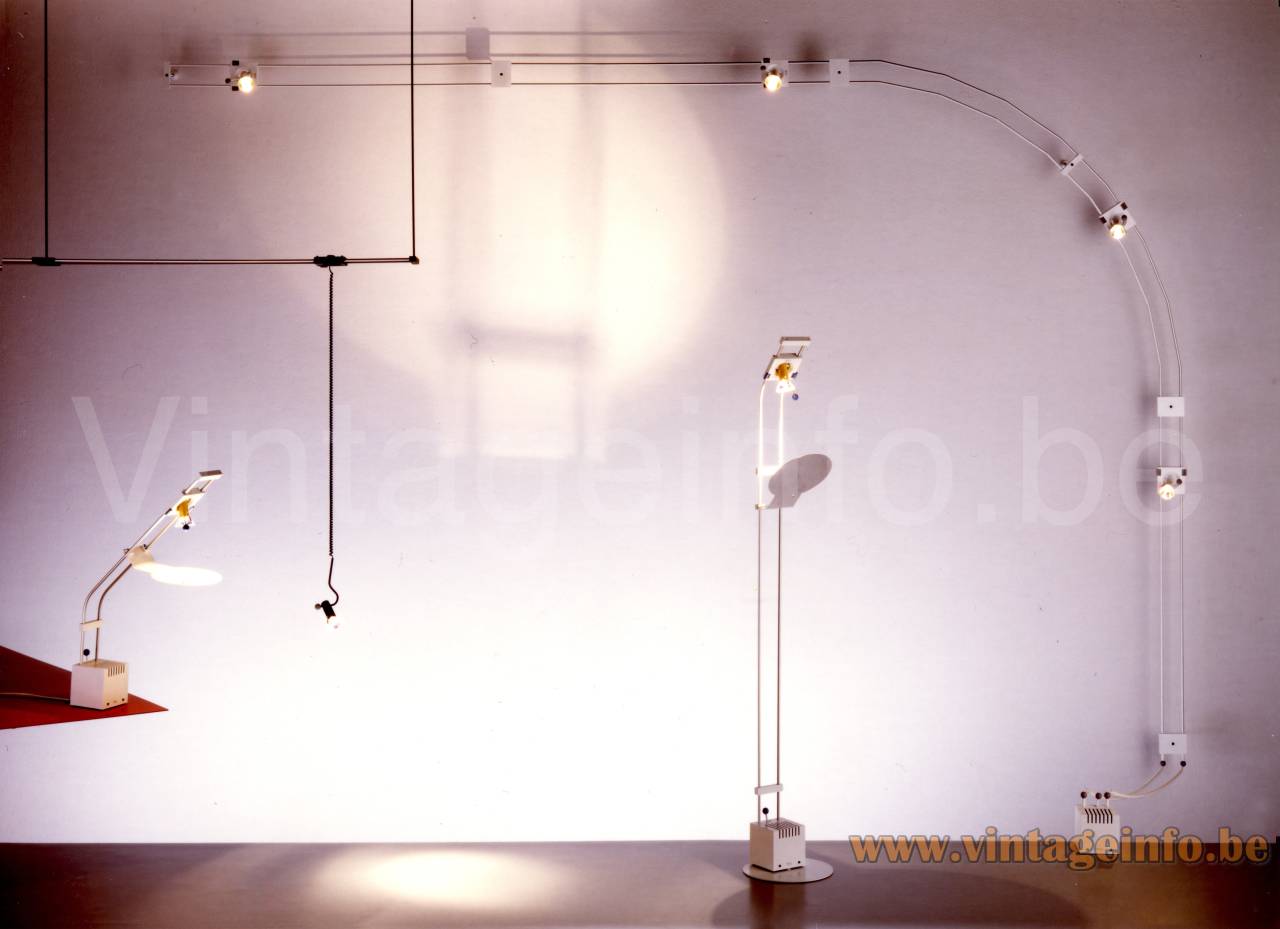
LINKE.PLEWA.DESIGN – Brillantleuchten TWI-LIGHT – Halogen Lighting System
In the early 1980s, 12-volt halogen lighting suddenly became the new sensation. Designs such as the iconic Tizio had already demonstrated the potential of compact, low-voltage light sources. Soon, parallel tensioned steel wires stretched from wall to wall with small automotive halogen lamps suspended between them became the fashionable solution — minimal, bright, and technically daring.
Linke.Plewa.Design appreciated the concept but considered the tension wires too limiting in terms of construction and spatial flexibility. Track lighting systems had existed for years — so why not adapt this principle to the new generation of compact halogen lamps?
Instead of cables, the designers developed a system based on two parallel 6 mm silver steel rods, combined with a specially designed adapter and a universal luminaire head. When presented to Brillantleuchten, the concept was received with enthusiasm. Coincidentally, at the same time the company Haloform (Eckhard Halemeier) introduced an innovative low-voltage lighting rail system, using a protected current-carrying copper conductor integrated into a slim aluminium/plastic profile of only 6 mm diameter. The adapter designed by Linke.Plewa.Design proved to be perfectly compatible.
What followed was the development of a comprehensive lighting programme: individual luminaires, table and floor lamps, adapters, accessories, and complete modular configurations. Technical challenges were solved, production tooling was completed, an initial series was manufactured, catalogues were printed, and the system was presented at trade fairs where it received design awards.
And then — quite suddenly — it was over.
In 1991, the former owners of Brillant sold their shares. The newly formed Brilliant AG immediately and drastically reduced the product range. With that decision, the ambitious TWI-LIGHT system was discontinued, despite being fully developed, launched, and internationally recognised.
Today, TWI-LIGHT stands as an example of early 1980s low-voltage innovation: technically precise, modular in concept, and ahead of its time — a system that ended not for technical reasons, but for corporate ones.
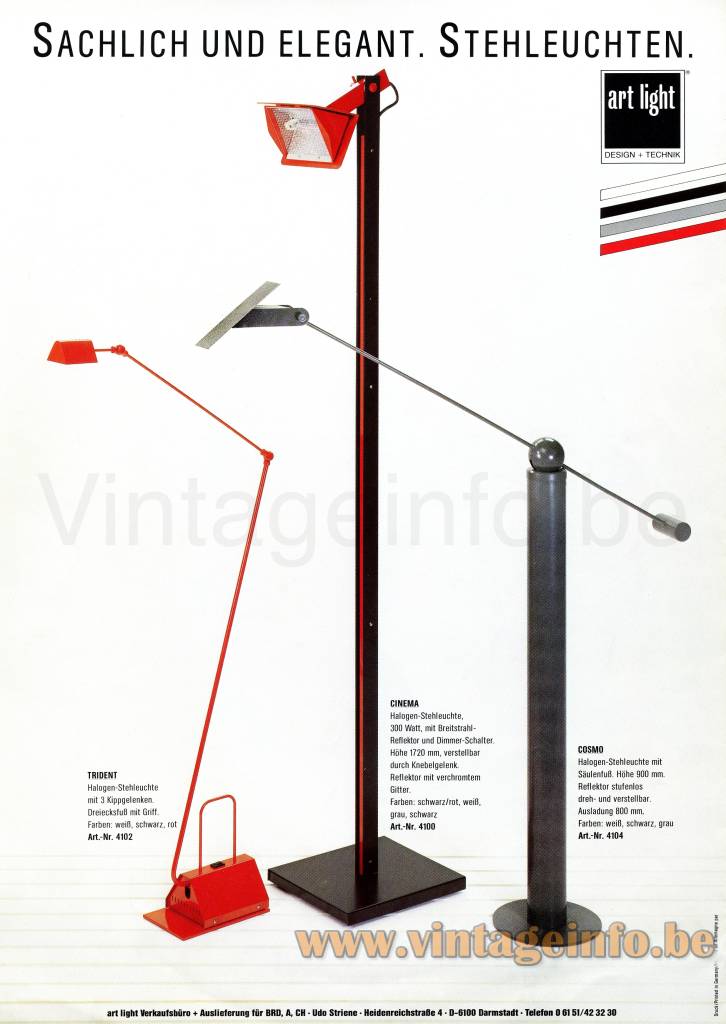
LINKE.PLEWA.DESIGN – Art Light Floor Lamps – Trident, Cinema & Cosmo
Under the label Art Light, several technically expressive halogen floor lamps were introduced, each reflecting a distinct mechanical character and formal clarity. These designs demonstrate the studio’s consistent interest in visible construction, adjustability, and functional honesty.
The Trident (Art. No. 4102) is a halogen floor lamp with three articulated joints and a distinctive triangular base with integrated handle. Available in white, black, or red, it combines mobility with structural directness.
The Cinema (Art. No. 4100) is a powerful 300-watt halogen floor lamp with wide-beam reflector and integrated dimmer switch. The reflector, protected by a chrome-plated grid, can be adjusted via articulated joints. With a height of 1720 mm and available in black/red, white, grey, or black, it presents a bold and almost architectural presence.
The Cosmo (Art. No. 4104) features a cylindrical column base and a freely adjustable reflector. With a height of 900 mm and an extension of 800 mm, it offers controlled flexibility within a compact, vertical structure. Available in white, black, or grey, the Cosmo expresses a quieter but equally precise technical language.
Together, these models illustrate Art Light’s ambition to combine industrial robustness with refined mechanical detailing — lighting conceived not as decorative objects, but as functional instruments.
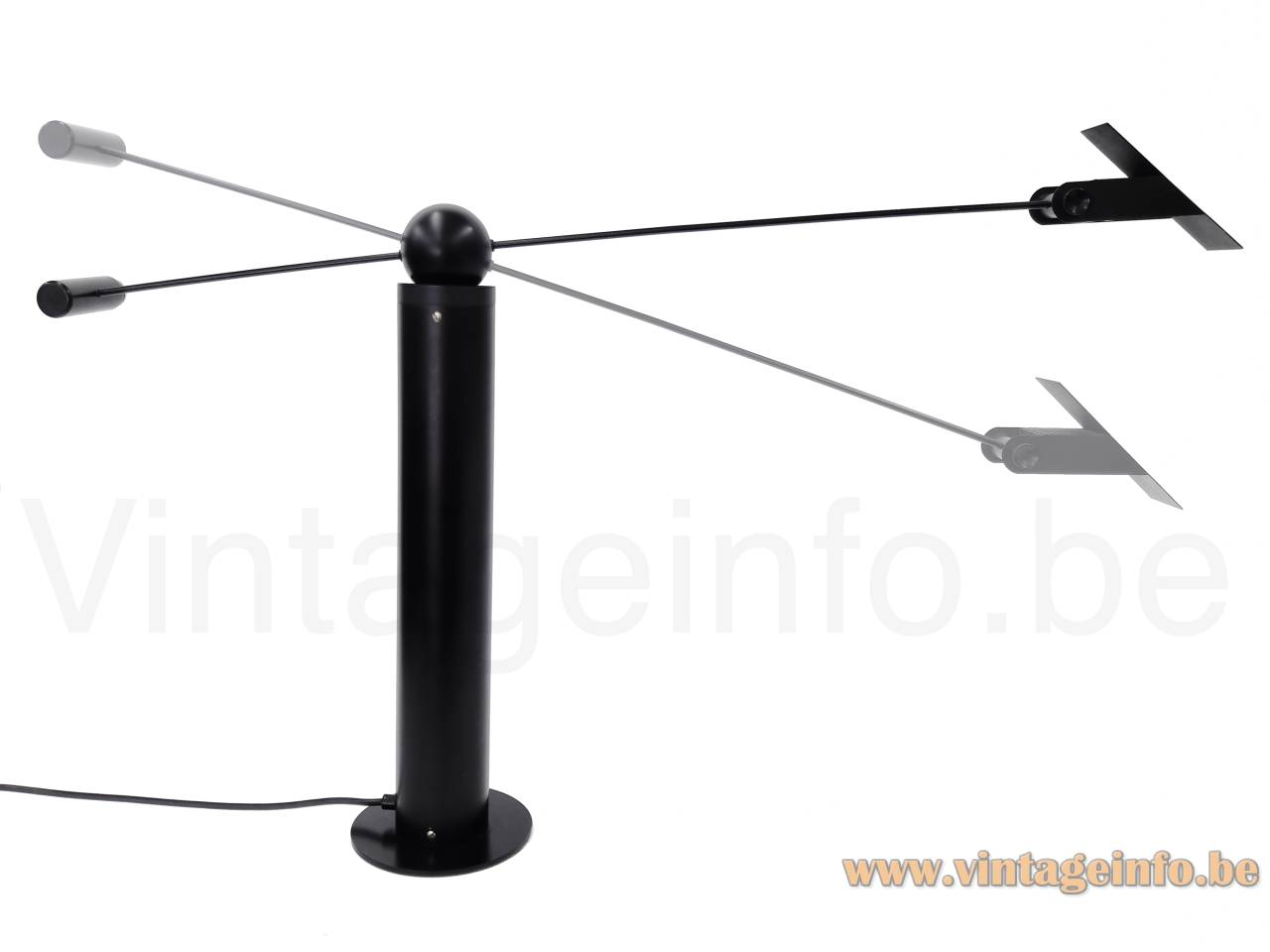
LINKE.PLEWA.DESIGN – Art Light “Cosmo” Desk Lamp (1978)
Originally developed as a semester project by Heico Linke at the HfBK Hamburg in 1978, this halogen desk lamp already demonstrated the mechanical clarity and construction-driven thinking that would later define much of his professional work.
The lamp is fully adjustable, rotating 360° and tilting approximately 60° vertically. The spherical joint — realised in the working prototype using a billiard ball — rests on top of the column and is held in position by a tension spring. Precisely balanced counterweights and calibrated friction allow the arm to be positioned freely while remaining stable without locking mechanisms. The original functional model was constructed from aluminium and PVC, with a brass counterweight and the transformer housed inside the vertical column.
In 1979, the lamp was produced in a very small edition by a Dutch lighting company and presented at the Hannover Messe. A licensing agreement was repeatedly promised but never concluded, despite legal discussions. Shortly afterwards, the manufacturer died unexpectedly, bringing the original production to an abrupt end.
Only a few years later, the exact same design resurfaced in the programme of the Swiss company Baltensweiler, where it was manufactured and sold under their own name. In some references the design was even attributed to Rosmarie Baltensweiler.
Let’s be clear: this was not a case of “inspiration”. The design had already been developed, prototyped, exhibited and produced in small numbers under Heico Linke’s authorship. Its later commercialisation elsewhere occurred without proper attribution. The lamp still appears today on high-end sales platforms as a Baltensweiler model — as if its earlier history never existed.
Technically, the original prototype was not entirely VDE-compliant due to the absence of a stabilising base plate. But formally and conceptually, the design was remarkably coherent — and undeniably original.
Same lamp form appears on 1stdibs under Baltensweiler branding — illustrating how the design later re-entered the market.
LINKE.PLEWA.DESIGN – Elkamet Standby Table Lamp 1994 iF Design Award
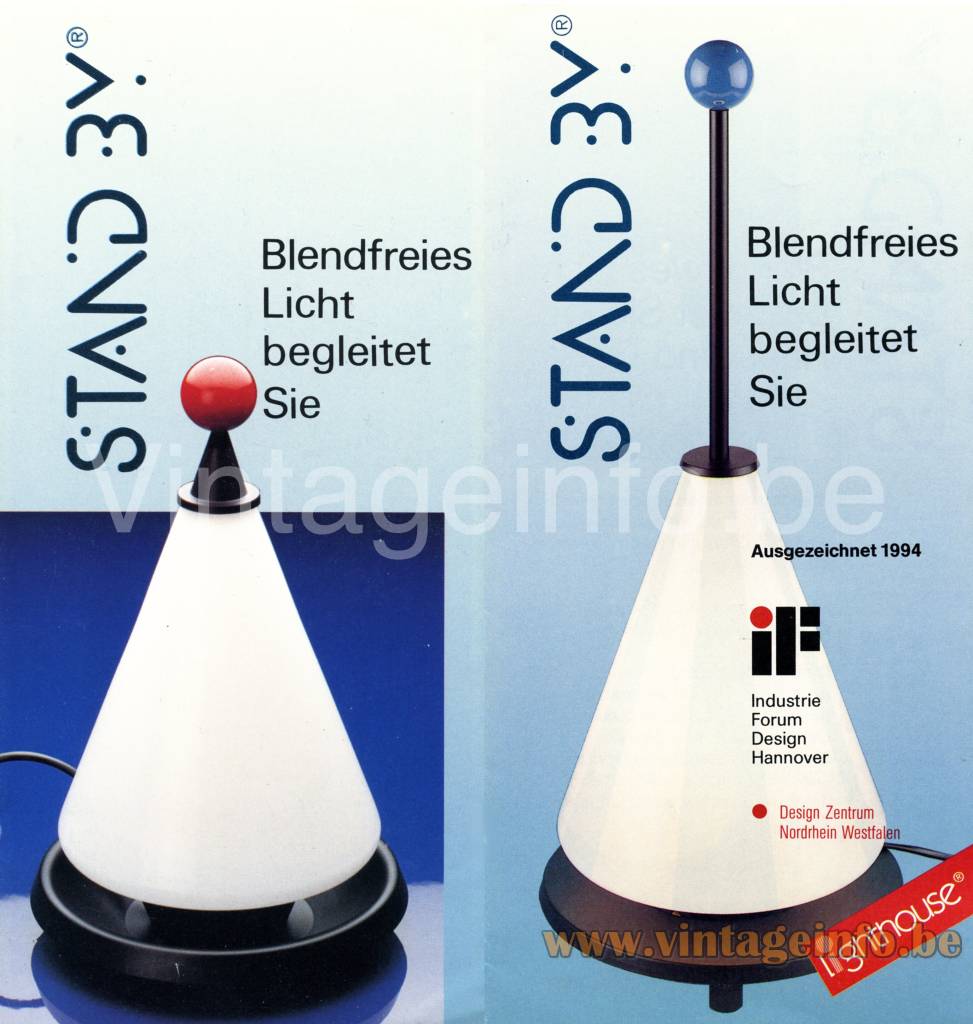
The lamp was originally designed for Brillantleuchten, but the designers were advised to approach ELKAMET instead. The large version was soon put into production. At the manufacturer’s request, a smaller version was later developed, which would eventually be found in countless children’s rooms around the world.
Over time, several graphic designers and artists contributed to the lamp’s success. Particularly memorable were the charming and distinctive motifs created by the incomparable graphic artist Janosch.
LINKE.PLEWA.DESIGN – 1991 Lustry Desk Lamp (Unrealised Design)
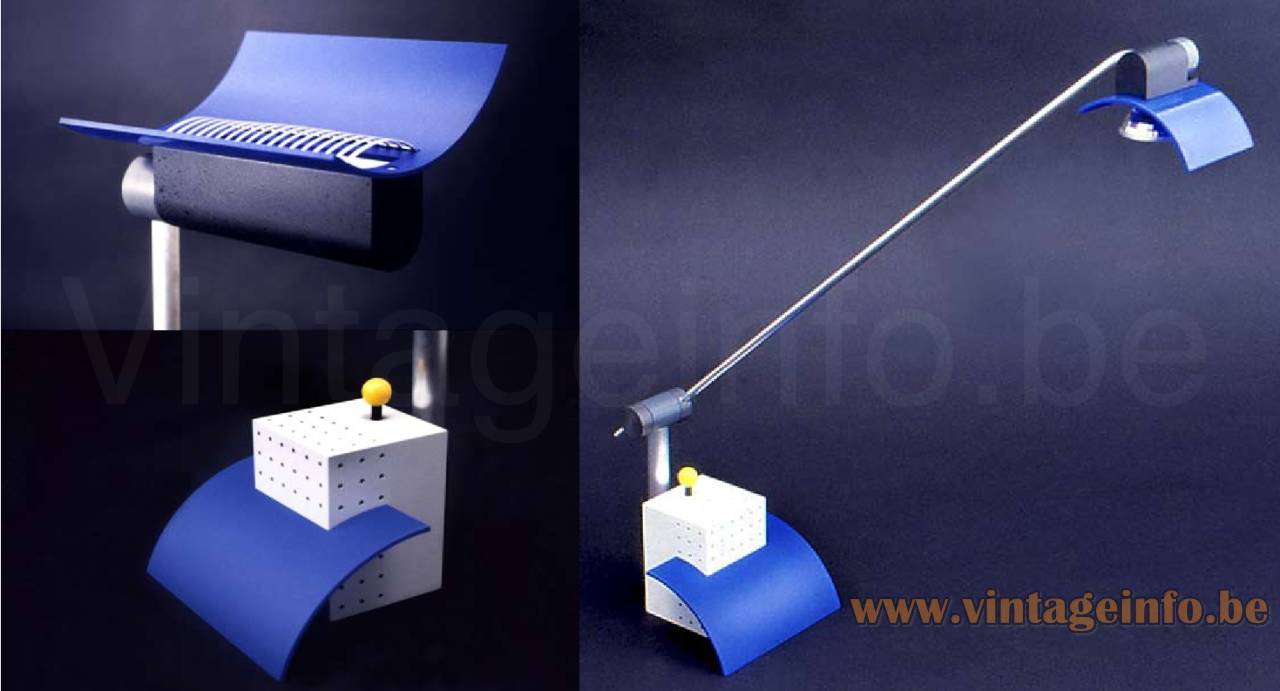
Lustry is a historic glass manufactory in the Czech Republic, located not far from Dresden. The glassworks is internationally known for its elaborate and ornate chandeliers.
Linke.Plewa.Design was commissioned by Lustry to develop a contemporary table lamp — a design intended to bring a more modern direction to the company’s traditional production. The concept combined a plastic housing with a reflector and a curved base element made of hand-blown glass.
Despite the careful balance between tradition and modernity, the final design proved to be too forward-looking for the manufacturer. In the end, Lustry decided not to proceed with production. The step into a more contemporary design language was, at that time, one they were not prepared to take.
The project remains an interesting example of an unrealised attempt to bridge historic craftsmanship and modern industrial design.
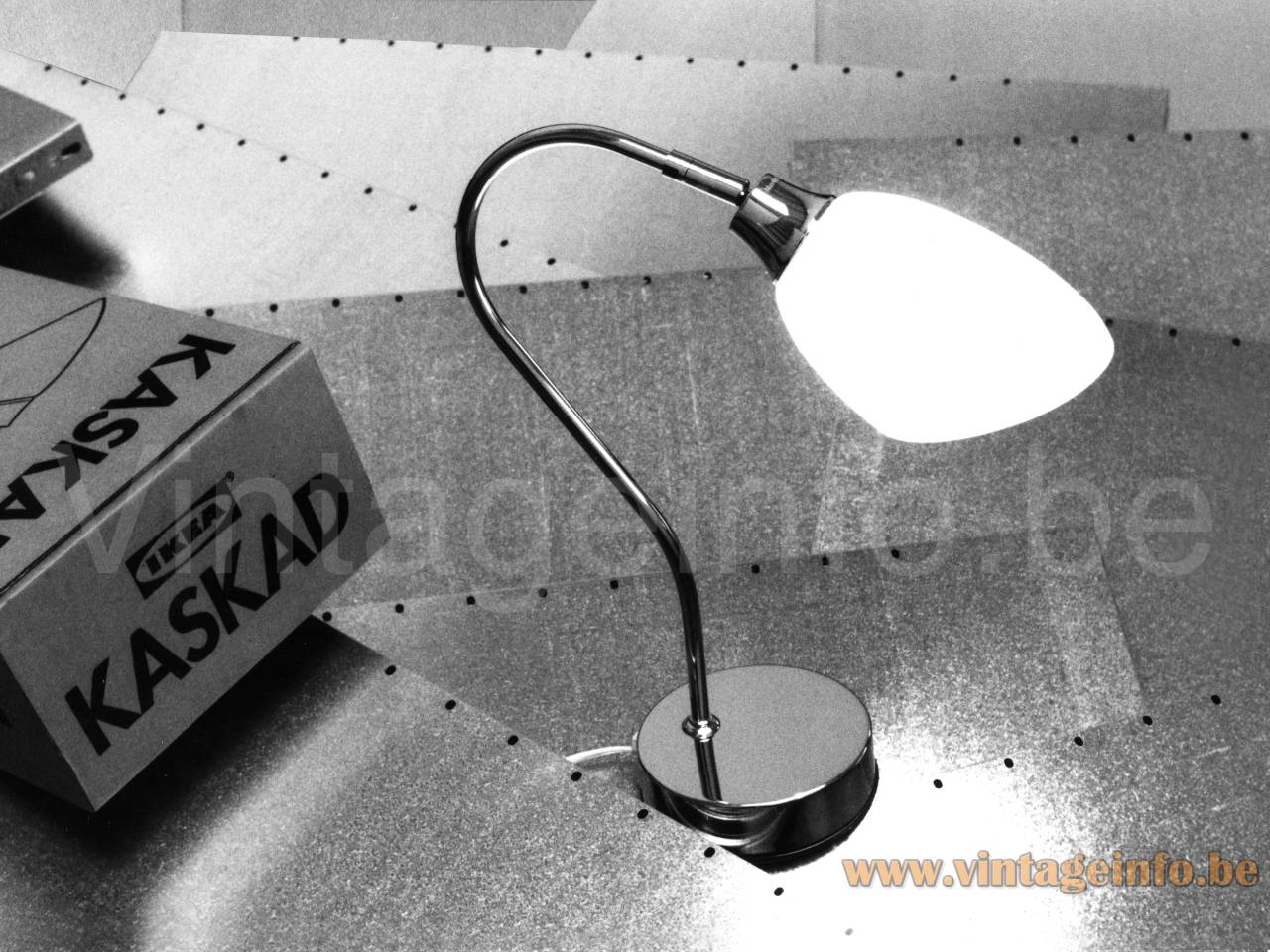
LINKE.PLEWA.DESIGN – 1991 KASKAD Table Lamp for Brillantleuchten
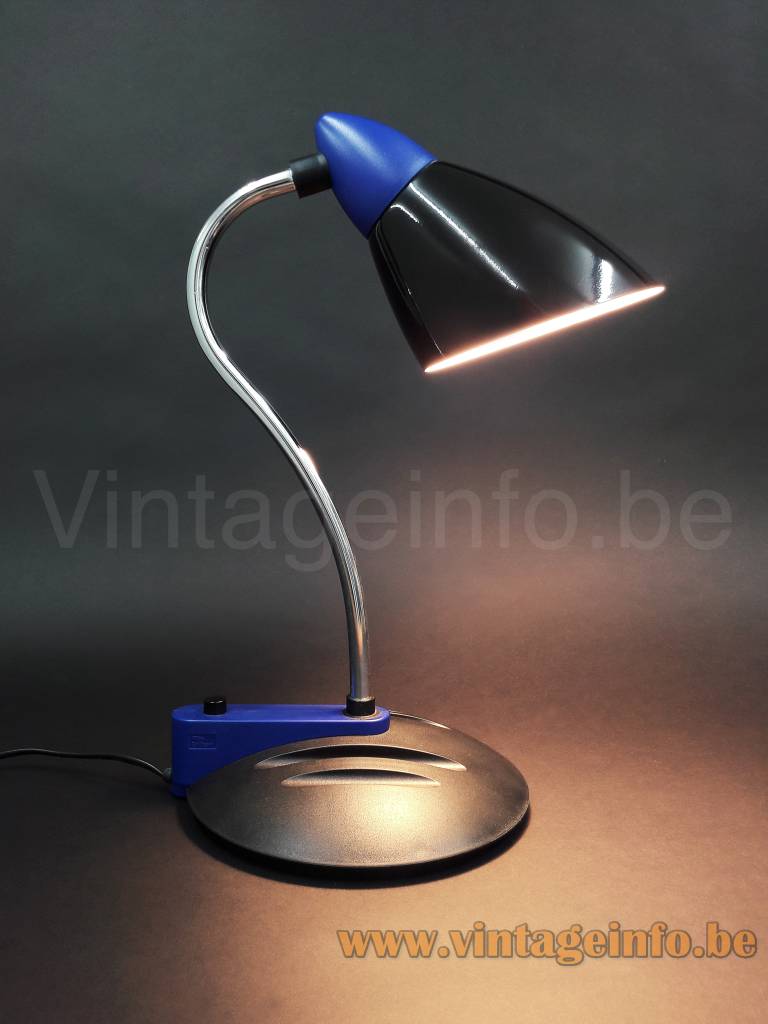
The original KASKAD table lamp was designed in 1991 and marked the final project Linke.Plewa.Design created for Brillantleuchten.
This version shows a far more refined and characteristic design language than the later IKEA adaptation. The elegant curved metal stem, carefully proportioned base and the balanced glass shade reflect the studio’s precise and technically controlled approach to lighting design. It was a compact yet sophisticated halogen desk lamp — minimal in appearance, but clearly engineered with attention to detail.
As the last design delivered to Brillant before the collaboration ended, the KASKAD represents the closing chapter of an important partnership. Ironically, it would not be the end of the lamp’s commercial life.
LINKE.PLEWA.DESIGN – 1995 IKEA KASKAD
A few years later, the design reappeared in a modified version produced by Brillantleuchten for IKEA, where it was included in the Swedish IKEA catalogue of 1995.
The IKEA version retained the basic concept but was clearly adapted to meet mass-market production standards and pricing structures. The result was a more simplified and commercially styled interpretation — practical, accessible and in line with IKEA’s mid-1990s product identity, but less distinctive than the original Brillant model.
While the 1991 KASKAD closed the creative collaboration between Linke.Plewa.Design and Brillantleuchten, the adapted version proved commercially successful. Brillant continued producing the lamp for IKEA and reportedly generated significant revenue from it — a design that ended one partnership quietly continued its life elsewhere, and quite profitably.
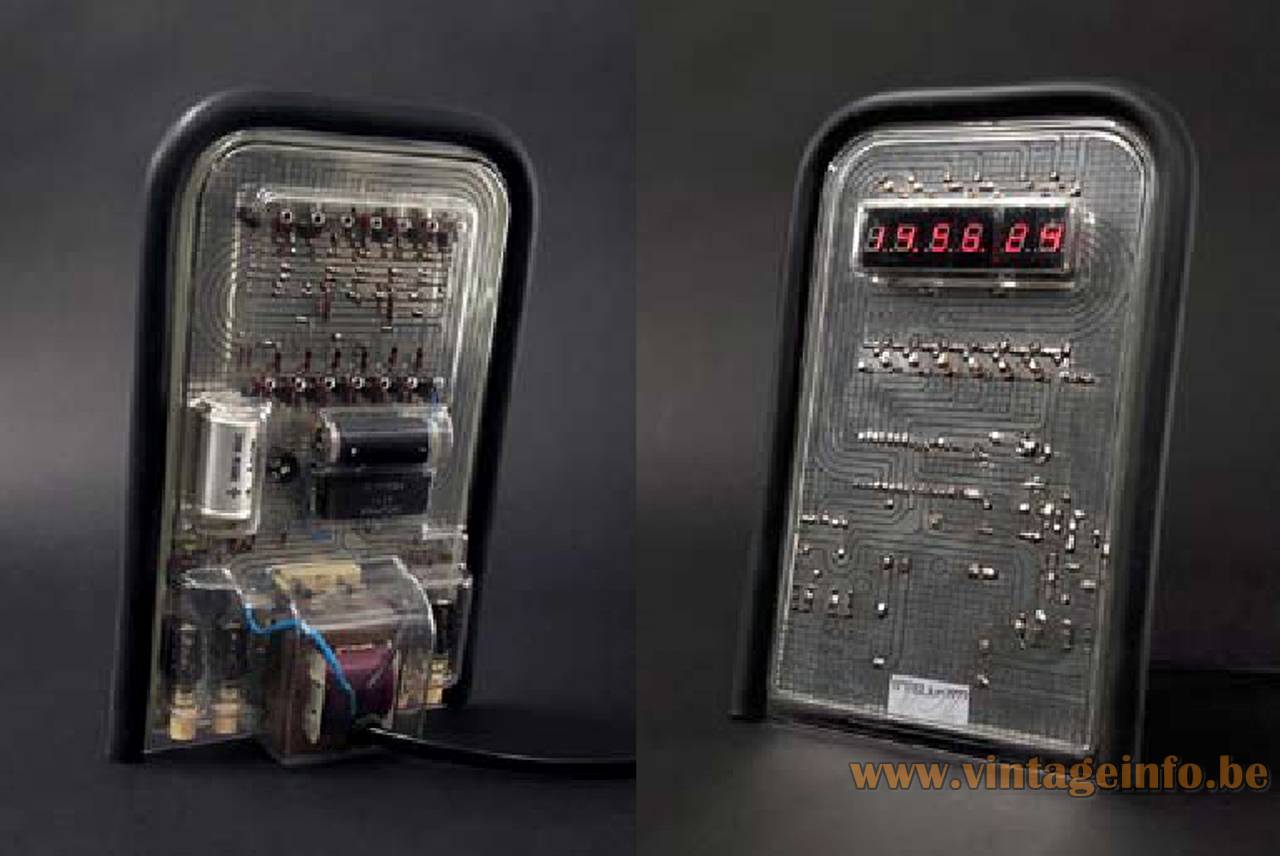
BUCHNER.LINKE.PLEWA.DESIGN – 1979 Table Clock
Designed in 1979 under the name BUCHNER.LINKE.PLEWA.DESIGN, this remarkable table clock represents an early and radical exploration of electronic aesthetics as visible design.
In 1980 the clock was awarded a prestigious horology prize, including a prize money of DM 2,500 — a considerable sum at the time.
What made this design exceptional was the decision to treat the printed circuit board not as something to be hidden, but as a graphic element. The clock consists of a single circuit board carrying all functional components, enclosed between two vacuum-formed acrylic housing halves. A rubber profile holds both transparent parts together.
The goal was clear: the structure of the electronics itself — the layout of components, connections and circuitry — should remain visible and become part of the visual identity of the object. In 1979 this approach was highly unconventional and ahead of its time.
Only ten examples of this clock were ever produced.
Beyond lighting design, Heico Linke created a substantial body of clock designs. A separate page dedicated to these works is linked below.
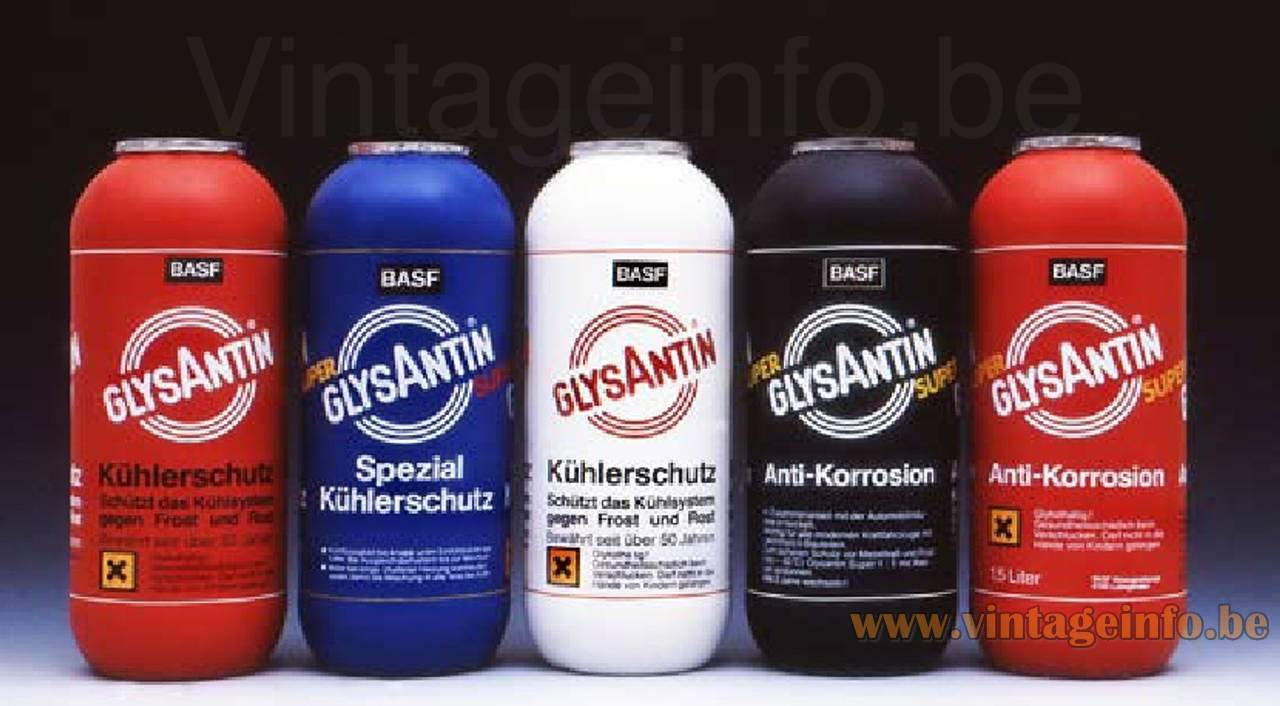
LINKE.PLEWA.DESIGN – BASF – Glysantin / Glysantin Super Redesign (1983)
In 1983, Linke.Plewa.Design was commissioned by BASF to redesign the product presentation of Glysantin and Glysantin Super, with a clear objective: improved usability and a stronger, unified visual identity.
The task was not limited to graphic adjustments. The studio developed a comprehensive design concept intended to support an expandable product family. The existing plastic bottle was retained due to positive functional experience, but was improved with the introduction of a screw cap to ensure safer and cleaner handling.
Colour schemes were revised according to principles of colour psychology, particularly to emphasise the higher positioning of Glysantin Super within the product range. The label design was restructured through a distinctive three-part division — effectively creating “three front sides.” This ensured that the product name GLYSANTIN remained readable from multiple viewing angles. The slightly angled typography added dynamism and increased visual impact.
The resulting design not only improved functionality and clarity but also strengthened brand recognition at the point of sale, successfully meeting the strategic objectives defined by BASF.
Many thanks to Heico Linke for all the images and help.
LINKE.PLEWA.DESIGN (1978–1994)
Linke.Plewa.Design was a German industrial design studio founded in early 1978 in Hamburg by Heico Linke and Jens Plewa. The studio emerged from the academic environment of the Hochschule für bildende Künste Hamburg (HfBK). At the time of its foundation, Plewa had just completed his studies, while Linke was still a student and would graduate in 1979. The studio remained active until 1994 and developed a broad and diverse body of work covering lighting, industrial products, technical devices, measurement instruments, consumer goods, clocks, toys, and packaging design.
The first studio space was located in St. Pauli, at Bernhard-Nocht-Straße 3, on the corner of Antoni Straße, with a direct view over the port of Hamburg and Dock 11. In September 1978, a fellow student, Reinhardt Buchner, joined the studio. During this early phase, the office operated under the name BUCHNER.LINKE.PLEWA. This collaboration lasted for approximately four years. After that period, the cooperation with Buchner ended and the studio continued its work under the original name, Linke.Plewa.Design.
Working practice and scope
Linke.Plewa.Design never positioned itself as a lighting-only studio. Although lighting design formed a highly visible and successful part of its output, it existed alongside a wide range of non-lighting projects. The studio worked in close cooperation with manufacturers, engineers, and technical partners, developing projects from early concepts and study models into production-ready designs. Technical feasibility, tooling, safety requirements, and series production were integral parts of the design process.
This multidisciplinary practice is a defining characteristic of Linke.Plewa.Design and explains the studio’s presence across many different industrial contexts, from lighting and furniture-related products to technical equipment and consumer goods.
Lighting design
Lighting represents one of the most recognisable areas of the studio’s work. From the late 1970s onwards, Linke.Plewa.Design explored adjustable luminaires, compact light sources, and later low-voltage halogen systems. Many designs combined mechanical adjustability, joints, counterweights, adapters, and rails with a clear and functional formal language.
Between 1986 and 1991, the studio collaborated intensively with Brillantleuchten. This cooperation resulted in a wide lighting programme including individual luminaires as well as complete systems. The most ambitious of these was the TWI-LIGHT (Twilight) system, a modular halogen lighting system consisting of rails, adapters, spotlights, table lamps, floor lamps, and accessories. The system reached production stage, was presented at trade fairs, accompanied by printed catalogues, and received design awards.
Following the takeover of Brillantleuchten in 1991 and its transformation into Brilliant AG, large parts of the existing product range were discontinued. As a result, several Linke.Plewa.Design projects, including further developments of TWI-LIGHT, were terminated abruptly despite being technically mature and commercially launched.
In addition to system lighting, the studio designed a number of distinctive individual luminaires, including the widely sold Circo table lamp, the Segma table lamp, and the Triton series comprising wall, table, and floor lamps. Some of these designs are today frequently associated with postmodern or Memphis-style aesthetics, although they were developed independently and within an industrial design context rather than as part of any stylistic movement.
Beyond lighting: clocks and industrial products
Alongside lighting, Linke.Plewa.Design created a substantial number of non-lighting products. These included a coherent series of clocks, as well as measurement devices, housings, packaging systems, toys, and technical consumer products. These designs demonstrate the same attention to construction, usability, and clarity found in the studio’s lighting work and underline its role as a fully fledged industrial design office rather than a specialist lighting studio.
Manufacturers and clients
Between 1978 and 1994, Linke.Plewa.Design worked for a wide range of manufacturers and industrial clients, including: ART LIGHT, ALLMESS, AUDIO VALVE, BASF, BEIERSDORF / KROM, BRENDEL, BRILLANTLEUCHTEN, ELKAMET, EUCOFORM, FERRERO, HALEMEIER / HALOFORM, IKEA, LIPPOLD & LIPPOLD / MOTOR ELECTRIC Ltd. (Hong Kong), LUSTRY, OTT INTERNATIONAL, STAFF, ZUMTOBEL
Awards and recognition
The work of Linke.Plewa.Design received several important international design awards, including multiple iF Design Awards for lighting and industrial design projects. These awards document the professional recognition of the studio’s work during its active years and its position within the German design landscape of the late 20th century.
Archive and documentation
During the active years of the studio, the office was broken into twice, resulting in the theft of a large number of slides and photographs documenting its work. What survives today therefore represents only part of the original archive. In 2025, Jens Plewa, as the custodian of the remaining material, undertook the extensive task of collecting and scanning all surviving photographs from the joint studio period. Even this incomplete archive still conveys the intensity, productivity, and breadth of the studio’s design activity.
End of the studio
In 1994, Linke.Plewa.Design ceased operations. Jens Plewa subsequently founded his own design office, PLEWA WORKS, while Heico Linke continued his professional career as an employed designer. Today, the work of Linke.Plewa.Design is increasingly documented and reassessed as part of a broader industrial and technical design culture, rather than as isolated design objects.
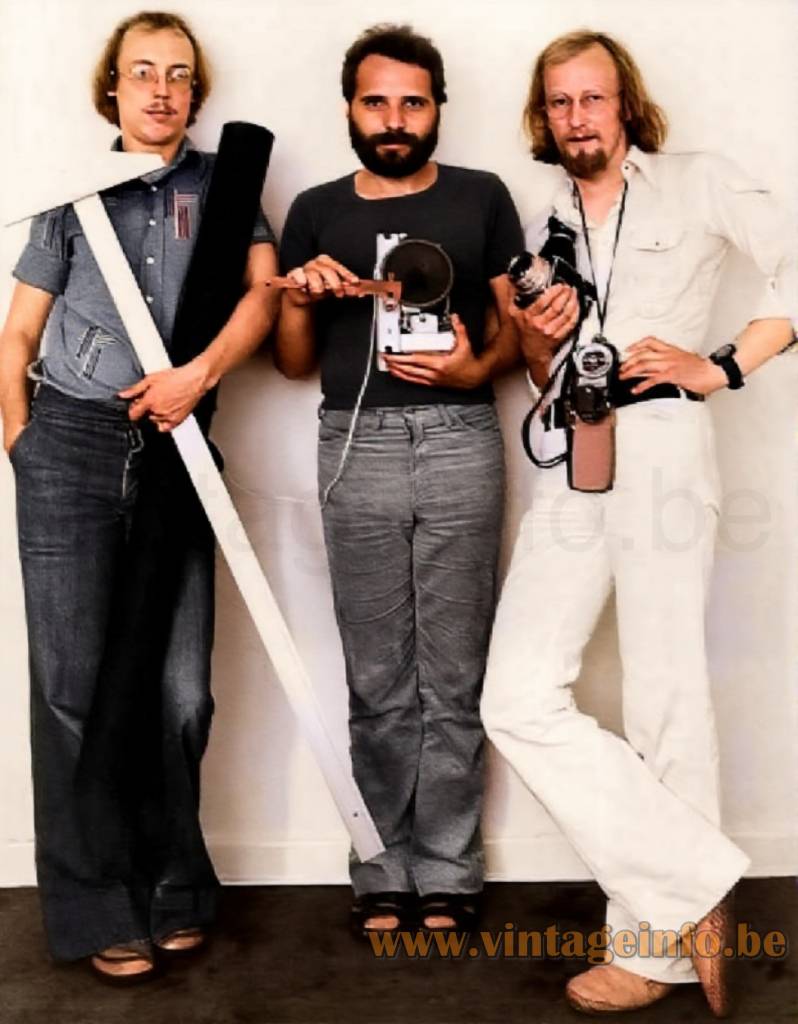
LINKE.PLEWA.DESIGN – Jens Plewa, Heico Linke, Reinhardt Buchner
1979: from left to right in the photo: Jens Plewa, Heico Linke and Reinhardt Buchner.
Heico Linke
Heico Linke (born 1951) is a German industrial designer, musician, and songwriter. Linke studied Industrial Design at the Hochschule für bildende Künste Hamburg (HfBK) from 1974 to 1979. During this period, he developed several functional and technical design concepts as student projects, some of which later evolved into professional products. In 1978, together with Jens Plewa and later joined by fellow student Reinhardt Buchner, he co-founded a design studio that initially operated under the name BUCHNER.LINKE.PLEWA.
After the collaboration with Buchner ended, the studio continued as Linke.Plewa.Design, remaining active until 1994. During these years, Heico Linke was closely involved in the conception, development, and realisation of a wide range of products, including lighting systems, luminaires, measurement devices, technical housings, consumer products, clocks, and industrial objects.
A defining characteristic of Linke’s design work is the visible integration of mechanical and technical logic. Constructional elements such as joints, counterweights, rails, adapters, and balancing mechanisms were treated as essential parts of the design rather than hidden components. This approach is particularly evident in his lighting designs from the late 1970s and 1980s.
Between 1986 and 1991, Linke played a key role in the development of numerous lighting designs for Brillantleuchten, including both individual luminaires and modular systems. Among the best-known designs associated with him are the TWI LIGHT (Twilight) system, the widely produced Circo table lamp, the Segma table lamp, and the Triton series comprising wall, table, and floor lamps. Heico Linke has stated that the OTT luminaires and the TWI LIGHT system rank among his absolute favourite designs of everything he has ever created.
Music, songwriting and instrument design
Parallel to his career as an industrial designer, music has always been a central part of Heico Linke’s life. He is active not only as a musician but also as a songwriter, having written a substantial body of original music. Over the years, he performed in various bands, including The Retired Cowboys, and released several recordings. His musical output also includes a dedicated children’s music CD, reflecting a playful and narrative side of his creative work.
Closely connected to his musical activities is Linke’s long-standing engagement with instrument design and construction. He designed and built numerous technically sophisticated string instruments, including custom-made steel guitars and experimental instruments. These were not conceptual pieces but fully functional, playable instruments, many of which were sold and continue to be used by musicians. The technical ingenuity of these instruments mirrors the same hands-on, construction-driven mindset found in his industrial design work.
Later career and personal life
After the closure of Linke.Plewa.Design in 1994, Heico Linke continued his professional career as an employed designer. From 1995 until his retirement in 2014, he worked for ZACK Edelstahl, a leading European manufacturer of stainless steel home accessories.
Heico Linke lives in Schleswig, in northern Germany — a town shaped by history and maritime culture. Today, his work as a designer and musician is increasingly being revisited and documented, highlighting a creative practice that bridges industrial design, music, and technical craftsmanship.
LINKE.PLEWA.DESIGN – Heico Linke & Jens Plewa
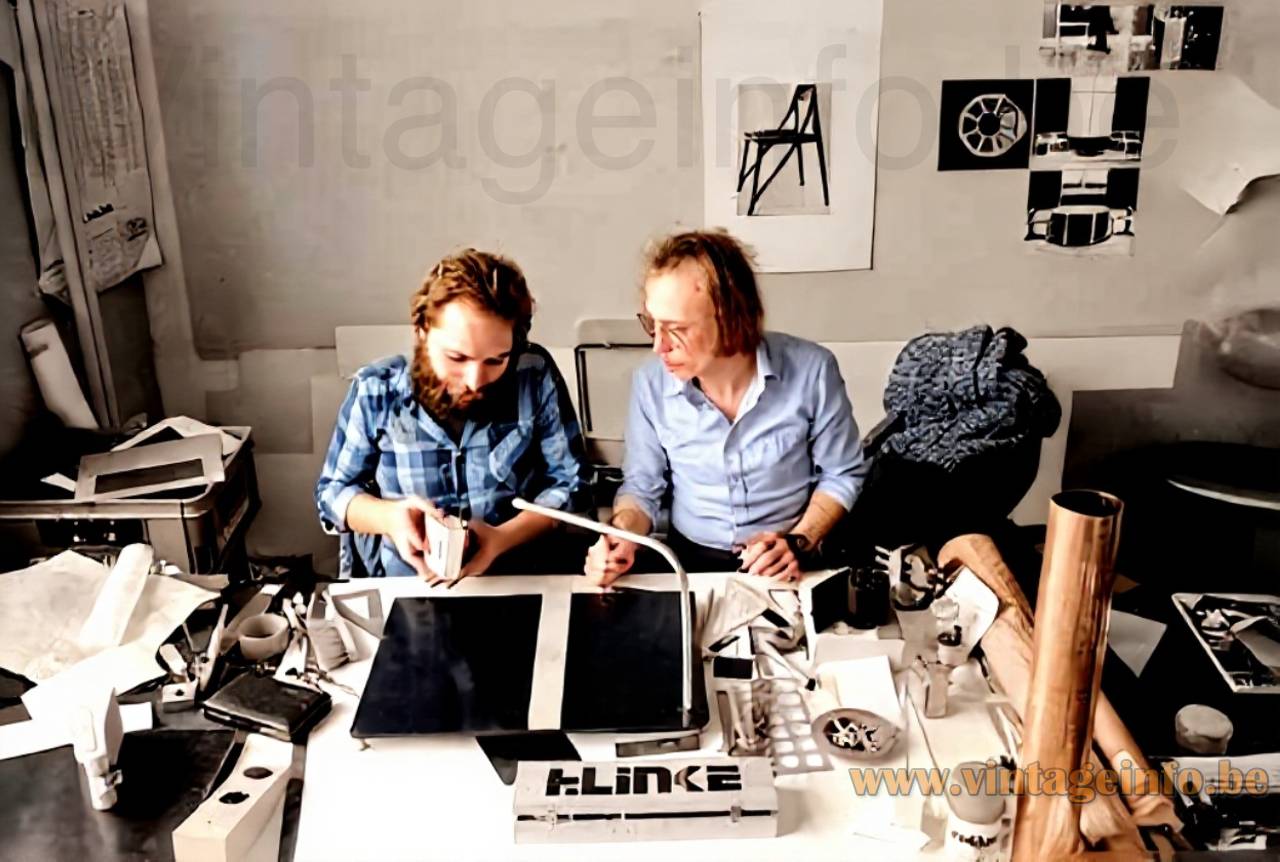
1978: Heico Linke & Jens Plewa at work.
Jens Plewa
Jens Friedrich Plewa (born 1949 in Stade, Lower Saxony, Germany) is a German industrial designer. He spent his early childhood in Himmelpforten, a small village with approximately 300 inhabitants at the time, where he lived until the age of ten. He later completed his Abitur in Stade.
Before beginning his formal design education, Plewa spent one year at sea, working aboard a cargo ship operating in the Mediterranean and along the African coast as far south as the equator. This period was followed by his mandatory military service.
From 1973 to 1978, Jens Plewa studied Industrial Design at the Hochschule für bildende Künste Hamburg (HfBK). In 1978, together with Heico Linke, he co-founded the design studio Linke.Plewa.Design. The studio remained active until 1994 and developed a wide range of industrial, technical, and consumer products for numerous German and international manufacturers.
Within Linke.Plewa.Design, Jens Plewa contributed to the studio’s systematic and multidisciplinary approach, working across lighting design, industrial products, packaging, and technical equipment. His work reflects a strong emphasis on practical functionality, production-oriented thinking, and formal clarity, supporting the studio’s reputation for technically intelligent and durable design solutions.
After the closure of Linke.Plewa.Design in 1994, Plewa continued his professional activity through his own design office, PLEWA WORKS, which he operated from 1995 until 2024. During this period, he remained active in industrial and product design, building on the experience and principles developed during the Linke.Plewa years.
Jens Plewa’s career spans nearly five decades of industrial design practice. His work forms an integral part of the legacy of Linke.Plewa.Design and contributes to the broader context of late 20th-century German industrial design, characterised by technical competence, functional discipline, and long-term usability.
LINKE.PLEWA.DESIGN- 1978 OTT International – System 8000 Spotlights
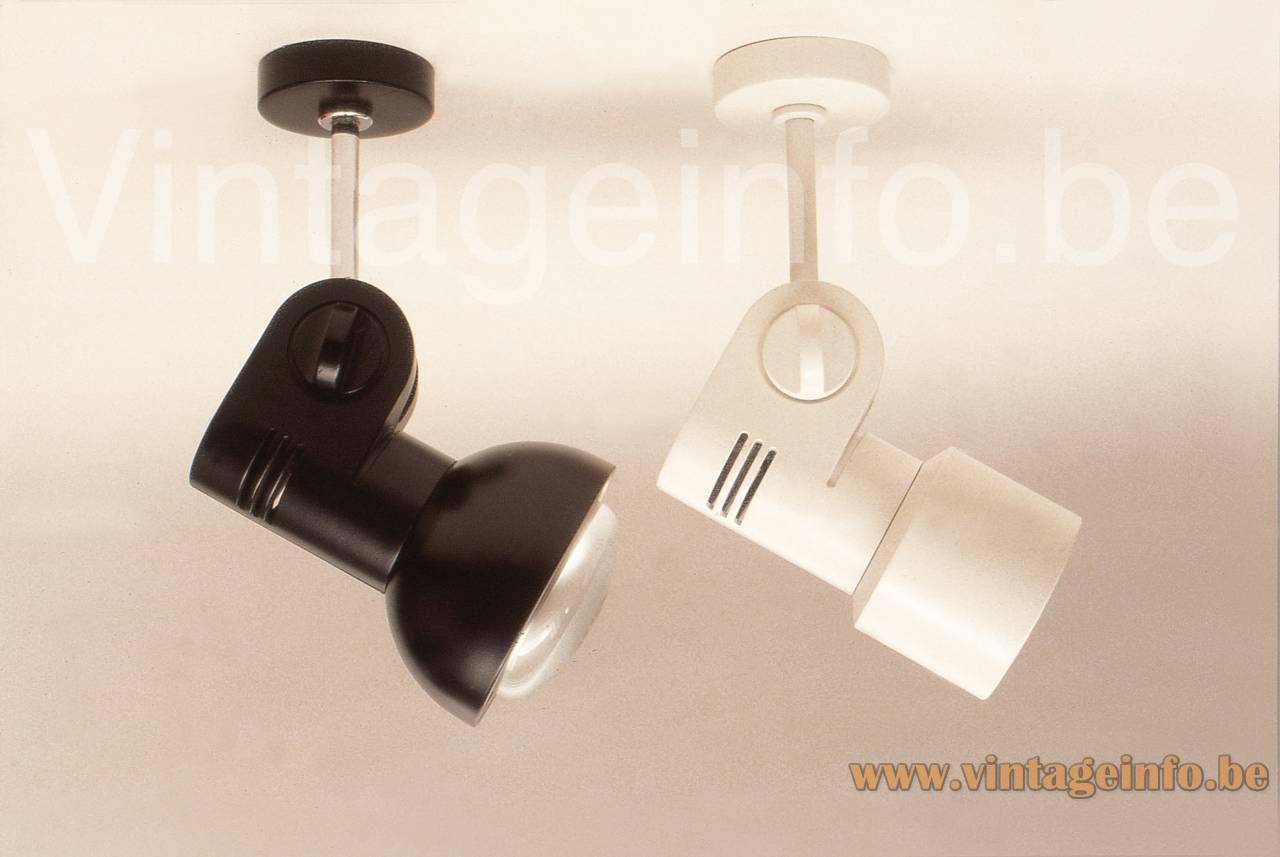
Shortly after founding their design studio, Linke.Plewa.Design secured its first major client: OTT International. At the time, OTT was primarily known for producing large-scale chandeliers for the Arab market. However, the company also wished to participate in the growing trend towards smaller and more contemporary ceiling luminaires.
The first designs developed for OTT were quickly refined and moved into larger-scale production. A floor lamp from this series was already featured in several design magazines, signalling a promising new direction for the company.
Then, quite unexpectedly, the entire project was halted. The owner, Mr. Ott, sold the company, and the new management showed no further interest in continuing the programme.
Fortunately, a small number of luminaires could still be obtained from the warehouse before the project disappeared entirely. Looking back, these designs were ahead of their time — an early indication of the direction contemporary lighting would soon take.
LINKE.PLEWA.DESIGN – Staff Spotlights for Track and Ceiling Lights
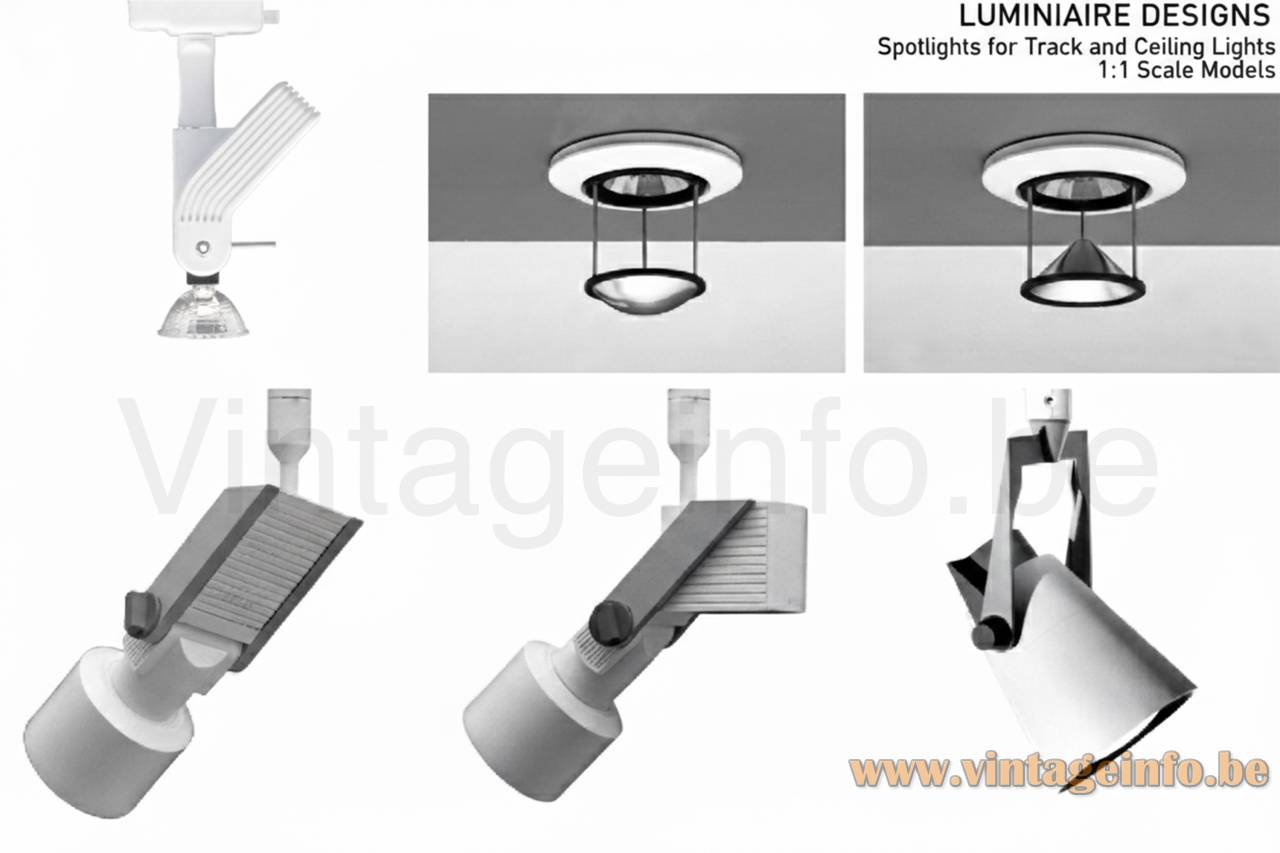
Spotlight designs for track and ceiling-mounted lighting systems.
Conceived and built as full-scale (1:1) functional models, demonstrating the studio’s rigorous, prototype-driven approach to product development.
LINKE.PLEWA.DESIGN – Zumtobel – STARLIGHT Ceiling Recessed Luminaire
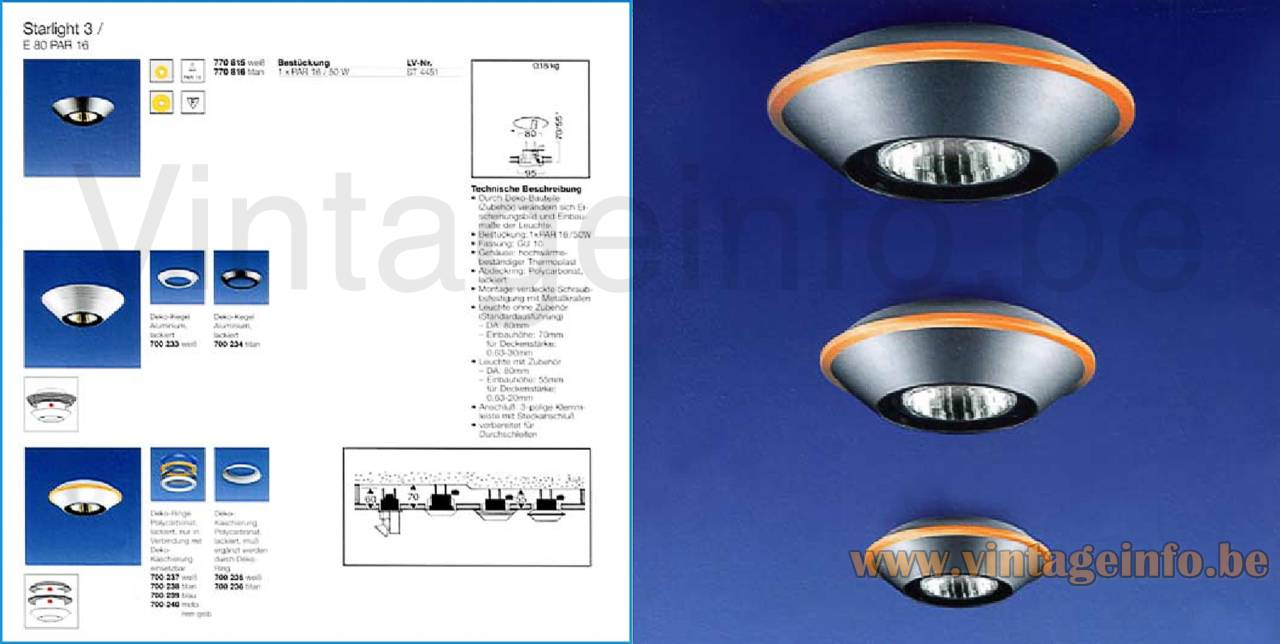
The STARLIGHT ceiling recessed luminaire was designed for Zumtobel during the early era of compact halogen lighting. At a time when low-voltage halogen sources were redefining architectural illumination, this design responded with clarity and technical precision.
The luminaire features a distinctive conical reflector housing, combining aluminium with a visible accent ring that subtly emphasizes the circular geometry. The recessed construction ensures a clean ceiling integration, while the compact halogen source delivers focused, high-intensity light suitable for both architectural and commercial environments.
As part of Zumtobel’s professional lighting programme, the STARLIGHT series was conceived not as a decorative object, but as a precise lighting tool — engineered for reliable performance, controlled beam distribution, and seamless installation within modular ceiling systems.
Its restrained industrial aesthetic reflects the technical optimism of the 1980s: minimal, functional, and purpose-driven.
LINKE.PLEWA.DESIGN – HALOFORM / EUCOFORM – MEGA Spotlights (1986–1991)
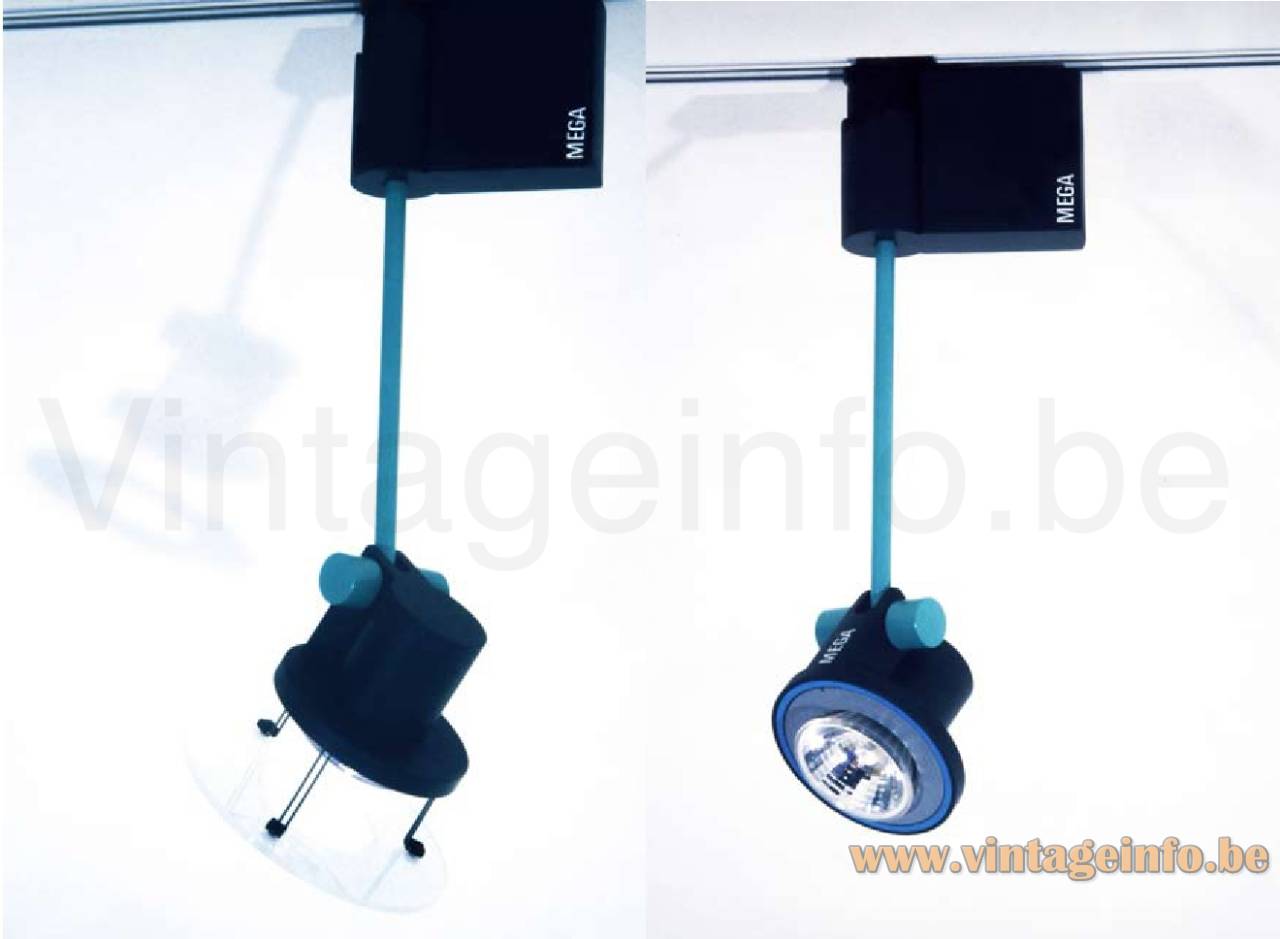
Between 1986 and 1991, Linke.Plewa.Design developed a range of lighting concepts and 1:1 models for HALOFORM, EUCOFORM and BRENDEL, including recessed ceiling luminaires and spotlight solutions designed for modular applications.
One of these designs was the MEGA spotlight series (pictured here in blue). The MEGA programme was conceived as a compact, technically precise spotlight family, accompanied by related MEGA recessed luminaires. The designs reflect the late-1980s shift towards small, powerful halogen sources and adaptable systems — lighting intended as a functional tool rather than decorative object.
LINKE.PLEWA.DESIGN – WELLE Möbel – Children’s Chair (1985)
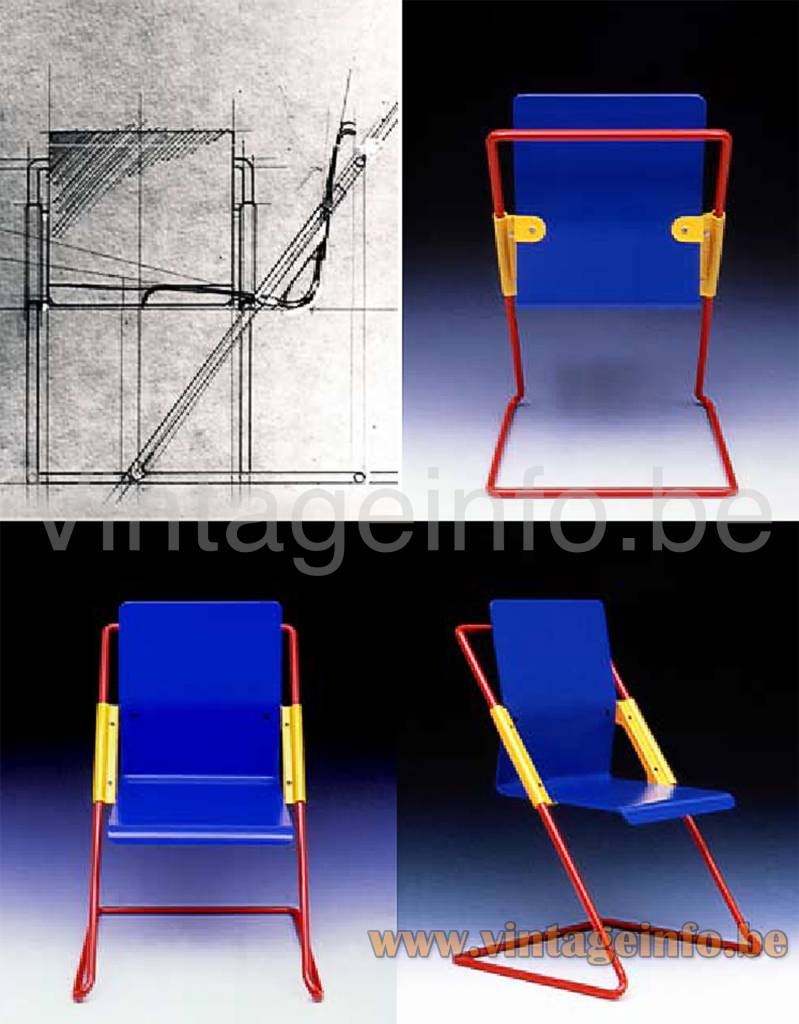
Designed in 1985 for WELLE Möbel, this children’s chair was conceived as functional seating for kindergartens and daycare centres. The concept responded to a practical challenge: children of different ages and sizes require different seat heights. Rather than producing multiple chair sizes, the design offered an economical solution through a height-adjustable seat shell.
The chair combines ergonomic considerations with structural clarity. It was suitable not only for institutional use but also for domestic and contract environments. Optional additions included upholstery and armrests, allowing the chair to adapt to different contexts.
Technically, the chair was designed as a cantilever construction, ensuring flexibility and comfort while remaining stable. It was stackable, tip-resistant, easy to assemble, and built for high durability. Individual components could be replaced without difficulty, and additional functional elements — such as small tables or armrests — could be attached with ease.
Beyond its functional qualities, the chair presents a clear and timeless formal language. In its bold colour combinations, it inevitably recalls early modernist influences, yet remains firmly rooted in practical, late-20th-century product design.
Links (external links open in a new window)
LINKE.PLEWA.DESIGN – iF Design Awards
Art Light Cosmo desk lamp for sale on 1stdibs – Baltensweiler copy
Vintageinfo – Designs by Linke Plewa
Brilliantleuchten lamps – Under construction
ART LIGHT lamps – Under construction
Elkamet lamps – Under construction
OTT International lamps – Under construction
LINKE.PLEWA.DESIGN Clocks – Under construction