- Categories
- Categories
Last 5 Viewed
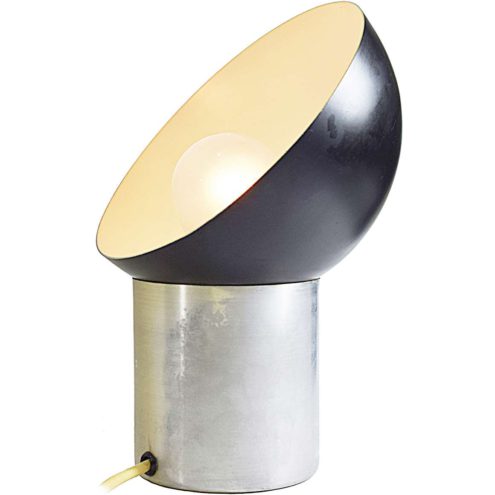
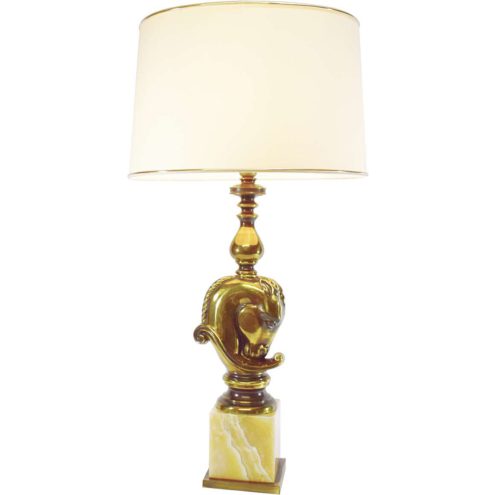
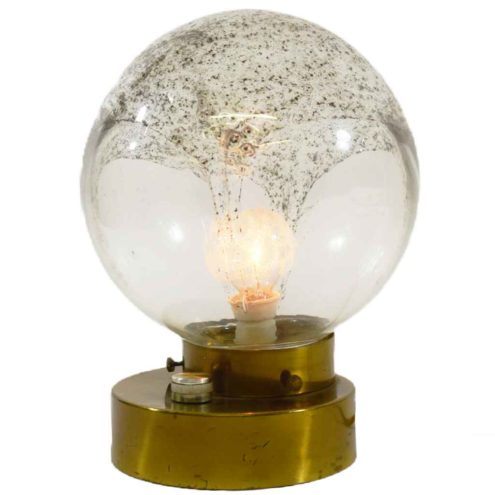
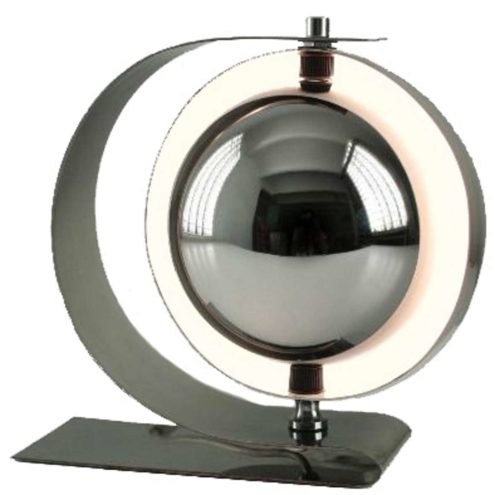
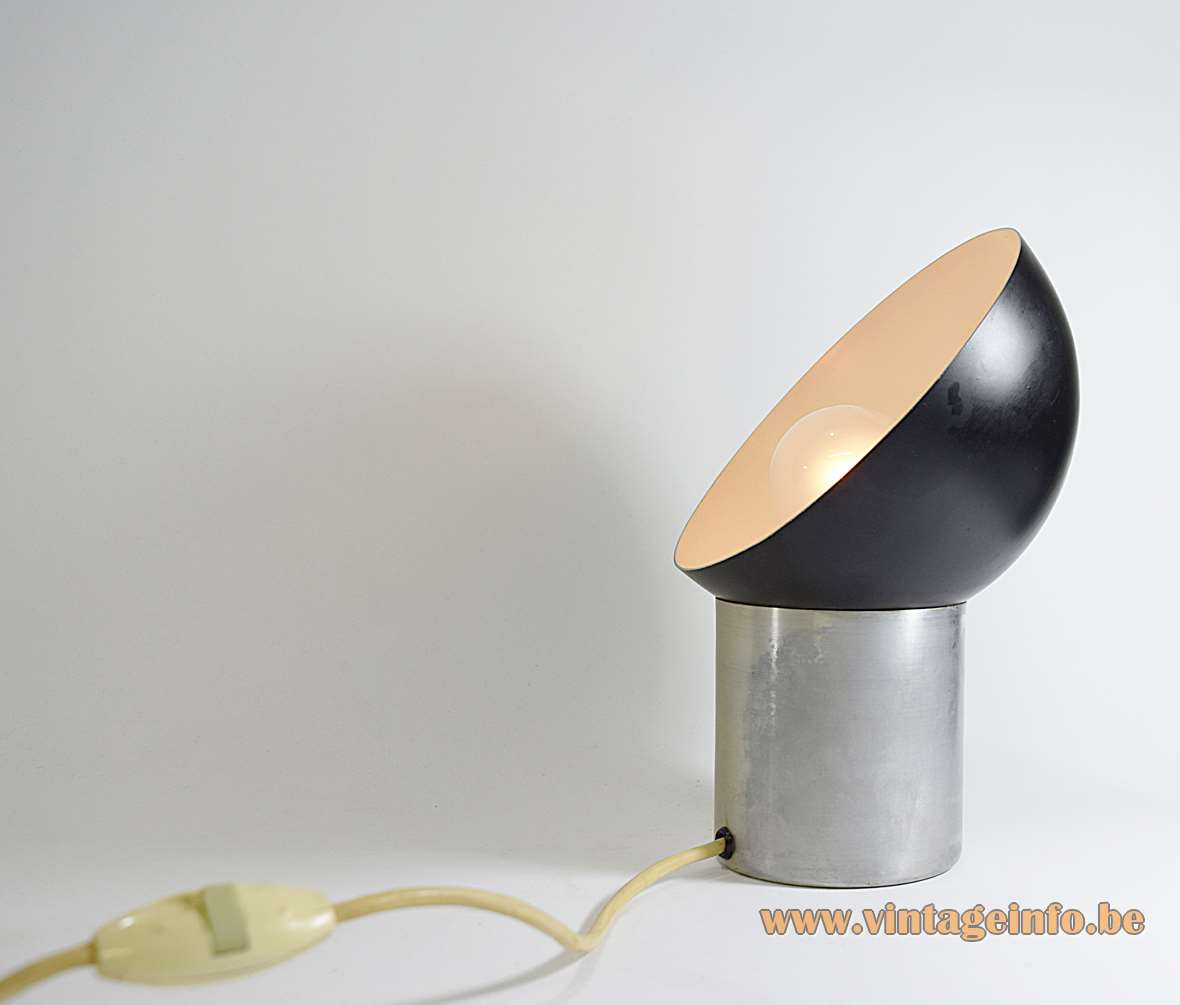
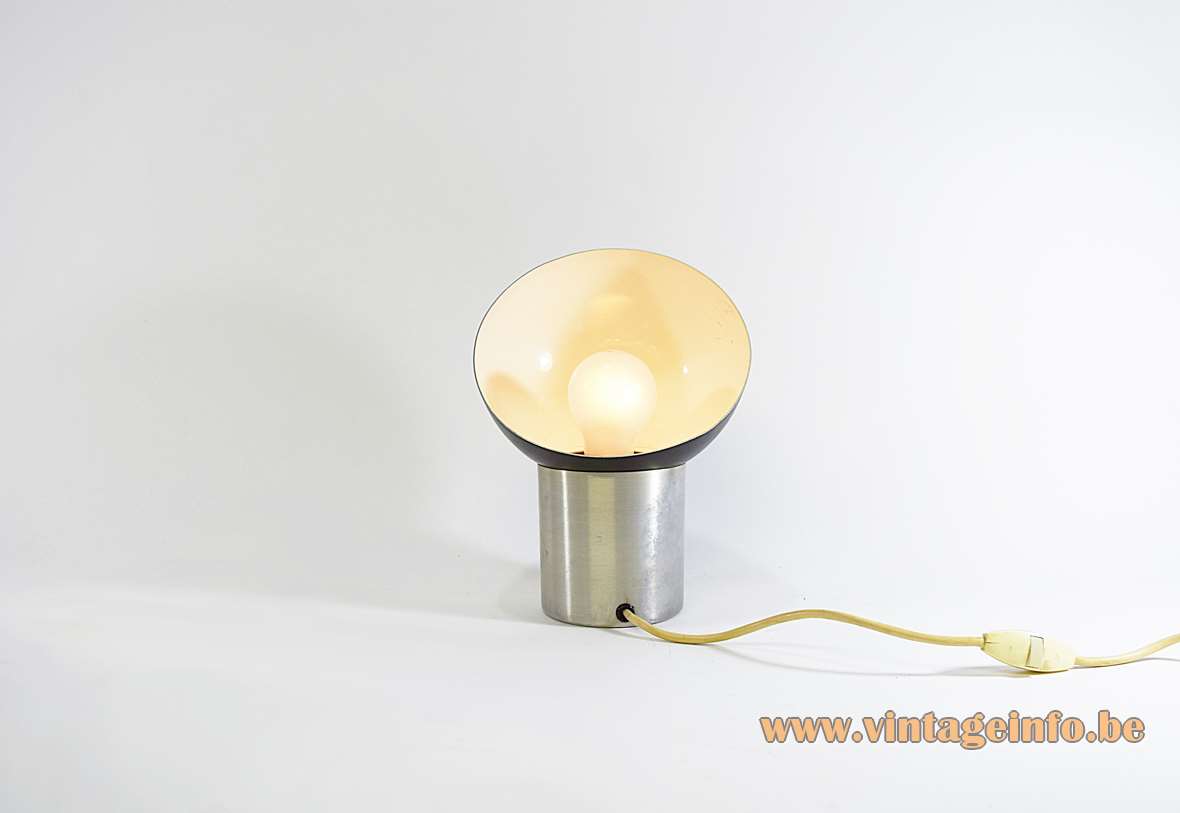
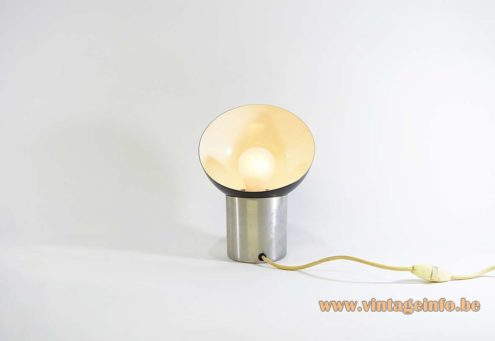
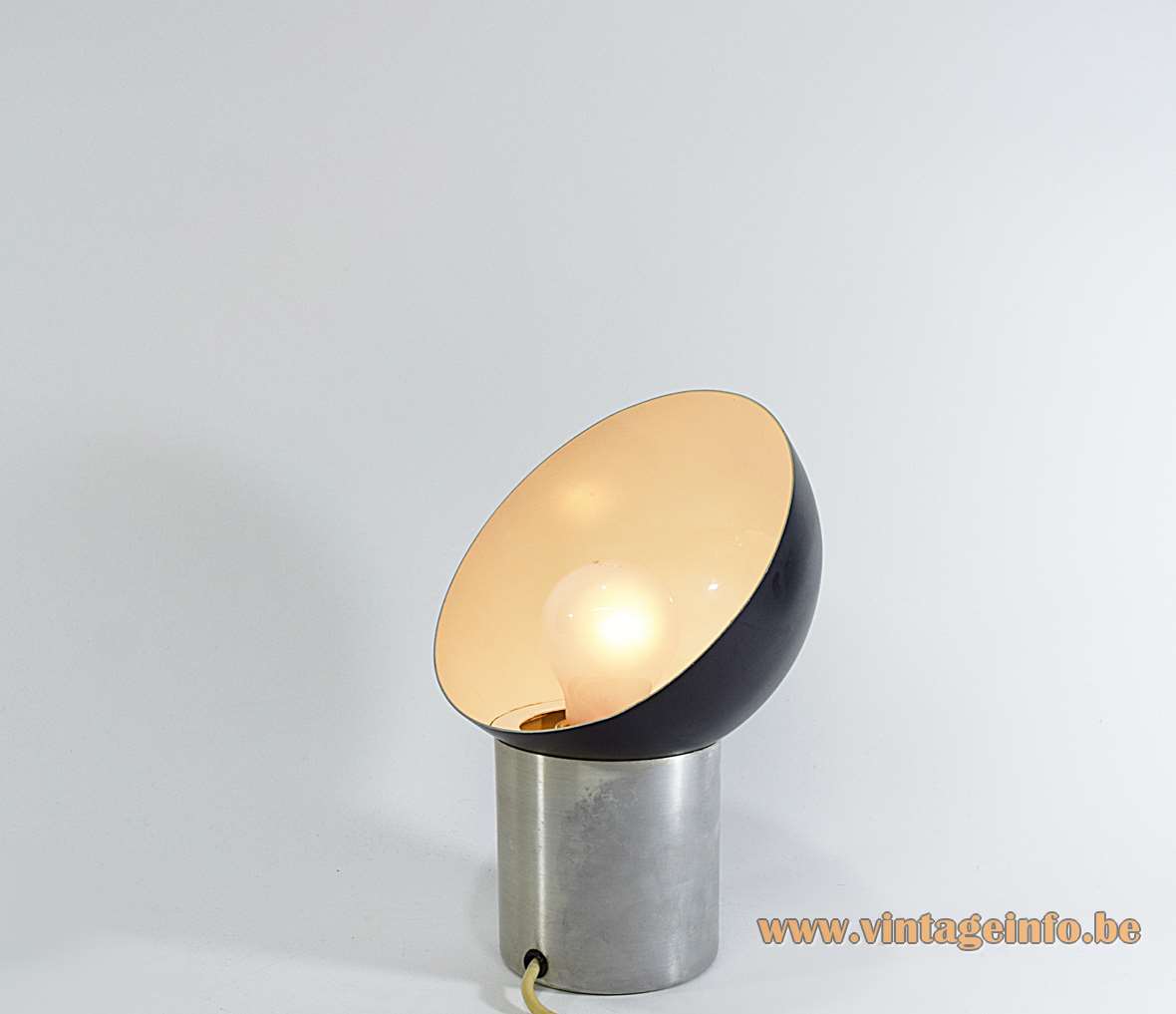
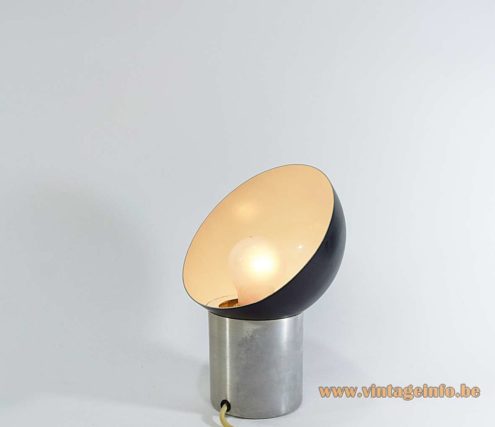
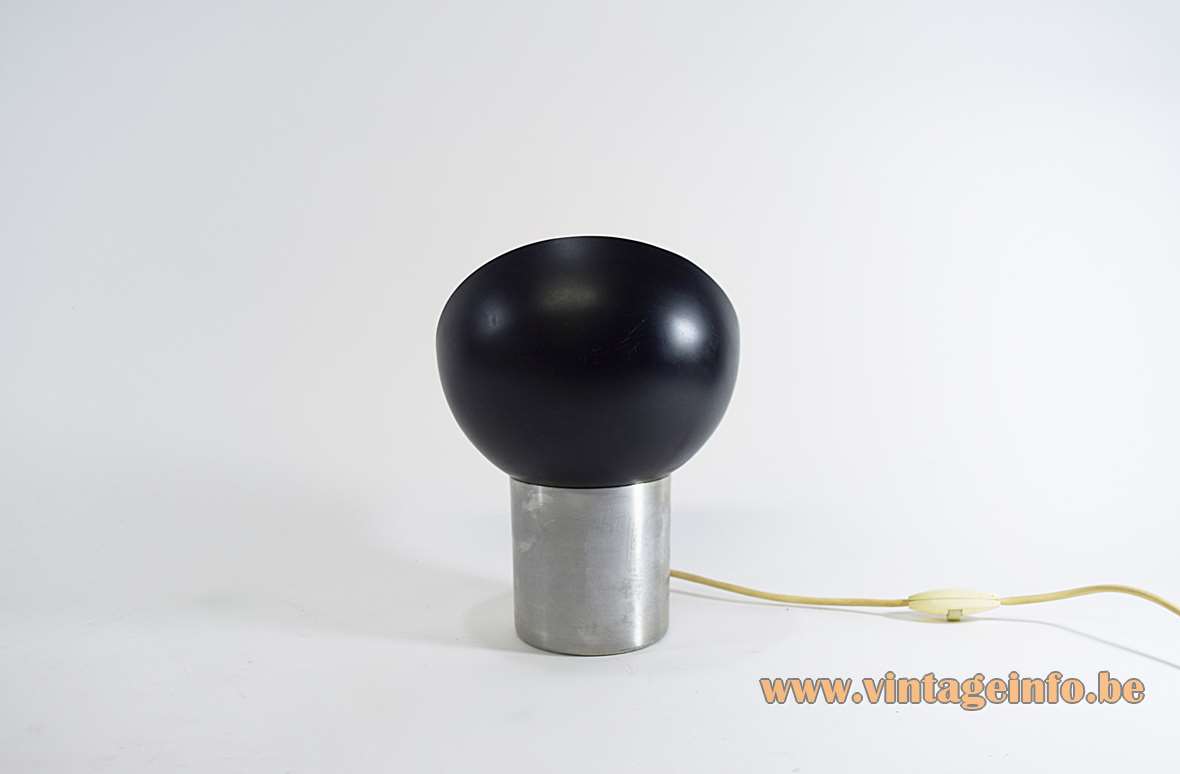
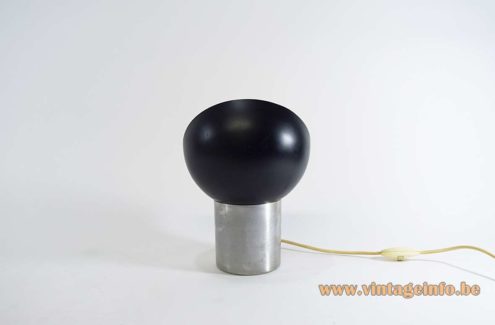
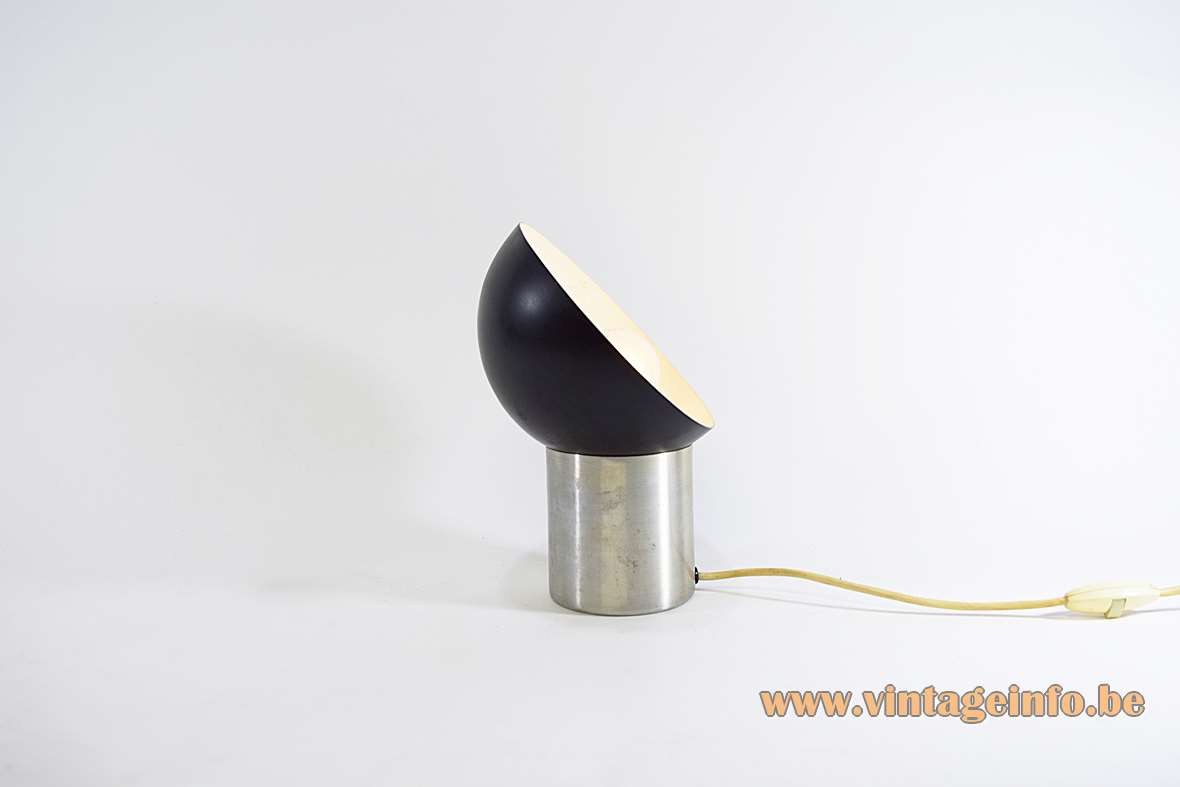
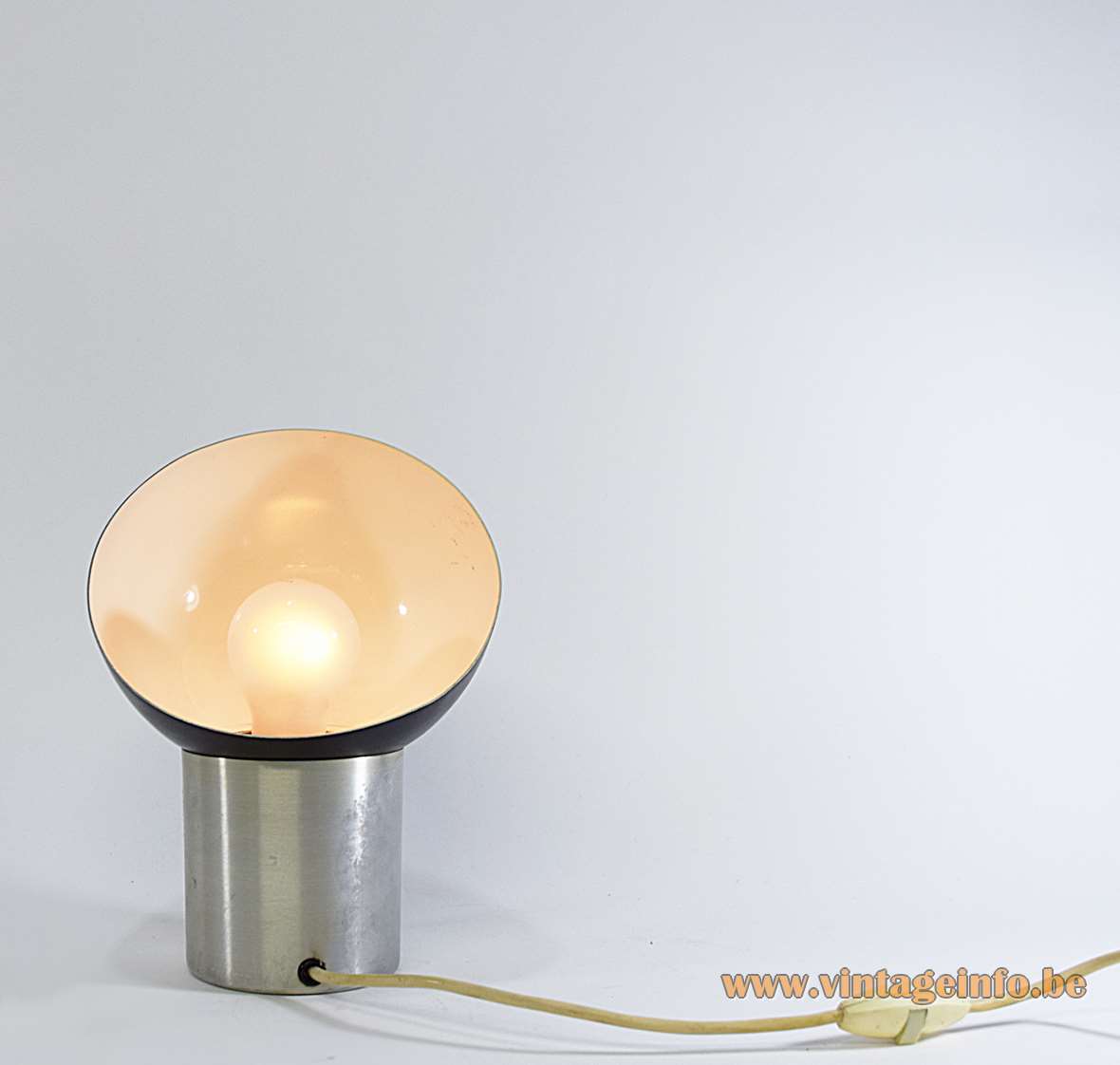
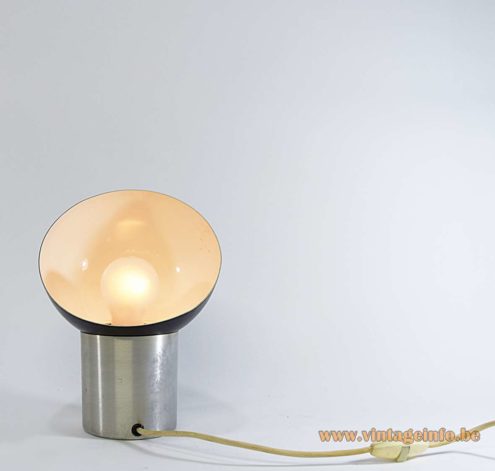
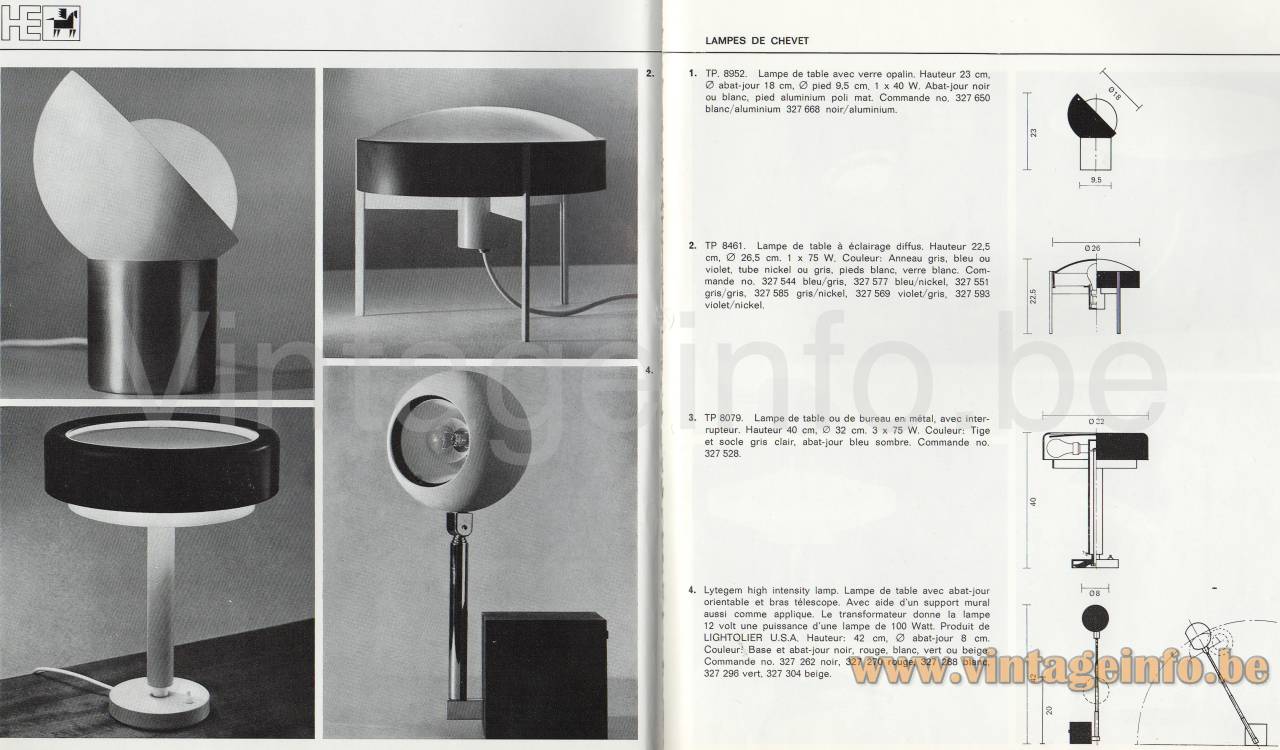
Half Globe Display Table Lamp – 1960s Hiemstra Evolux Catalogue Picture
This half globe display table lamp is model TP 8952. Other lamps in this catalogue are table lamp models TP 8461, TP 8079, and the Lytegem table lamp, made by Lightolier.
Links (external links open in a new window)
Vintageinfo
Many thanks to Max from AfterMidnight for the catalogue picture.
Half Globe Display Table Lamp
Materials: Black painted aluminium half globe lampshade, painted white on the inside. Brushed aluminium tubular base. Some plastic parts. Porcelain E27 socket.
Height: 25 cm / 9.84”
Width: 18 cm / 7.08”
Base: ∅ 9,5 cm / 3.74”
Electricity: 1 bulb E27, 1 x 100 watt maximum, 110/220 volt.
Not any type of light bulb can be used, a globe light bulb is preferred.
Period: 1960s, 1970s – Mid-Century Modern.
Designer: To be appraised.
Manufacturer: Hiemstra – Evolux, Amsterdam, Netherlands.
Other versions: This half globe display table lamp comes in black or white.
Unfortunately, the photos of this lamp were taken years before the catalogue photo appeared, and the wrong bulb is in it, as you can see.
Hiemstra Evolux
Hiemstra Evolux N.V. was a Dutch lighting company based in Amsterdam, closely associated with designer and entrepreneur N. J. (“Niek”) Hiemstra. The roots of the firm go back to 1934, when Hiemstra and his brother-in-law Simon Evenblij started a design office in Delft. A few years later, they began producing lighting (initially including chandeliers), gradually specialising in luminaires. During this early period, metal components were at times produced by Gispen, which had the machinery and capacity for metalwork.
By the late 1950s and early 1960s, the company operated under names that included Hiemstra Evolux and Verlichtingsindustrie Hiemstra. Period labels and catalogues show that the business used more than one Amsterdam address, including Keizersgracht and Prinsengracht (and possibly additional locations over time).
Hiemstra continued to collaborate with Gispen, and the name Gispen Culemborg appears on catalogues linked to Hiemstra’s lighting activities. Later, the company entered into a cooperation with the Dutch electrical wholesaler Technische Unie; the business reportedly flourished under that umbrella, and after some years Technische Unie took over the company.
Like many Dutch lighting firms of the time, Hiemstra Evolux did not only manufacture its own designs but also acted as a seller and distributor, offering lamps by other (often foreign) manufacturers alongside its own production.
Although attributions can be confusing in the vintage market, contemporary documentation confirms that N. J. Hiemstra was not merely a reseller: he also designed lighting himself. This is supported by period press coverage and catalogued models bearing his name, and by the fact that Hiemstra Evolux designs appear consistently in the Dutch design trade and collector landscape.
After the cooperation with Technische Unie, the story did not stop there. In 1961, the name was changed to Hiemstra Evolux (often explained as “evolution in light”). Within Technische Unie, the work was continued by Chris Hiemstra (Niek Hiemstra’s youngest son) and his business partner Harry Swaak, who were asked to take over his father’s lighting activities.
From 1977 onwards, Technische Unie was sold and taken over several times: it became part of the British Rotaflex Group and later ended up with the American company GTE (already active in the lighting market through Sylvania). In this process, the name Hiemstra Evolux gradually disappeared; by 1983 the company was operating under the name Lumiance.
What happened to Lumiance? After Hiemstra Evolux was renamed Lumiance (by 1983), the name continued mainly as a brand within larger international lighting groups rather than as an independent Dutch manufacturer. In later decades, Lumiance appears as part of the wider Sylvania portfolio (often listed alongside brands such as Concord).
In 2007, the European/Latin American lighting business of SLI Sylvania was acquired by Havells, and Lumiance remained associated with that brand family.
In 2015, Havells announced the sale of a substantial part of its Sylvania lighting business to Shanghai Feilo. As a result, the Lumiance name effectively continued under the evolving corporate structure commonly referred to in the market as Feilo Sylvania.
iF Design Awards: Several products by Hiemstra Evolux (and later Lumiance) are listed in the official iF Design Award database. For example, the “Spots” lighting series (listed as Hiemstra Evolux B.V., Haarlem, with designers credited as Chris Hiemstra and H. J. Swaak), as well as projects such as Quadrolon Mini and Luxline 65 credited to Hiemstra Evolux / Team Chris Hiemstra.
The wall light Planeta is listed in the official iF Design Award database as an award-winning project from 1985. The entry credits the manufacturer as Lumiance (Haarlem, Netherlands) and the design as Team Chris Hiemstra. This iF listing therefore relates to Lumiance (the later company name), not directly to Hiemstra Evolux.